
Oxford University research showcased at IF Oxford 2026
Launching this week, IF Oxford – Oxford’s annual science and ideas festival – will host approximately a hundred science-themed events and activities at around 30 venues across Oxford and beyond. Featuring interactive activity zones, art exhibitions, performances, discussions, talks, podcast recordings, walking tours, craft workshops and more, the vibrant, inclusive festival has something for everyone. Oxford University researchers and collections will play a prominent role throughout the festival, bringing the latest research and ideas to audiences across the city.
IF Oxford is a vibrant, inclusive Festival where everyone can get hands-on with science, meet experts and explore big ideas through a wide range of activities. Image credit: IF Oxford.

Why you are what you eat
Why you are what you eat. EXPLORAZONE, Saturday 17 October and Zone ONE, Thursday 29 October. Researchers from Oxford University’s MRC Weatherall Institute of Molecular Medicine (MRC WIMM) and Radcliffe Department of Medicine will explain the crucial roles that iron and sugar play in our bodies, from carrying oxygen in the blood to powering cells.

“IF Oxford is a brilliant opportunity for our researchers to connect with the local community and give people a glimpse of what they are working on. This year, we’re bringing along some new activities exploring metabolism, including the important roles that iron and glucose play in our bodies. Visitors can expect some fast-paced metabolite matching and the chance to chat with our researchers about how what we eat affects the way our bodies work.”
Levitating Superconductors
Levitating Superconductors. EXPLORAZONE, Saturday 17 October.
Discover how superconductors carry electricity with no resistance, and watch a superconductor levitate over a racetrack of magnets. Find out how superconductors are used today in MRI scanners, particle accelerators and maglev trains, and how Oxford University physicists use some of the strongest magnetic fields on Earth to understand these materials and design new ones.

“Seeing superconductivity happen in front of you is a real ‘wow’ moment, whatever your age. Visitors will be able to get hands-on with the demonstrations and ask our researchers anything they like, from how the levitation works to what it's like doing experiments at temperatures close to absolute zero. Come along to see physics that really does look like magic!”
Coloured glass workshops
Coloured glass workshops. Tuesday 20 October and Thursday 22 October. Researchers from Oxford’s Department of Earth Sciences will explain the scientific principles that create the vibrant hues of coloured glass. Participants will have the opportunity to extract copper, and get hands-on with rocks and ores.

“We were inspired by the current exhibition at the Oxford University Museum of Natural History called 34: critical raw materials, to come up with some activities around the metals that bring colour to the planet. With funding from the Royal Society of Chemistry, we have designed hands-on experiments to show how different metals can colour glass and turn flames into vivid bursts of colour; and to see how pure metals can be extracted from solutions, using electricity.”
Ruskin’s skies
Ruskin’s skies. Ashmolean Museum, Saturday 24 October.
The Western Art Print Room at the Ashmolean Museum will present a rare opportunity to see a selection of John Ruskin’s watercolour studies of skies and cloud formations, some annotated by him with observations on pollution and weather conditions.
The exhibition will complement an immersive performance of Ruskin’s prophetic public lecture ‘Storm-Cloud of the Nineteenth Century’, taking place the same day at the Museum of Natural History, Oxford University. This lecture, originally given in 1884, speaks of the disastrous impacts of industrialisation, including on air pollution.
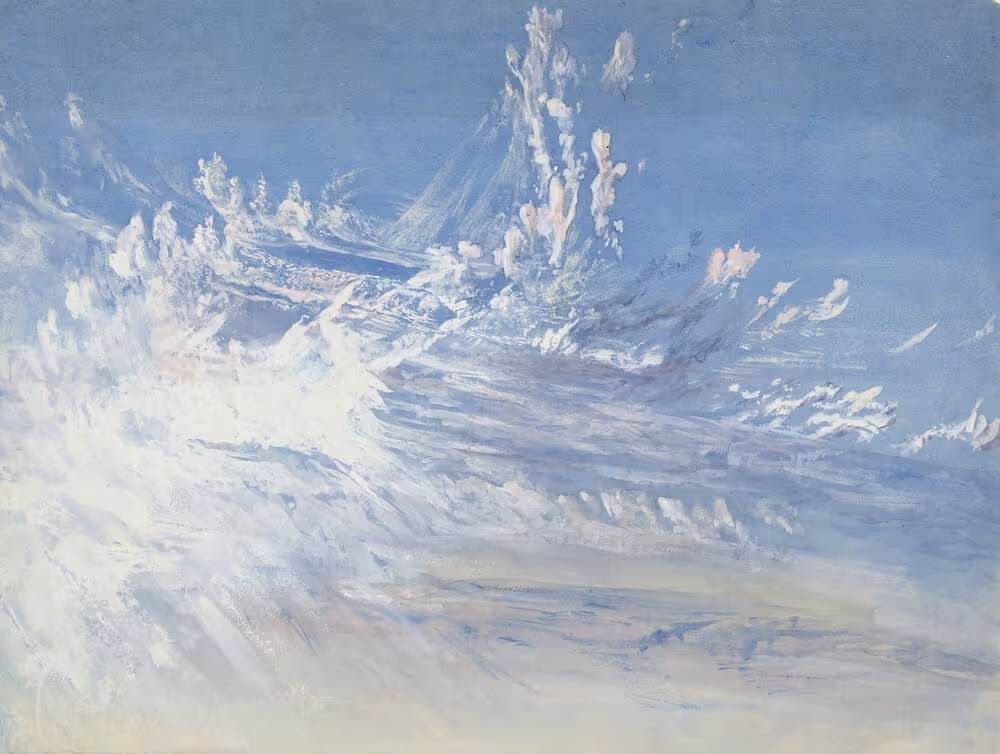

“Ruskin urged his students to ‘rise early’ and ‘always watch the sunrise and the way the clouds break from the dawn’. His studies of the sky reveal not just his poetic and emotional response to clouds, but also his scientific aim to capture an accurate record, pinning down a transient moment of memory in paint. Whatever the weather, visitors will find their day brightened by the beauty of these wonderful works!”
Cutting edge science
Cutting edge science. EXPLORAZONE, Saturday 17 October and TECHWORKS, Sunday 25 October.
Learn about research taking place at Oxford University’s Nuffield Department of Orthopaedics, Rheumatology and Musculoskeletal Sciences (NDORMS).

“Meet our friendly researchers and find out more about the cutting-edge science going on at NDORMS. Try your hand at surgery or operating an ultrasound machine. Find out more about medical trials, your immune system and the tools our scientists use to do their research.”
Other events
Dancing Dark Matter. Zone ONE, Thursday 29 October. Join Dr Kimberly Palladino, from Oxford University’s Department of Physics, to explore dark matter: the mysterious, invisible substance that makes up most of the Universe. By combining science, music, dance and discovery, this immersive performance will trace the invisible forces that hold galaxies together.
Weapons of Mass Persuasion: Propaganda during war & peace? The Bullingdon, Monday 26 October. Gretel Kahn from Oxford University’s Reuters Institute for the Study of Journalism joins Dr Nina Kruglikova to explore how the language, imagery and rhetoric of wartime propaganda posters can be used to persuade, mobilise and control public sentiment.
Festival programme and tickets:
The festival programme, including dates, times, locations and booking links for individual events, can be found on the IF Oxford website. Most events require advance booking, with many having a ‘Pay What You Decide’ ticketing system. To keep up to date, you can also follow #IFOx2026 on X and Instagram.
For more information about this story or republishing this content, please contact [email protected]


