
Exceptional early-career researchers awarded 2026 European Research Council Starting Grants
Today, four University of Oxford researchers have been awarded prestigious European Research Council (ERC) Starting Grants, each worth €1.5 million for a period of up to five years.

European Research Council (ERC) Starting Grants, are designed to support exceptional researchers at the beginning of their careers to develop ambitious ideas, build their own teams and establish their independence at a pivotal stage in their careers.

The ERC is the premier European funding organisation for excellent frontier research. Their Starting Grants, part of the Horizon Europe programme, are designed to support exceptional researchers at the beginning of their careers to develop ambitious ideas, build their own teams and establish their independence at a pivotal stage in their careers. This year, the scheme attracted a record 4,807 proposals, with just 421 (8.8%) of these being funded.
About the Oxford recipients:
Associate Professor Alison Andrew (Department of Economics).
Populations in low- and middle-income countries are aging fast, yet access to sizeable pensions is rare. Professor Andrew will use the ERC Starting Grant to study how people in low- and middle-income countries support themselves in old age through their own work and savings, through money and care from family, and through government programs and how these different sources of support fit together. The project combines detailed data on households across eleven countries with a large-scale field experiment built around the rollout of a new pension scheme for informal workers in rural Uganda. The findings will speak to the design of pension and social policies that protect older people while taking into account impacts on families.

“The ERC grant will give me the time, freedom and resources to explore questions that I think are both hugely important and really interesting. It will allow me to build a team to study how people in low- and middle-income countries support themselves in old age - how family support, savings, work and public pensions fit together - and what this means for designing policy as these countries age rapidly.”
Dr Hugh Ford (who will join Oxford’s Department of Biology from University College London in early 2027)
Dr Ford will use his Starting Grant to carry out 3D imaging of information processing in live tissues, using the soil-dwelling amoeba Dictyostelium as a model organism. Despite having no sensory, nervous or muscular system, Dictyostelium cells come together to form a motile tissue which effectively “sees”, “smells”, and “touches” its environment, enabling the organism to navigate. By live imaging cell communication across tissue scales, Dr Ford aims to determine how the 3D signalling patterns adapt to stimuli (such as light) and coordinate tissue responses. Ultimately, this research aims to establish principles by which complex tissue behaviour emerges from simple cell behaviours.

“I am deeply grateful to the ERC for continuing to take chances on research that can be labelled as too out there or left-of-field. There’s a lot of talk about “primitive cognition” but we lack experimental tests. Maybe that’s because some ideas are so bizarre they border on unbelievable. Dictyostelium is such a beautiful organism and I hope my work will do it justice.”
Dr Andrea Luppi (Department of Psychiatry)
Despite decades of research, our understanding of brain function remains fragmented, making it difficult to connect discoveries across different disorders, treatments and especially different species. Dr Luppi will use the ERC Starting Grant to develop a new ‘functional coordinate system’ for the brain: a common language to describe the full complexity of how brain regions act and interact across cognition, disorders, drugs and brain stimulation. The project will combine brain imaging across species and development of advanced computer models, with the goal to unlock insights overlooked by traditional methods, and accelerate how fundamental discoveries in other species can translate to humans.
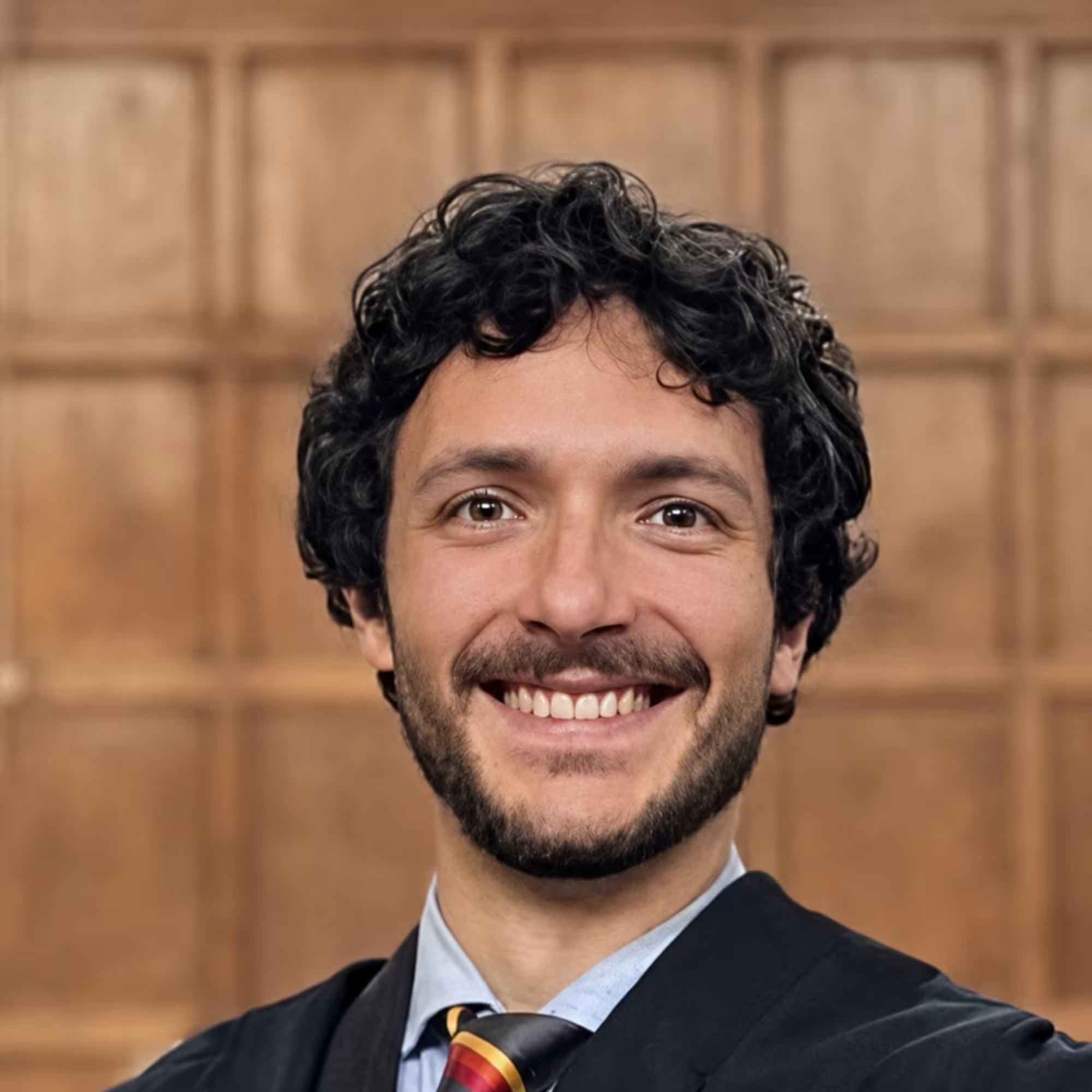
“I’m honoured and delighted to receive the backing of the ERC to develop my vision into an independent research programme. Having the freedom and support to think ambitiously is an extraordinary privilege. I am especially excited at the opportunity to lead a team who share this vision, to expand its reach and impact. I am incredibly grateful to my mentors and colleagues, and very excited for what comes next.”
Dr Stephen Turton (Faculty of English)
Dr Turton will use his Starting Grant to create a digital edition of the letters of James A. H. Murray, the first chief editor of the Oxford English Dictionary from 1879 to 1915. Making the Dictionary would not have been possible without the information Murray received about words, their meanings and their origins from hundreds of scholars, authors and volunteers writing to him from around the world. The largest collection of these letters, over 7,000, is held by the Bodleian Library. The aim of Dr Turton’s project is to transcribe and publish the entire collection, using it to reconstruct and analyse Murray's global web of correspondence through commentaries, maps and network graphs.

“The Oxford English Dictionary remains a monumental work of human collaboration, and Murray's letters reveal the passion, tenacity and comradeship that first brought the dictionary into being. Getting to share the letters with the world through the Starting Grant is an immense privilege.”
Further information about the 2026 ERC Starting Grants can be found on the ERC website.
For more information about this story or republishing this content, please contact [email protected]


