
Fourteen Oxford academics awarded major European Research Council Advanced Grants
Today, fourteen researchers at the University of Oxford were awarded Advanced Grants from the European Research Council (ERC), each worth up to €2.5 million over a period of five years.
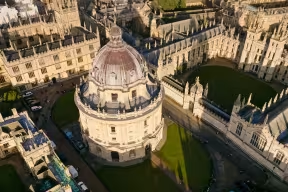
Fourteen researchers at the University of Oxford have been awarded prestigious Advanced Grants from the European Research Council (ERC).

The ERC Advanced Grants competition, part of the EU’s Horizon Europe programme, is one of the most prestigious and competitive funding schemes in the EU. It gives senior researchers the opportunity to pursue ambitious, curiosity-driven projects that could lead to major scientific breakthroughs. A record of 3,329 proposals was submitted to this funding round, with 9.6% of proposals being selected for funding.
President of the European Research Council, Professor Maria Leptin, said: ‘The new Advanced Grant projects demonstrate the creativity, ambition and intellectual boldness that frontier research requires. The ERC’s role is to support researchers who are asking difficult scientific questions and want to venture into unexplored territory in pursuit of new knowledge. Congratulations to all our new grantees.’
The fourteen Oxford recipients represent a diverse range of research fields across all four research Divisions:
Professor Harry Anderson, Department of Chemistry
Professor Anderson’s project will investigate the chemistry and physics of molecular quantum rings: nanostructures that confine electrons to a circular path resulting in unique quantum mechanical behaviour. It will focus on quantum rings with a radius between 1 and 10 nm, which have scarcely been investigated. The core objective is to create molecular materials with unprecedented emergent electronic and magnetic properties and to understand their structure-property relationships.
“I feel excited, and very privileged, to have been awarded five years of flexible funding to pursue the field of research that most interests me, even when its applications are far from clear. I would not have been able to secure this grant without a lot of help from colleagues and collaborators. Special thanks must go to my group for their exciting results and brilliant ideas.”
Professor Zhengming Chen, Oxford Population Health
Professor Chen’s project will bring together population biobank data from more than 1.15 million people in East Asia, Europe and Latin America to study how body fat affects health. It will look beyond weight alone to better understand different types of obesity, why some people develop metabolic diseases even at a healthy weight, and how these patterns may vary across ancestries and populations. By combining genetic, clinical and molecular data, Professor Chen aims to characterise disease burden associated with obesity, uncover the biological mechanisms behind obesity and identify new targets for more precise prevention and treatment.
“This ERC advanced grant provides a unique opportunity to transform our understanding of how adiposity influences human health across diverse populations. The scale, diversity and depth of the data available are unprecedented and the evidence generated will inform disease prevention worldwide.”
Professor Jason Davis, Department of Chemistry
Professor Davis’s project seeks to establish foundations for controlling the interactions between nano materials and molecular water, with downstream applications in environmentally responsive imaging, therapy and diagnostics. A central part of this is the design of hybrid inorganic-organic responsive nano materials, including magnetic liposomes and paramagnetic polymers. The aim is to control water movement and displacement and, in so doing, deliver a step change in the generation of environmentally responsive imaging, besides our ability to capture circulating cells and diagnose pre-symptomatic neurodegeneration.
“The award is an acknowledgement of preliminary work done by talented people in my group, a number of valuable collaborations and the importance of this form of funding to UK research teams.”
Professor Ben Green, Mathematical Institute
Professor Green’s project will explore questions in pure mathematics about patterns and structure within sets of whole numbers. The project brings together two areas of modern mathematics: additive combinatorics, which studies how sets of numbers behave when they are added together, and higher-order Fourier analysis, which can detect mathematical patterns beyond the reach of classical methods. Ultimately, this could open new ways to understand the hidden structure of numbers.
“It is great to have the approval of colleagues that obtaining an ERC Advanced Grant represents, and a pleasure to acknowledge the collaborators without whom a successful outcome would not have been possible. The grant itself will make it possible to assemble a team of talented early-career researchers in Oxford to work on problems I genuinely care about, and I look forward to starting the recruitment process.”
Professor Robert Klassen, Department of Education
Teacher shortages are a global challenge, yet we know surprisingly little about how to attract talented young people into the profession. Professor Robert Klassen's project (his third funded by the ERC) will develop a new science of motivation-based teacher recruitment. TEACHFORCE combines motivation science, AI-driven digital technologies, and longitudinal studies to understand how and when young people make decisions about teaching as a career. The findings will help education systems address teacher shortages through more personalised and evidence-based recruitment strategies.
“Receiving an ERC Advanced Grant is an honour and an exciting opportunity to pursue ambitious research on this global challenge. I am particularly grateful to my colleagues in Oxford’s Department of Education and the exceptional members of my research team whose ideas, energy and commitment have helped shape this programme of work.”
Professor Elias Koutsoupias, Department of Computer Science
Professor Koutsoupias’s project addresses a fundamental question at the frontier of computer science: what are the principles for designing robust, predictable, and efficient algorithms for strategic environments? By developing a new mathematical framework called ‘algorithmic regularity’, the research will establish foundational theories to ensure algorithmic fairness and stability. Ultimately, this work aims to solve long-standing open problems and shape the next decade of algorithmic mechanism design.
“Receiving this grant is an incredible honour that will allow my research group to tackle fundamental questions in algorithmic theory and explore open questions at the intersection of computer science and economics.”
Professor Ketan Patel, MRC Weatherall Institute of Molecular Medicine
Professor Patel’s research will focus on DNA repair pathways and their effect on human health and ageing. Previous work by his group identified that chemicals such as acetaldehyde and formaldehyde – produced in the body through metabolism, diet and alcohol consumption – damage DNA, causing cancer and tissue degeneration. In this ERC-funded programme, his team will investigate these effects in vital organs such the brain, liver and kidney to understand how the body protects against them. They will also screen for potential drug candidates to reduce age-related decline linked to metabolic stress.
“By uncovering how different organs respond to DNA damage caused by everyday metabolic processes, we hope to identify new strategies for protecting human health as we age. I’m very grateful to receive this support from the ERC, which is a tremendous vote of confidence in both the scientific questions we pursue and in the talented colleagues and collaborators whose expertise and dedication make this ambitious research possible.”
Professor Barbara Petrongolo, Department of Economics
The GENTALENT project will investigate how childbirth, workplace organisation and social norms shape the division of paid and unpaid work within families, and how these patterns affect careers, parental wellbeing and child development. By combining rich administrative and survey data with new approaches to understanding gender specialization, the project will build a research platform to analyse the future of work and family.
“I am truly honoured to receive an ERC Advanced Grant. This award provides a unique opportunity to pursue an ambitious research agenda on pressing challenges facing modern societies. I’m looking forward to starting new collaborations with my co-authors and form new research partnerships with postdocs and DPhil students.”
Professor Alex Scott, Mathematical Institute
Professor Scott’s project will develop new methods for understanding the structure of graphs and networks. It will ask how local patterns in large, complex networks can be identified, combined and interpreted to reveal global structure, even when the data are noisy or only approximate. The work will address long-standing mathematical problems such as the Erdős-Hajnal Conjecture and help lay the groundwork for coarse graph theory, a new field focused on the large-scale geometry of graphs.
“I’m delighted that the ERC has decided to fund this project, showing their support for fundamental mathematical research. I am very excited to have the time and resources to pursue this work, alongside a team of talented students and postdocs.”
Professor Rick Schulting, School of Archaeology
‘Stocking the Past’ combines existing and novel biomolecular approaches to identify the foods eaten by people in Neolithic and Bronze Age Britain and Ireland. In particular, it will help distinguish between the consumption of cereals and animal products such as meat and dairy, something that existing methods have struggled to achieve. In doing so, the project will shed light on a major debate about whether arable farming ‘collapsed’ a few centuries after its arrival around 4000 BC, resulting in a shift towards livestock-based economies. The approach will be more broadly applicable for studying past diets in many other regions and time periods.
“The ERC award will allow us to pursue a challenging research problem with a level of focus and support that would otherwise be impossible to achieve. I am especially pleased to be able to support promising early career researchers through the project.”
Professor Mona Simion, Faculty of Philosophy
The AI-KNOW project will examine how artificial intelligence (AI) is changing the way we create, assess and use knowledge. As AI systems become increasingly embedded in scientific research, education and everyday decision-making, the project will ask whether they are simply advanced tools or whether they can be said to understand information and bear responsibility for the claims they produce. The project aims to develop a clear philosophical framework for understanding whether, and in what sense, people can gain knowledge from AI-generated outputs.
“I am extremely excited to receive this grant. The urgency of answering questions pertaining to the use of AIs in producing knowledge cannot be overstated, yet we operate without principled frameworks for understanding their epistemic contributions. AI-KNOW is a transformative project which will fill this major theoretical gap.”
Professor Bernhard Staresina, Department of Experimental Psychology
Professor Bernhard’s Ontogeny of Memory (MemOnto) project will address the paradox known as infantile amnesia: the fact that most of us retain little or no conscious memory of our earliest years, despite the extraordinary amount of learning that takes place during this period. The project will combine electroencephalogram recordings, studies in rodents and computational modelling to test two complementary possibilities: that early memories fade because sleep-based consolidation mechanisms are still developing, or because the developing brain progressively transforms how memories are represented, rendering them difficult to access later in life.
“Receiving the Advanced Grant allows me and my team to apply our work on sleep and memory to one of the most intriguing remaining puzzles in psychology and neuroscience - why do we remember so little from a time when we learned so much? It fosters an exciting collaborative network within and beyond Oxford, spanning developmental psychologists, rodent electrophysiologists and computational modelers.”
Professor Kate Watkins, Department of Experimental Psychology
Despite decades of research, the brain mechanisms underlying stuttering remain one of the great unanswered questions in speech neuroscience. The STUTTER project will bring together advanced brain imaging, neurophysiology and novel therapeutic approaches to understand why stuttering starts, why it stops and why it sometimes persists, with the ultimate goal of improving outcomes for children and adults who stutter.
“This grant means a great deal to me, both professionally and personally. Like many researchers, I have had to navigate repeated rejections in an increasingly challenging funding landscape, so receiving support for this work is both validating and motivating. It gives us the opportunity to pursue questions that have motivated my research for many years and that could make a real difference to people who stutter.”
Professor Martin Weidner, Department of Economics*
Professor Weidner’s HOTMAP project will develop new statistical methods to help economists draw more reliable conclusions from complex data, particularly to make economic estimates based on machine learning more robust and less vulnerable to bias. This could improve the way economists assess cause and effect, and support better analysis in areas including policy evaluation, studies using natural experiments and research that tracks changes over time.
“I am delighted and honoured to receive this ERC Advanced Grant. It will allow me to work on an ambitious research agenda over five years, and to bring the wider econometrics community together through workshops and conferences as we develop methods that I hope will be genuinely useful to applied researchers across economics.”
The full list of ERC Advanced Grant winners can be found on the ERC website.
For more information about this story or republishing this content, please contact [email protected]
*Professor Weidner will be moving from Oxford to join University College London (UCL) later this year.


