
Academy of Medical Sciences elects five Oxford researchers as new Fellows
The Academy of Medical Sciences has elected five University of Oxford biomedical and health scientists to its fellowship in 2026.


The new Fellows have been elected to the Academy in recognition of their outstanding contributions to advancing medical science, through discovery research, translational work and the application of scientific knowledge in ways that deliver tangible benefits for patients and the wider public.
The Oxford Fellows are among the 60 new Fellows announced this year who will be formally admitted to the Academy at a ceremony on Tuesday 30 June.
The new Fellows are:
Professor Tao Dong, Ita Askonas Professor of Translational Immunology at the Nuffield Department of Medicine, Founding Director (Oxford), CAMS-Oxford joint International Centre for Translational Immunology and Founding Director (Oxford), Chinese Academy of Medical Sciences Oxford Institute (COI).
Professor Dong has a longstanding commitment to understanding the role of T-cells in disease protection or pathogenesis, with implications for patient outcomes, vaccine design, and novel therapeutics. By linking functional data with multi-omic single cell and T cell receptor (TCR) repertoire analysis, her group are investigating and identifying potential targets and pathways to augment and control the immune response as a way of improving the outcome of several important human diseases, including SARS-CoV-2, influenza, Monkeypox virus infection and cancer.
Professor Dong said: 'I am honoured to have been elected as a Fellow of the Academy of Medical Sciences. Credit goes to the wonderful members of my group, past and present, as well as my mentors and collaborators, the wonderful research environment provided by the Nuffield Department of Medicine and the Weatherall Institute of Molecular Medicine.'
Professor Oliver Pybus FRS, Professor of Evolution & Infectious Disease in the Department of Biology.
Professor Pybus is a Professorial Fellow of New College and a Co-Director of the Oxford Martin School Programme on Pandemic Genomics, and was the founding Editor of the open access journal Virus Evolution. He holds a Professorship at the Royal Veterinary College.
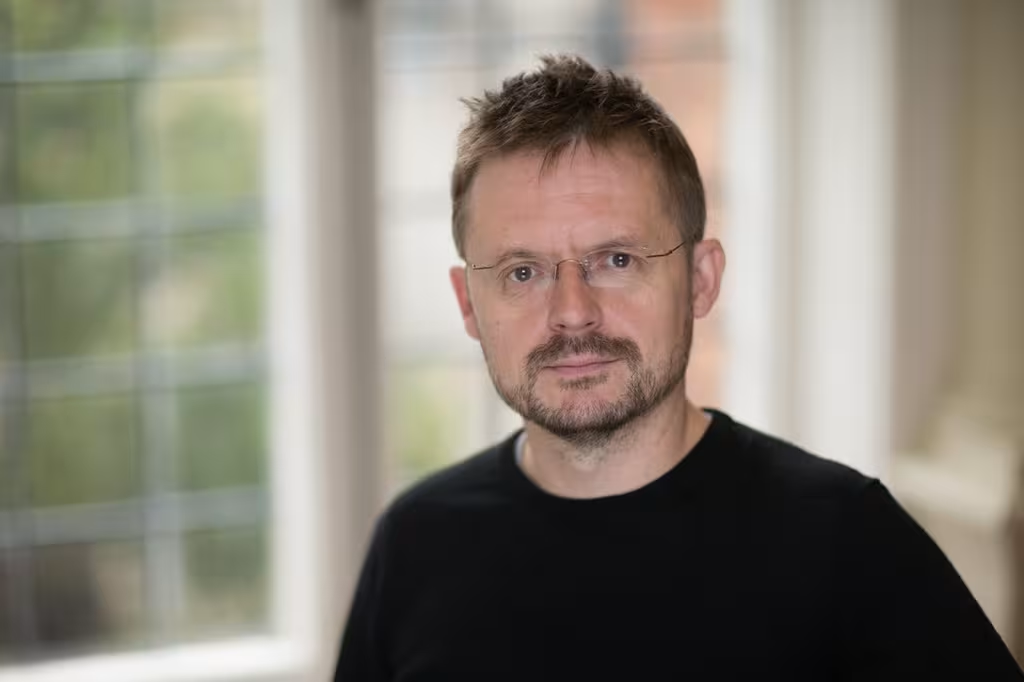
Professor Pybus said: 'I am delighted and honoured to be elected a Fellow of the Academy of Medical Sciences. I look forward to supporting the work of the Academy, especially in the field of One Health, and to further strengthening the bonds between the medical, veterinary and biological sciences.'
Professor Julian Savulescu, University of Oxford, Uehiro Chair in Practical Ethics at the Uehiro Oxford Institute.
Professor Savulescu has held the Uehiro Chair in Practical Ethics at the University of Oxford since 2002. He has degrees in medicine, neuroscience and bioethics. He founded ad directed the Oxford Uehiro Centre for Practical Ethics. He also directed the Oxford Martin Programme for Collective Responsibility for Infectious Disease at the Oxford Martin School at the University of Oxford, and co-directed the interdisciplinary Wellcome-funded Oxford Centre for Ethics and Humanities in collaboration with Public Health, Psychiatry and History.
Professor Savulescu said: ‘It is a great honour and a tribute to many colleagues past and present who have contributed to the work we have done over the last 25 years. I would like to thank them and the Academy.’
Professor Christian Siebold, FRSB, Professor of Structural Biology in the Nuffield Department of Medicine.
Professor Siebold's research looks at how cells communicate with each other, and how these signals control normal development, brain function and disease, especially cancer. His group studies important signalling systems, including the Hedgehog and BMP pathways, which help cells decide what to become, where to move and how tissues are formed. When these signals go wrong, they can contribute to developmental disorders and tumour growth. His group use advanced imaging and structural biology methods, such as cryo-electron microscopy and X-ray crystallography, to see how signalling proteins fit together and work at the molecular level. This helps them to understand how key proteins, including Smoothened, Patched, Neogenin, Netrins and RGMs, control cell behaviour. By revealing how these systems are disrupted in disease, his team's work supports the development of new targeted treatments, including improved cancer therapies.
Professor Siebold said: 'I feel honoured to be elected as a Fellow of the Academy of Medical Sciences. This is a wonderful acknowledgement of the work of my group, my collaborators, my mentors and the outstanding research environment.'
Professor Nicola Whiffin, Associate Professor / Group Leader and Wellcome Career Development Award Fellow at the Big Data Institute and the Centre for Human Genetics in the Nuffield Department of Medicine.
Professor Whiffin leads the Computational Rare Disease Genomics group, which specialises in analysing large genome sequencing datasets to better understand the genetic basis of rare disease to improve both diagnosis and access to treatments. She is particularly interested in ‘non-coding’ regions of the genome that have traditionally been understudied but make up >98% of our DNA. She is an expert in the annotation and interpretation of genetic variants in non-coding regions, for which she has led the creation of clinical guidelines. In 2024, her team led a global collaboration that identified variants in a non-coding RNA gene RNU4-2 as a cause of a remarkably prevalent neurodevelopmental disorder, ReNU syndrome. She now works with ReNU syndrome families to advocate for increased awareness of the disorder and as a scientific advisor for the patient advocacy group ReNU syndrome United.
Professor Whiffin said: ‘I am delighted to be elected as a Fellow of the Academy of Medical Sciences. This honour recognises the work of incredible team members past and present, whom it has been an absolute pleasure to work alongside, as well as many wonderful collaborators and mentors.
‘Our work aims to find new diagnoses for individuals with rare genetic disorders, particularly focusing on regions of DNA that have previously been unexplored. I am excited to join the Academy and look forward to opportunities to work with others in the fellowship to advocate for increased equity in genetic testing and awareness of rare genetic disorders.’
Professor Andrew Morris CBE FRSE PMedSci, President of the Academy of Medical Sciences, said: ‘It is a privilege to welcome this outstanding new cohort to the Fellowship of the Academy of Medical Sciences. Each of our new Fellows has been recognised by their peers for exceptional achievement for the influence their work has had in advancing medical science and improving health.
‘The diversity of disciplines represented this year reflects the richness of modern medical science and the value of collaboration across fields. At a time when health challenges are increasingly complex, the Academy’s Fellowship provides a trusted, independent platform for scientific leaders to work together, champion excellence, and help ensure research delivers real benefits for people and communities.’


