
Expert Comment: Why are we still obsessed with the Bayeux Tapestry?
Professor William Whyte, Professor of Social and Architectural History in the Faculty of History at the University of Oxford, Fellow of St John's College and incoming Editor in Chief of the Oxford Dictionary of National Biography, sets the British Museum's sold-out autumn exhibition in context, explaining how the nineteenth century turned an eleventh-century embroidery into a national icon and why we are still drawn to it.
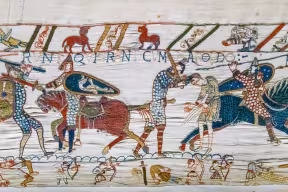

It’s not from Bayeux. It’s not a tapestry. It recounts the defeat of the English in unremitting, gruesome detail. Yet this great, nearly 70-metre-long embroidery created towards the end of the eleventh century seems to exercise an irresistible fascination, a fascination made all the more compelling as it comes to London for public display.
For all its antiquity, this is fairly recent icon. It languished in the cathedral at Bayeux, largely unvisited and generally unremarked, for centuries. Not until the nineteenth century, in fact, did it become the source of much attention outside Normandy. One spur was the emperor Napoleon’s decision to exhibit it in Paris in 1803 as he drummed up enthusiasm for what turned out to be an abortive invasion of England. Still more, English antiquarians, increasingly obsessed by the medieval past, seized on this remarkable relic as a uniquely precious source – one so splendid that it could never really be trusted to the French.

“With our own anxiety and our current search for a national story that will unite us all, we are in fact not that far away from the Victorians. Little wonder we’re still obsessed with something that mattered so much to them too.”
They commissioned drawings and prints and eventually photographs. One even stole a small sample, which caused understandable outrage. In the 1880s, a group of women in Staffordshire set out to recreate the Tapestry ‘so that England should have a copy of its own’. Using the facsimile made for what is now called the V&A Museum, they embroidered a complete copy, employing no less than 45 kilos of wool to do so. It was not a slavish imitation, not least because the photographs they were using had been doctored to conceal or omit indecency. Several naked Normans are, as a result, equipped with natty gold pants.
When complete, this modern English version of a medieval English embroidery drew crowds. It was publicly exhibited, toured the country, and, in 1895, was acquired as a likely tourist attraction. You can still visit it at the Reading Museum and Art Gallery, where it is marketed as ‘Britain’s Bayeux Tapestry’.
By the turn of the twentieth century, this was just one of a range of places where the public could encounter this important work of art. ‘Never, perhaps, was so important a document written in worsted’, observed one contemporary. It inspired paintings, poetry, and parody, featuring in Punch cartoons and prompting Tennyson’s epic drama of 1876, Harold. It was also the subject of fierce debate between historians. Was it created by the English or the French, by Mathilde, King William’s wife, or by the mysterious Ælfgifu, who was depicted in the design, but was otherwise unknown? Was it Norman propaganda or did it convey a subversive Anglo-Saxon subtext?
It was in part this mystery that gave the subject such a fascination. Everyone had a view and almost anyone could find a connection with the subject-matter. For some, the Battle of Hastings was a disaster, killing off a tradition of Anglo-Saxon freedom. For others, it was the foundation of the modern world, as England was drawn into the development of western Christendom and the feudal state. Above all, in an age of nationalism across the world, all nations were seeking to articulate a distinctive national story and to find a useable national past, one not necessarily grounded on religious themes. In this great embroidered narrative, they found a vivid, visceral, and apparently verifiable picture of a pivotal moment in England’s history.
In that sense, the Bayeux Tapestry is a nineteenth-century creation. It’s not unlike – and, indeed, helped encourage – the forest of statues and rooms of full of historical paintings produced at the time. The desire to emphasize the national past also inspired other monuments, whether the National Gallery (founded in 1824) or National Portrait Gallery (1856), the London Blue Plaques Scheme (1866) or the Dictionary (now, Oxford Dictionary) of National Biography (1885).
Although there is a tendency to see the Victorians as unshakably self-confident, they were in fact profoundly anxious about their world. Social and political change, massive technological disruption and new, truly global challenges left them unmoored and insecure. The poet Matthew Arnold captured that sensibility in his 1853 evocation of, ‘This strange disease of modern life, With its sick hurry, its divided aims.’ Many in the nineteenth century sought in the past some hope for the future. The medieval world, in particular, seemed to offer an encouraging model, whether of chivalry or Christianity, organic community or the freedom of peasant life. The Bayeux Tapestry was coopted and celebrated in that context.
With our own anxiety and our current search for a national story that will unite us all, we are in fact not that far away from the Victorians. Little wonder we’re still obsessed with something that mattered so much to them too. And if you can’t get tickets to the London exhibition, then you can also thank them that the ‘British Bayeux Tapestry’ is still available in Reading.
For more information about this story or republishing this content, please contact [email protected]


