
Expert Comment: Why the justice system must exercise caution on musical evidence
Professor Naomi Waltham-Smith, Director of Research in the Faculty of Music and Douglas Algar Tutorial Fellow at Merton College, University of Oxford, argues that the justice system must exercise far greater caution in its use of rap and drill as criminal evidence, warning that misinterpretation can reinforce racial stereotyping and distort fair process.
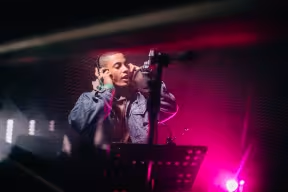

No-one would imagine that binge-watching one of Britain’s favourite crime dramas could land you in jail. Prosecuting someone on the basis that their creative tastes or practices are suggestive of criminal intention or propensity might sound like a “ridiculous proposition.” But that is what is happening to young people from marginalised backgrounds, predominantly Black working-class boys, who write or participate in performing rap music.

Drill music in particular—a popular subgenre trafficking in stock-in-trade depictions of “road” culture and performative braggadocio—is regularly used by police and prosecutors as evidence to insinuate “gang” affiliation, even in cases where the only connection is sharing a track or appearing in the background of a video.
This practice of “putting rap on trial” has faced scrutiny in the US for some time and is an increasing source of concern among scholars, lawyers, journalists, and advocacy groups in the UK. Research at the University of Manchester identified over 70 cases with 250 defendants in the three-year period from January 2000 alone, and it is impossible to know the full scale of the practice.
Closed workshops I convened with Emma Snell at JUSTICE involving legal professionals, youth workers, and community organisations showed that both the socio-cultural context and the aesthetic value of rap are often poorly understood within the justice system.
Such music-making plays a vital therapeutic role in contending with conditions of socio-economic suffering, as illustrated by United Borders’ B.U.S. programme that brings at-risk youths together on a double-decker bus kitted out with a recording studio to work on their lyrics and create tracks. A key aim of my collaboration with JUSTICE, United Borders, Dr Lambros Fatsis, Dr Yusef Bakkali, and Adèle Oliver is to raise awareness within the justice system of rap’s musical conventions and artistry, the positive impacts of this creativity for communities, and the chilling effects that criminalisation has on young people’s participation in culture.
The “Manchester 10” case, in which several young Black men and boys were convicted for being part of a revenge killing conspiracy, brought these issues sharply into the public eye. In January 2025, the Court of Appeal quashed the conviction of one of the teenagers, Ademola Adedeji, because he had been wrongly identified in a short video submitted in evidence; the clip found on the phone of a co-defendant showed a Black boy with drill music playing in the background.
The Court noted that “it is vital in any case to avoid the unfair stereotyping of individuals, based on their race, as members of gangs” and that individuals with shared musical interests should not unfairly be labelled as gangs. Gang narratives are frequently used to construct collective intent, and CPS data show that Black people are 16 times more likely to be prosecuted under joint enterprise than white people. Joint enterprise, which allows multiple people to be jointly convicted of serious crimes such as murder where they are found to have assisted or encouraged the offence, is controversial because it risks capturing young people with peripheral or no involvement in criminality purely due to their social networks. Stereotypes of rap-making as gang activity, amplified by moral panics in the media, thereby become a vector for fuelling racial disparities in the justice system.
The Court of Appeal did not grapple fully with when rap should be admissible as evidence or JUSTICE’s third-party interventions warning of the risks of misinterpretation. Addressing these concerns now falls to the CPS, which has been consulting on its guidance on “gang” related offences and musical evidence, and is now formally committed to issuing revised guidance and to convening a national scrutiny panel involving third-sector representatives, legal professionals and academics. Despite recognizing the challenges posed, the government recently resisted an amendment to the Victims and Courts Bill that would have set a statutory test for the admissibility of creative expression in criminal proceedings, deciding that the issue was best addressed through non-legislative means.
The challenge is that creative expression can sometimes be of probative value. But deciding whether musical expression represents fact or fiction, confession or observation, is no straightforward task, especially for a genre composed of exaggerated stereotypes and hyperbolic first-person narratives, and steeped in references to earlier tracks and traditions. Parsing the literal from the figurative, and generic codes from a track’s unique signatures, requires a detailed, nuanced grasp of the genre’s musical conventions and history.
Currently, the system over-relies on police officers as expert witnesses, rather than musicologists or sociologists. To ensure robust decision-making, the CPS should issue guidance on the use of musical evidence requiring that decisions on its relevance be informed by independent expertise in the genre’s artistic conventions and socio-cultural context. Musical evidence should only be admissible where it can, on this expert view, reasonably be given a literal interpretation, and refers to the specific facts in the case. Otherwise, racial disparities and distrust in the justice system will persist, with adverse impacts on young people’s cultural participation and on the vital contribution Black genres make to the UK music industry.
Aestheticized presentations of road culture, whether in drill or Top Boy, are widely consumed by white middle-class audiences. And yet for the racialized young people who find their outlet in rap, fictionalized violence all too readily occasions stereotyping and prejudice. This reflects a temptation for the hardships in which this music is created to drown out the skill and ambition in creating it. This continues a long history, even among fierce critics of racial injustice, of reducing Black musical expression to a raw cry of pain or shout of anger. But art is more than a diary entry of suffering or reportage on poverty. Its value lies in the novel ways it can promote critical reflection on the great societal issues of the day precisely because its creative invention and experimentation prompt us to imagine a world other than it is. A just hearing for rap will require judges, prosecutors, and defence lawyers alike to recognize that rap can do this no less than other genres.
For more information about this story or republishing this content, please contact [email protected]


