
Original colours of an ancient Egyptian shrine recreated by innovative light display
The Ashmolean Museum, part of Oxford University, has transformed the 2,700-year-old Shrine of King Taharqa with a colourful light projection. For the first time, this reveals how the unique ancient Egyptian building would have looked in its original splendour.
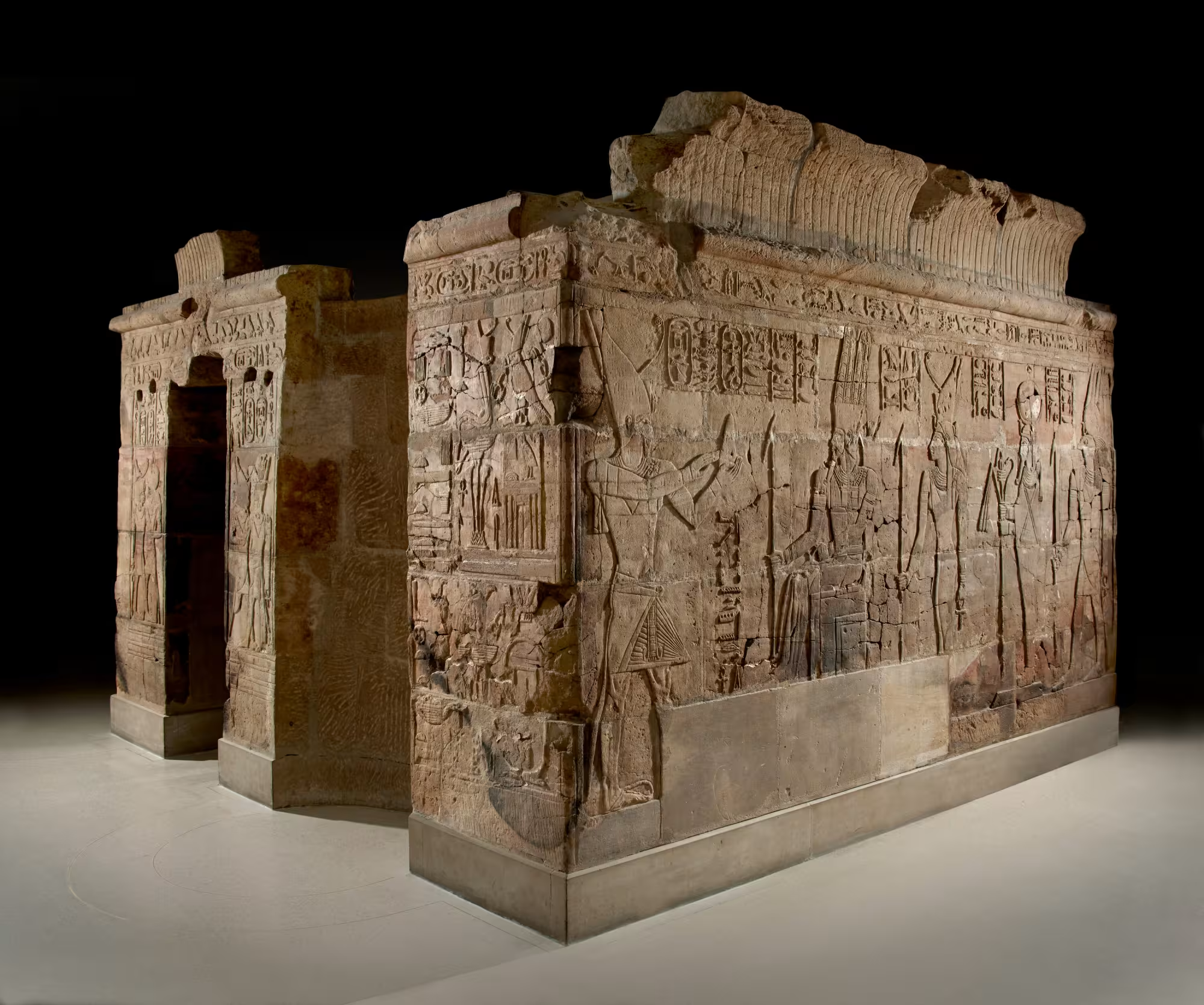
The Shrine of King Taharqa at the Ashmolean Museum. © Fisher Studios, 2026 - courtesy of Ashmolean Museum, University of Oxford

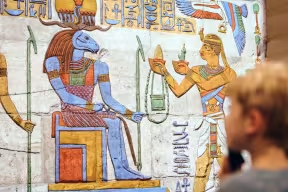
The Shrine of King Taharqa, the only free-standing pharaonic building in Britain, is the centrepiece of the Ashmolean Museum’s Ancient Egypt and Sudan galleries. Although the Shrine's sandstone walls appear largely uncoloured today, they were once covered in elaborate painted decorations. This new installation uses digital projection to shine the original colours onto the Shrine's carved surface, allowing viewers to watch its ancient decoration emerge before their eyes.
Made possible through the generous support of Lord and Lady Lupton, the new installation marks the 90th anniversary of the Shrine's arrival at the Ashmolean Museum in 1936.
The impressive, 4-metres square monument was built between 690–654 BCE by King Taharqa, who ruled both Egypt and Kush (in present-day Sudan). The Shrine originally stood within the great temple of the god Amun-Re at Kawa in northern Sudan. Its intricately carved walls depict the king making offerings to the gods, expressing both his royal authority and his devotion to the divine. No objects or decoration were found inside the Shrine, but it may have once housed a statue of the ram-headed god, Amun-Re, or King Taharqa himself, and would have been the focus for worship by the temple priesthood.
Two specially created films explore the monument's remarkable history and meaning. The first follows the Shrine's journey from its construction in ancient Sudan, through centuries of burial until its excavation in the 1930s, to the scientific discoveries that have made its colourful reconstruction possible. The second brings the carved scenes into focus, introducing King Taharqa and the gods and goddesses represented on the walls, while revealing the significance of their elaborate costumes, symbols and offerings.
“A trip to Egypt in 2022 inspired my interest in the vivid colours used millennia ago, preserved by the arid climate, and still visible today. I hope that this use of technology in the Ashmolean will similarly inspire our visitors, especially the young.”
How research revealed an invisible colour scheme
Deciphering the original colours- including brilliant blues, reds and yellows – required a range of complementary research techniques.
In 1990, microscopy analysis was carried out on surviving fragments of the painted layers to reveal which pigments had been used. This showed that the base layer was pink, made from red pigment combined with white. This created a surface or ‘ground’ over which other colours were applied.
Other pigments included:
- Red: ochre, derived from haematite, an iron oxide mineral.
- White: thought to be made from kaolin, a clay mineral.
- Yellow: ochre, derived from yellow iron oxide.
- Black: composed of carbon, probably soot from oil lamps.
- Blue: ‘Egyptian blue’/blue frit.
The discovery of Egyptian blue was particularly exciting for the research team. Egyptian blue is the earliest known synthetic pigment, and is made by combining silica (sand containing quartz and calcium carbonate), calcium (limestone), and copper.
“Many of the stone monuments and statues of the ancient world in our museums were once brightly coloured. We are enormously grateful to Lord and Lady Lupton for their generous support in helping us reveal the Shrine of Taharqa in a completely new light.”
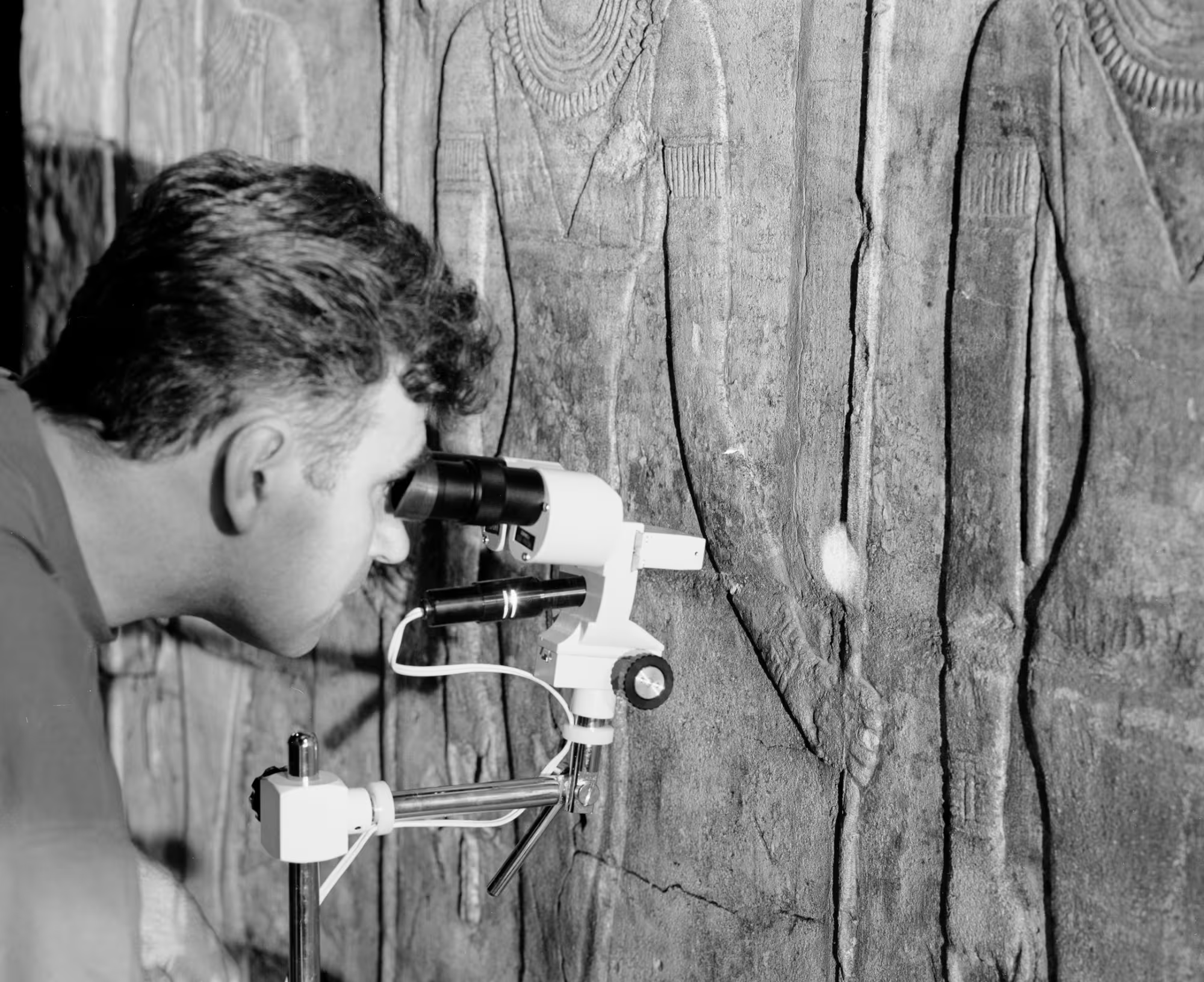
Egyptian blue luminesces in the infrared spectrum (IR). To see where the pigment had been used on the Shrine, a digital camera was equipped to record the luminescence of the blue paint when excited by a modified flash – details that are not visible with the naked eye. This was carried out in 2013 by Caroline Armstrong as part of her MA thesis in Forensic Archaeology and Anthropology at Cranfield University. The images revealed that the pigment appears to have been reserved for specific divine figures and imagery. These include the body of the ram-headed god, Amun-Re, and several other features, including the hieroglyphic inscriptions.
Revealing where the other pigments had been used on the shrine required two additional techniques: hyperspectral imaging and X-Ray fluorescence. This research was completed in 2019 by Ian Maybury for his MSc thesis in Science and Engineering in Arts, Heritage and Archaeology.
Hyperspectral imaging illuminates a subject with a white light source and for each pixel in an image detects the reflectance spectra given. This can be used to characterise and map the colours in the image. X-ray fluorescence is a non-destructive analytical technique used to identify the chemical elements present in a material based on the characteristic wavelengths of radiation they emit when irradiated with X-rays.
Liam McNamara, Keeper of Antiquities and Lisa and Bernard Selz Curator of Ancient Egypt and Sudan at the Ashmolean Museum, combined all this previous research to produce a full reconstruction of the original painted decoration. This involved comparison with other painted temple reliefs of approximately the same date to ‘fill in the gaps’ on the shrine.

“This exceptional monument offers a fascinating insight into the art and archaeology of ancient Sudan. The new projection – and the scientific research behind it – will allow visitors to appreciate and understand the Shrine’s original painted decoration like never before.”
Photogrammetry was carried out by Dr Jorien Duivenvoorden (Assistant Professor in the Conservation of Architectural Finishes at the University of Amsterdam) to create a 3D model of the monument. This allowed the animators, Clay Interactive, to accurately map the projected reconstructions onto the wall.
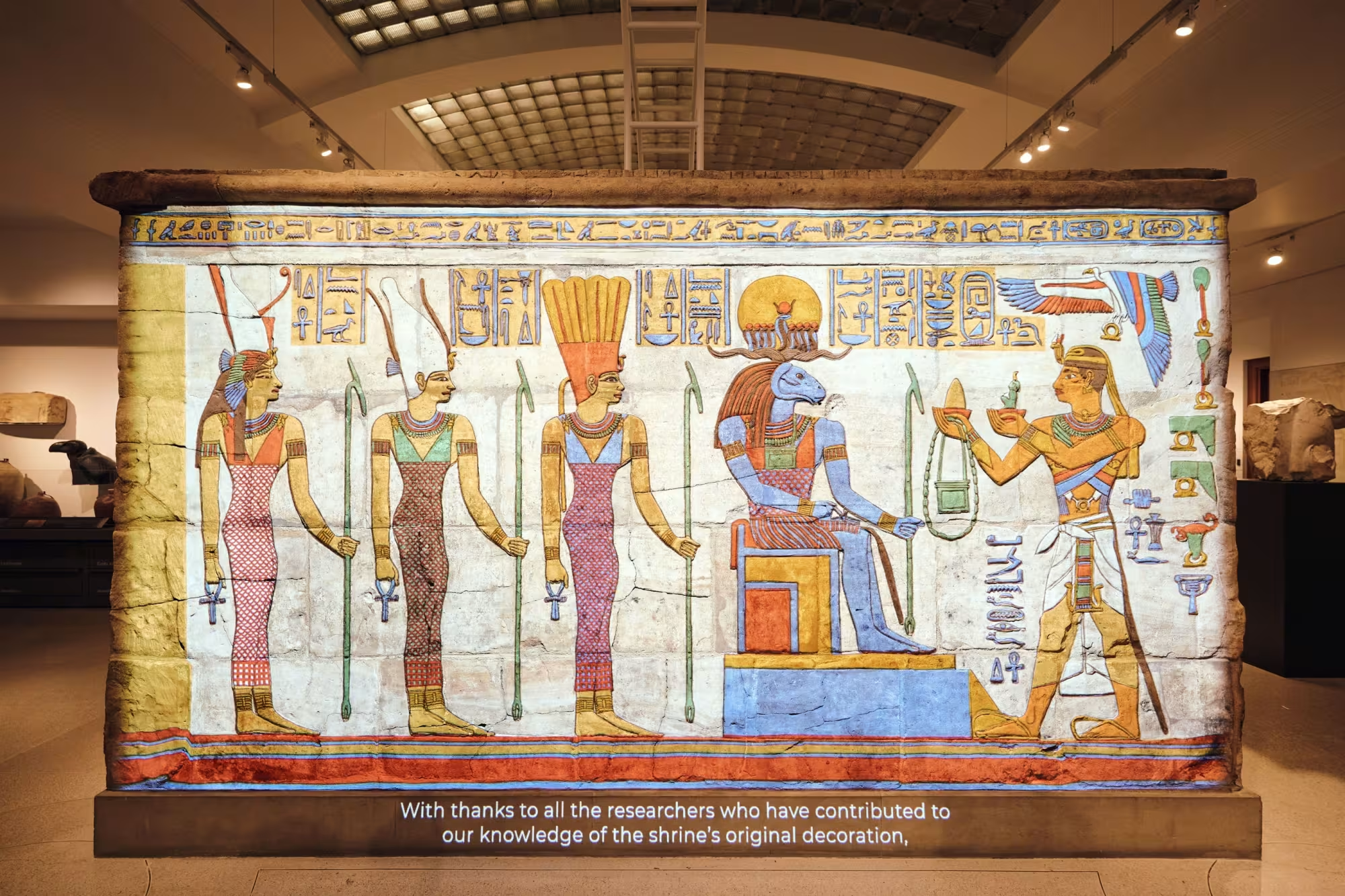
Liam McNamara said: ‘The research to reconstruct the original painted decoration on the Shrine of King Taharqa has involved collaboration with colleagues and students across several different disciplines. The results have transformed our understanding of this ancient monument. We hope that the presentation of this research using digital technologies will help our visitors engage with the type of work that goes on “behind the scenes” in the University’s museums.’
He added: ‘When I watched the first group of school children press the button to illuminate the Shrine, it was wonderful to hear their gasps of amazement as the colours were painted across the walls. Their faces lit up as the animations explained the roles of the king and the gods and goddesses, as well as translating the hieroglyphic inscriptions.’
The new permanent installation is free for all visitors to experience in the Ashmolean Museum's Ancient Egypt and Sudan galleries.
For more information about this story or republishing this content, please contact [email protected]


