
New Oxford MSc tackles the challenges of governing AI
Artificial intelligence is advancing rapidly and transforming professions and institutions. Some of the most difficult questions AI raises are not technological ones, but about accountability, public benefit and legal responsibility.


Understanding what AI can do – and how law, politics and public institutions should respond – is the focus of Oxford’s new interdisciplinary MSc in Law, Governance and AI, taught full time over 12 months and beginning in October 2027.
Jointly delivered by the Faculty of Law and the Department of Politics and International Relations (DPIR), the MSc in Law, Governance and AI will be taught by academics with expertise spanning computation, data law, public law, politics and international relations.
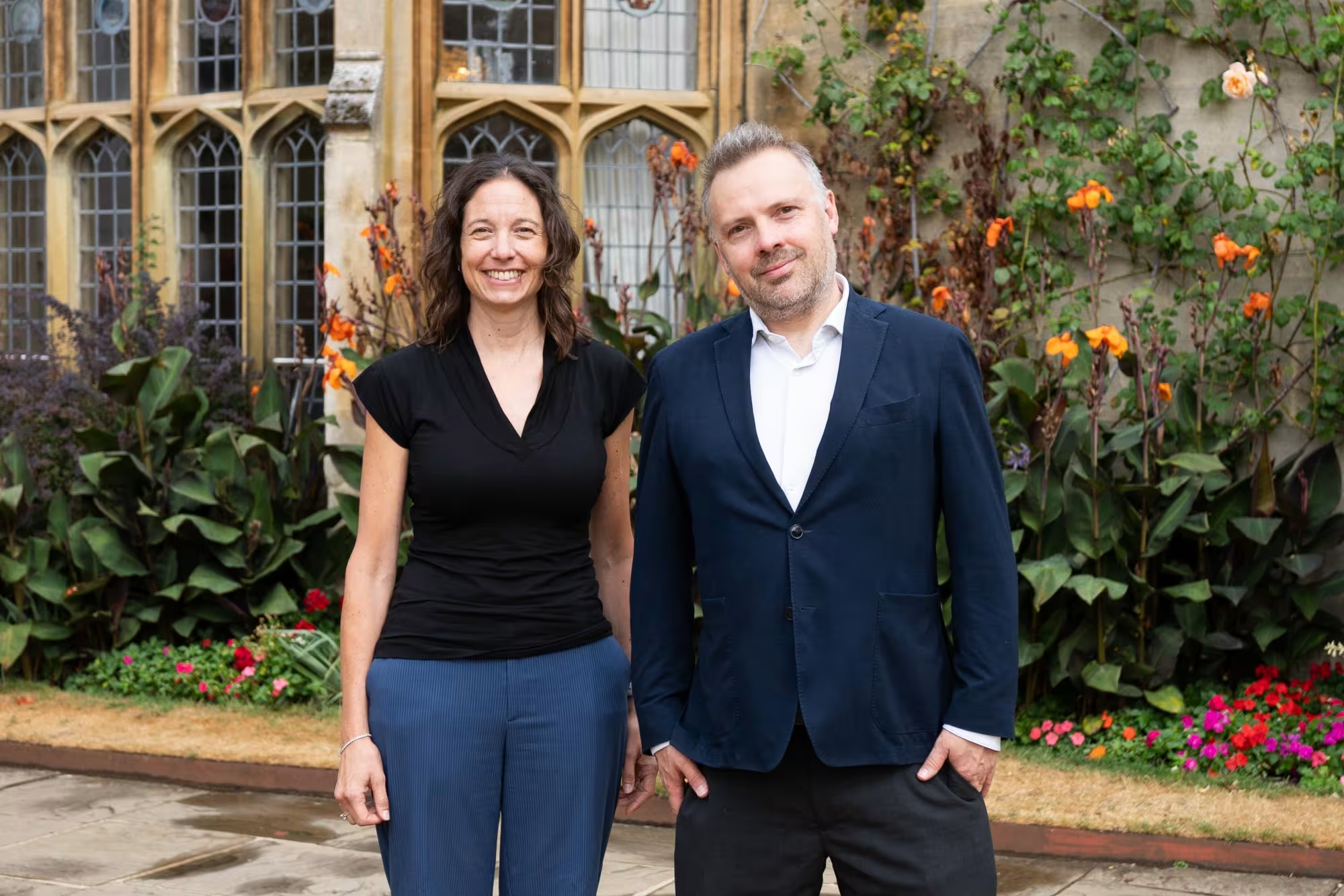
Rebecca Williams, Professor of Public Law and Criminal Law and one of the course directors, stresses that while media headlines often focus on dramatic predictions and existential risks, AI is already capable of causing harm. With effective regulation and design, some of those harms can be prevented.
‘It's about not just getting excited by the most recent media bandwagon but understanding it all from the ground up: the potential harms, the potential regulation of those harms and what the technology is actually doing, so that you can respond in an appropriate way.’
The course combines interdisciplinary teaching with building practical understanding of machine learning, data and AI tools. For Ben Ansell, Professor of Comparative Democratic Institutions and course director alongside Professor Williams, understanding the computational framework underpinning large language models alongside broader questions about societal impact is essential: ‘What do these things do? Why do they do things we might not want them to do? And how can we make them do things that would be useful for us for social purposes?’
Learning to think across disciplines
The programme follows the success of a course developed six years ago by Oxford's Faculty of Law and the Department of Computer Science, which brought together lawyers and computer scientists with the aim of developing ‘bilingual thinkers’. The experience highlighted how disciplines differ not just in what they know, but in how they think.
Professor Williams gives the example of how different students might interpret the word ‘can't’. While a lawyer is likely to understand it as meaning something is not allowed, a computer scientist may take it to mean something is not technically possible – and try to prove otherwise.
The MSc welcomes applicants from a range of academic backgrounds, bringing different perspectives on computation, law and political science into the classroom. That diversity helps students see their own discipline through somebody else’s eyes and avoid ‘talking past each other’, says Professor Williams.
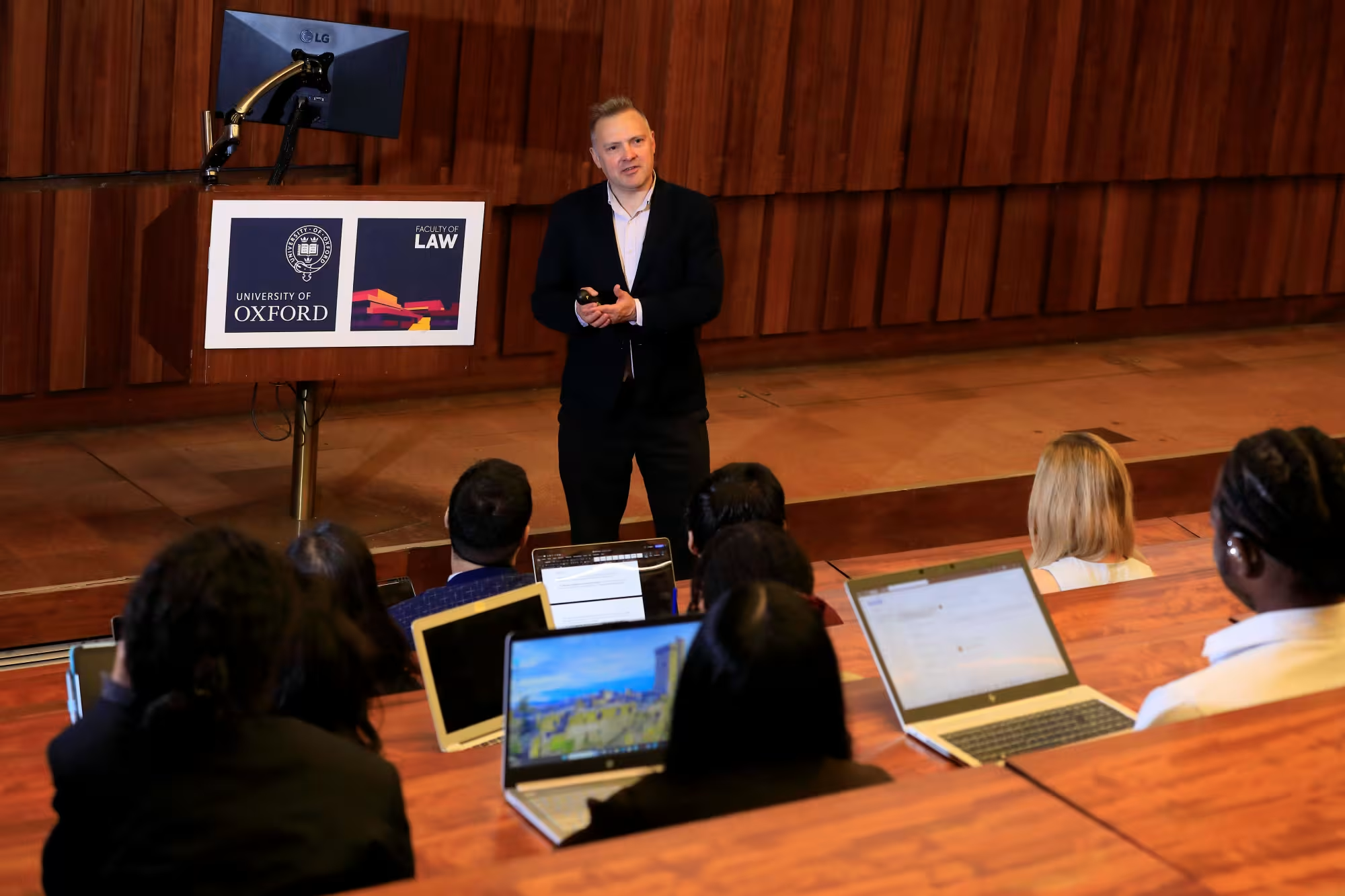
The objective is not to turn every student into a lawyer, computer scientist and political scientist, but to give them enough understanding of another field's vocabulary and culture to ask the right questions and understand the answers.
‘Interdisciplinarity is a big buzzword,’ says Professor Ansell. ‘But it’s going to work best if you have a substantive, clearly defined topic such as this. You can think of it as having different beams of light coming from different directions, all focusing on the same point.’
That approach matters because AI governance cuts across both disciplinary and institutional boundaries. Legal systems have extensive experience of regulating how the state exercises power over citizens, but AI raises new questions about how to ensure private companies use it fairly, how governments can use it effectively and how countries manage their reliance on technology developed elsewhere.
Putting ideas into practice
At the heart of the practical element of the programme is the Capstone Project, in which students apply that interdisciplinary approach to a practical problem.
‘The fastest way of teaching people this interdisciplinary, bilingual thinking and communication is to actually get them to do something, not just to sit in the classroom, but actually to go out and build something together,’ says Professor Williams.
Projects on the new MSc could involve real-world partners such as government departments or NGOs, or connect students interested in developing a start-up with expertise elsewhere in Oxford.
Preparing graduates for an AI-shaped economy does not mean everybody needs to become a software engineer, Professor Ansell argues. AI companies don’t just employ engineers but people from backgrounds including philosophy, psychology, economics and politics. Graduates entering law, government, finance and other sectors also increasingly need enough understanding of AI to engage with it critically.
‘We need to be training people to not only be able to use ChatGPT, but to actually understand how these models work so they don't get tricked by them.’
For Professor Williams, the course builds on one of Oxford’s distinctive educational strengths. ‘Critical thinking has always been one of the things that Oxford has been really good at, teaching people to have agency and to think not just what we do, what has happened; but what should happen and where should we be going?’
‘We want people who are excited about approaching a really important question from a bunch of different directions,’ says Professor Ansell. ‘You've got to be excited about doing that to do this course. You're not going to learn one thing; you're going to learn lots of things and how they mesh together.’
Find out more about the MSc in Law, Governance and AI here.


