
100% organic free-range egg production could have negative consequences for climate and nature
An international team, including researchers at the University of Oxford’s Smith School of Enterprise and the Environment, has revealed striking trade-offs between the different ways eggs are produced, with a wholesale shift to free-range and organic systems potentially raising greenhouse gas emissions and land use even as it aligns more closely with concerns about hen welfare.
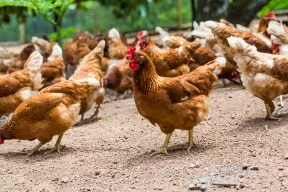

Using UK data, the study compared several possible scenarios for the egg industry, including shifts to barn, free-range and organic systems, while keeping egg output constant. The authors find that although cage-free systems may align more closely with public concern for hen welfare, they may also require larger hen populations and could increase environmental pressures. Switching entirely from a business-as-usual mix to free-range and organic production, for example, would raise emissions by 60% while almost doubling the amount of land used.
Dr Harriet Bartlett, Senior Research Associate in Sustainable Food Solutions at the Smith School of Enterprise and the Environment, University of Oxford, said: 'Our research highlights the importance of considering animal welfare, environmental impact and food production together when shaping the future of egg farming. Being aware of these tricky trade-offs will help us make better decisions for the environment and animal welfare in the future.'

“Our research highlights the importance of considering animal welfare, environmental impact and food production together when shaping the future of egg farming.”
The global food supply chain creates 26% of human-caused greenhouse gas emissions and is responsible for 78% of eutrophication (excess nutrient enrichment of water) and 32% of terrestrial acidification (soil damage). Egg production is a key driver of these impacts, having quadrupled over the past 50 years, even as advocacy for a wholesale move away from cage-based systems has grown.
The research recognises that the transition towards cage-free production is important for improving animal welfare. However, its findings also suggest that transitioning to cage-free systems without also improving factors such as mortality and feed efficiency is likely to increase environmental impacts.
Dr Bartlett said: 'This is not to say concerns around eggs from caged chickens can or should be dismissed or that we should return to restrictive caged systems. But we want farms and consumers to be aware of all the potential impacts when it comes to the methods by which we produce our food. By taking a broader view, we can find the best ways to balance these trade-offs as we pursue a more sustainable global food system.'
The study also found a significant rise in mortality for 100% free-range and organic systems. The authors acknowledge that the data used, collected between 2009 and 2010, do not capture more recent developments in laying-hen production, and describe this as an important limitation, but say these remain the most comprehensive dataset available for laying-hen production systems in the UK. They add that the results highlight the need to integrate environmental outcomes when guiding future transitions towards non-cage egg production.
The study, 'The environmental cost of welfare-driven policy changes in UK egg production', is published in Royal Society Open Science.
For more information about this story or republishing this content, please contact [email protected]


