
Oxford researchers contribute to major advance in the search for dark matter and gravitational waves
University of Oxford researchers have contributed to a major advance towards building large-scale quantum sensors capable of operating under real-world conditions. Ultimately, the work could help physicists probe the fundamental nature of dark matter, dark energy and gravitational waves. The results have been published today in Nature.

Atom interferometers could help reveal new insight into the nature of dark matter and dark energy by detect the tiny effects these phenomena may have on atoms. Image credit: koto_feja, Getty Images.

Around 95% of the Universe is thought to be made up of dark matter and dark energy, but their nature remains one of the biggest unsolved questions in physics. One way to search for clues is to use quantum sensing to detect the tiny effects these phenomena may have on atoms. However, this requires researchers to measure extremely small signals that can easily be overwhelmed by background noise.
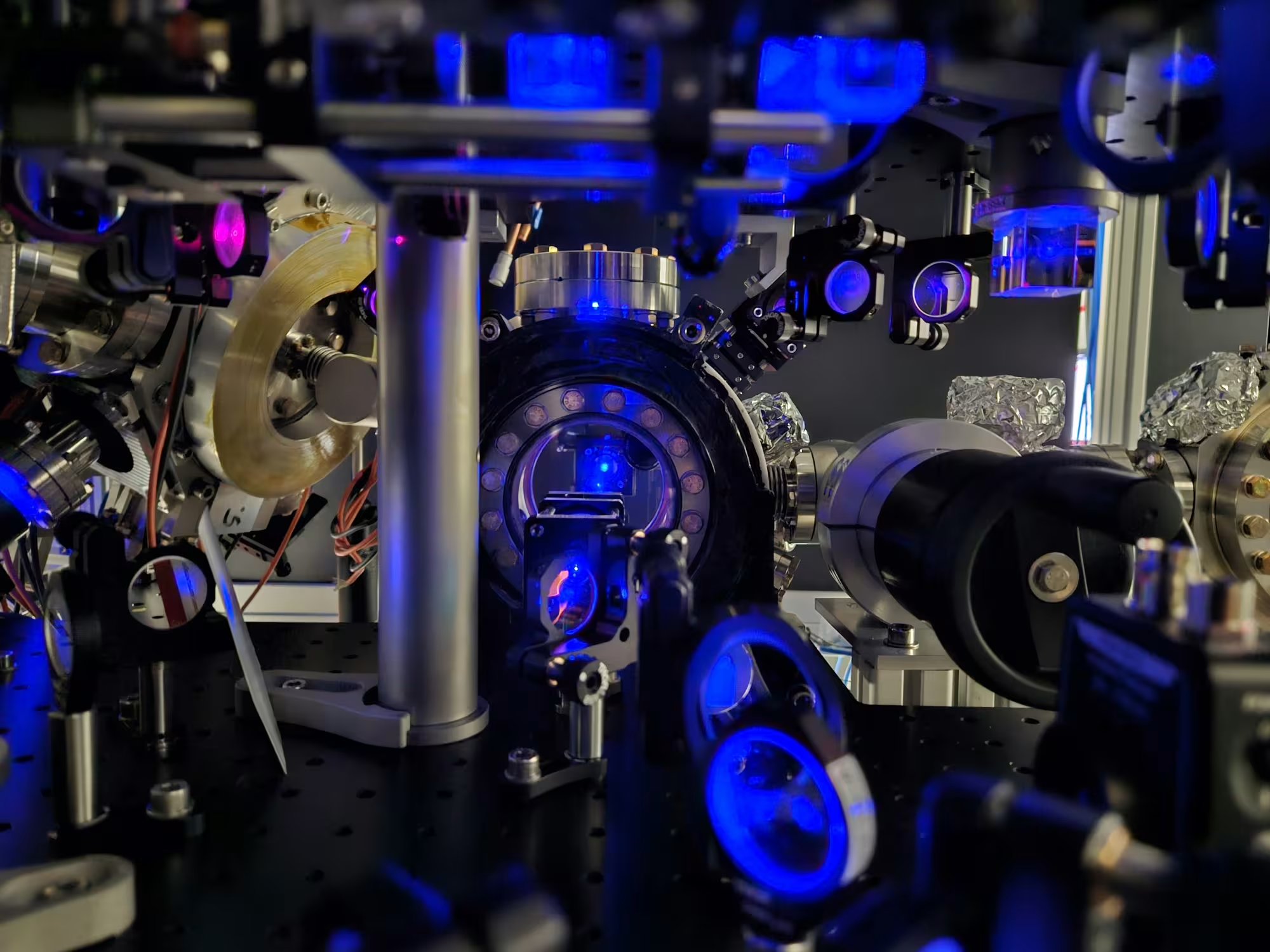
Long-baseline atom interferometers are emerging as one of the most promising technologies for this challenge. They use lasers to split clouds of atoms and then bring them back together, allowing minute changes in their motion to be measured with exceptional precision. These changes could be caused, for example, by a gravitational wave passing through the detector, or by a dark matter field shifting the energy levels of the atoms.
A major obstacle, however, is that the lasers used to control these experiments produce phase noise far larger than the signals researchers are trying to detect. If left uncorrected, this noise completely obscures the effects being measured.
To overcome this, scientists have proposed using a differential approach, in which two interferometers are compared so that shared noise cancels out. This method underpins plans for next-generation detectors, but until now it had not been demonstrated under realistic operating conditions.
The new study, from the Atom Interferometer Observatory and Network (AION) collaboration, has now shown that this approach is technically feasible in the regime where future detectors are expected to operate. Led by Imperial College London, AION brings together researchers from institutions across the UK to develop next-generation quantum sensing technologies.
Testing quantum sensors under realistic conditions
In the Imperial Ultracold Strontium Laboratory, the team built a tabletop prototype using two macroscopically separated clouds of ultracold strontium-87 atoms, interrogated by a single ultrastable clock laser.
The setup was designed to mimic the conditions expected in much larger future experiments, where controlling noise becomes increasingly difficult. To push the method to its limits, the team deliberately introduced large amounts of additional phase noise into the system, far more than clock lasers naturally produce, to simulate the conditions expected in long-baseline detectors.
Individually, each interferometer became unusable, with its signal obscured by noise. The interference patterns that normally allow measurements to be made were effectively erased.
However, when the two interferometers were compared, a clear signal could still be recovered. Although each individual measurement appeared random, the correlation between them revealed the underlying behaviour of the system. The combined measurement operated at the fundamental limit set by quantum physics, demonstrating that laser noise cancellation works as required.
“It is marvellous to see the injected signals faithfully recovered despite the high levels of simulated laser phase noise. I find the physics underlying the experiment fascinating – that an atom in two places at once can be such a nifty sensor – and look forward to seeing what discoveries await when the technology is scaled up.”
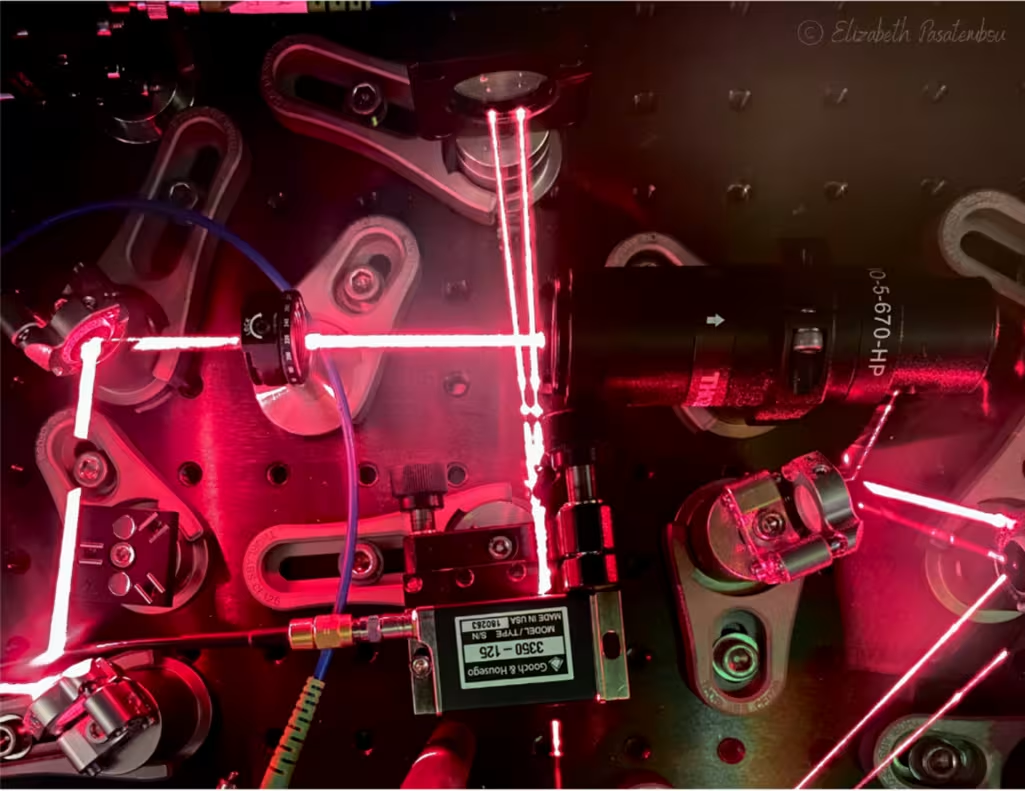
The researchers then went a step further, introducing an additional oscillating signal into the system, similar to what might be produced by a passing gravitational wave or a dark matter field. This signal could still be detected clearly, even under conditions where neither interferometer alone contained usable information.
The results provide the first experimental validation of a key principle underlying long-baseline atom interferometers, helping to resolve a central challenge in their design.
Jack Sander, Project Engineer for AION, said: ‘Oxford has played a significant role in the success of the AION-10 project, providing both substantial engineering expertise and senior leadership. In particular, our engineers helped define and realise designs underpinning a long baseline atom interferometer, translating ambitious physics requirements into practical, deliverable solutions. These contributions have been instrumental in addressing some of the experiment’s most demanding technical challenges and in advancing AION towards its scientific goals.’
“This work shows what can be achieved through long-term investment in quantum technologies and fundamental physics. Our result validates a key principle behind future quantum sensors, opening the way to studies of gravitational waves and searches for dark matter. Results such as this highlight the scientific opportunities and international leadership that can emerge from sustained support for ambitious, curiosity-driven research.”
Towards next-generation detectors
The AION programme aims to develop these technologies for large-scale experiments capable of probing new regions of the Universe.
Professor Christopher Foot (Department of Physics, University of Oxford), a member of the AION collaboration, said: ‘The laser lab in Oxford uses an ultrahigh vacuum system that was constructed collaboratively within the AION project; this is designed to be suitable for future generations of devices even taller that the 100m instruments currently envisaged. These findings build on years of progress on quantum technology within the AION programme in lasers and ultracold strontium physics, advances that made the experiment possible.’
The technology underlying these experiments has wider applications. Ultracold atom sources, ultrastable lasers and precision interferometry are core platforms that underpin next-generation atomic clocks for precise navigation systems that do not rely on GPS. Atom interferometry, in transportable instruments, is also a tool for mapping tiny changes in the Earth’s gravity field.
The study was dedicated to the memory of Professor Ian Shipsey of Oxford, former Head of the Department of Physics, whose vision and leadership played a key role in building the AION collaboration.
The AION collaboration, led by Imperial College London, includes researchers from King’s College London and the Universities of Birmingham, Cambridge, Liverpool, and Oxford, together with STFC Rutherford Appleton Laboratory. The programme was supported by the Quantum Technologies for Fundamental Physics (QTFP) programme, a joint STFC–EPSRC initiative.
The study ‘'A prototype differential atom interferometer for fundamental physics' has been published in Nature.
For more information about this story or republishing this content, please contact [email protected]


