
Monkey friendships with dogs, deer, and pigs offer clues to the evolutionary origins of pet-keeping
A new international study led by the University of Oxford suggests that some of the behavioural foundations of human-animal companionship may have far deeper evolutionary roots than previously thought.
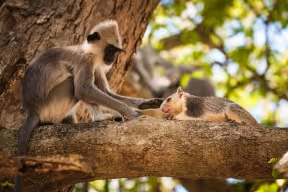

Why do humans keep pets? Researchers from the University of Oxford and collaborators around the world have compiled the first comprehensive review of friendly interactions between non-human primates and other species. The review documents 427 cases involving 88 primate species and 127 partner species, 55 of them non-primates, and finds that monkeys and apes frequently play, groom, hold, carry and even adopt individuals from other species.
Published in Primates, the study draws together evidence from the scientific literature (303 cases), media reports (58) and a survey of primatologists (66), making it the most comprehensive overview to date of cross-species social behaviour in primates.
Among the examples are stump-tailed macaques grooming domestic dogs in Thailand, tufted gray langurs gently stroking giant squirrels in Sri Lanka, young black-and-white snub-nosed monkeys playing with domestic pigs in China, and ring-tailed lemurs grooming bamboo lemurs in Madagascar. In one extraordinary case, first documented in Brazil in 2006, wild capuchin monkeys adopted an infant marmoset and cared for it over many months.

“These behaviours don't amount to pet-keeping as we know it, but they may represent some of the evolutionary building blocks from which human-animal companionship eventually emerged.”
Lead author, Associate Professor Cyril Grueter, School of Anthropology and Museum Ethnography, University of Oxford, said: 'Humans have long been considered unique in forming close social relationships with other species. Our study shows that many primates also display remarkable curiosity, tolerance and even caregiving towards animals that are not their own species. These behaviours don't amount to pet-keeping as we know it, but they may represent some of the evolutionary building blocks from which human-animal companionship eventually emerged.'
When animals of different species spend time together, it is usually for practical reasons, such as easier foraging or safety in numbers. These primates went further, playing with, grooming, carrying and curling up alongside other animals for no obvious reward, hinting at a social curiosity and a readiness to make friends across the species line that looks strikingly familiar.
Not every encounter ended well. Curiosity and caregiving could tip into rough handling, and the team recorded 13 cases in which a partner animal died. In one instance, a male baboon in Saudi Arabia appeared to have kidnapped a domestic puppy, carrying it around for long periods.
Beyond shedding light on the origins of human-animal relationships, the authors believe the findings also have implications for conservation and animal welfare.
Dr Grueter said: 'Understanding why some species readily form positive relationships with others could help improve the management of mixed-species groups in zoos and sanctuaries. More broadly, these findings provide new insights into the evolution of empathy, social flexibility and the remarkable capacity of primates to engage with animals beyond their own species.'
The authors hope their review will encourage primatologists to record these often-overlooked interactions more systematically during long-term field studies.
Read the study, 'Heterospecific social behavior in primates: insights into the evolutionary roots of pet-keeping', in Primates.
For more information about this story or republishing this content, please contact [email protected]


