
MSt in Global and Imperial History
A one-year taught course offering an introduction to graduate research into history with a global scope, emphasising comparison between regions. You will also be able to focus on periods or themes and undertake personal research.
Full time
- Upcoming application deadline for 2027-28 entry:
- 12:00 midday UK time on Thursday 7 January 2027
- Expected length
- 9 months
- Expected start date
- 3 October 2027
- English language level
- Higher level required
Application deadlines
Final application deadline for entry in 2027-28
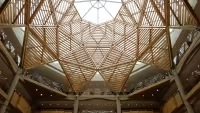
The atrium of the Schwarzman Centre for the Humanities

About the course
Global and imperial history in this context implies transoceanic and transcontinental connections, comparisons, and exchanges between cultures, polities and societies. It also examines broad patterns and systems in history, whether religious, political, economic, cultural or ecological.
Global history, in other words, is history with a global scope (often including European dimensions) that emphasises comparative perspectives. You are not expected to master the histories of multiple regions, but to use a global approach to cast light on your own research area.
Research training is combined with broad conceptual approaches that encourage students to learn from the recent historiographies of different periods and areas and with focused studies of periods or themes. You will be encouraged to attend some of the faculty’s many advanced research seminars.
The MSt in Global and Imperial History can be taken either as a free-standing degree, or as the first step towards a DPhil.
The faculty’s research is organised around historical periods, research centres, or in collaborative and individual research projects, and graduates are key participants in the wide range of seminars, workshops and conferences run by the History Faculty.
The Oxford Centre for Research in the Humanities (TORCH) offers a stimulating range of interdisciplinary activities. You are also encouraged to join the Oxford History Graduate Network (OHGN), which fosters friendships, conversations and collaboration.
Course structure
The course comprises a compulsory core course, an option subject course, and a research project. The core course is taught in Michaelmas term in seminar classes and tutorials. The option paper is taken in Hilary term, taught by specialists in that subject. You will agree the title of your dissertation with your supervisor in Michaelmas term, and work on it during the whole course, including the Easter vacation.
Core components
You will take one core course and submit a dissertation.
Option modules
You will take one option module.
Course details
Entry requirements
For entry in 2027-28