
MPhil in History (Intellectual History)
Graduate research training in the distinctive methodologies of intellectual history is complemented by optional courses that provide deeper subject knowledge and substantial personal research.
Full time
- Upcoming application deadline for 2027-28 entry:
- 12:00 midday UK time on Thursday 7 January 2027
- Expected length
- 21 months
- Expected start date
- 3 October 2027
- English language level
- Higher level required
Application deadlines
Final application deadline for entry in 2027-28
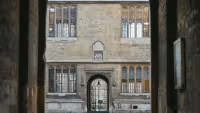
The Old Bodleian Library (Oxford University Images / Ian Wallman)

About the course
The MPhil in History has a sustained period devoted to archival research and writing, and is designed to give you a thorough training in historical research, improve your ability to conceptualise and engage with historical problems, and enlarge your understanding of the historical and historiographical context in which your own research is set. This course can serve as either a free-standing graduate qualification, or as a springboard to doctoral study. Skills training and option choice are flexible and open-ended, to allow you to gain the knowledge and training needed to complete your research project.
You will have the opportunity to study thinkers and ideas from the fourth to the twenty-first centuries, in diverse transnational geographical contexts. The course is designed to encourage you to work in and between areas such as Global Intellectual History, the History of Scholarship, the History of Science, the History of Art, Historiography and the History of Political Ideas.
Oxford is home to one of the largest communities of intellectual historians in the world, with expertise in every major area of Intellectual History, supported by world-class resources. Further information about Intellectual History research and activities can be found through the faculty website.
All graduate students are encouraged to engage with the faculty’s lively research culture of seminars, workshops, and discussions groups. There’s something happening nearly every day of the week and sessions often involve leading international scholars. The faculty also runs the Oxford History Graduate Network, which fosters conversation and collaboration between graduate students. Interdisciplinary activities are available through The Oxford Centre for Research in the Humanities (TORCH).
Course structure
You will take two compulsory core courses, a research masterclass, two optional subject courses, and undertake a substantial original research project.
The Historical Methods core course is taught in Michaelmas and Hilary terms of year one. The Writing History core course is taught in Trinity term of year one. The research masterclass is in Michaelmas of year two. Option courses are taken in Michaelmas and Hilary terms of year one. You should agree the title of your dissertation with your supervisor in year one and work on it throughout the course, including vacations.
Courses and research are supported by a skills programme for general historical or field-specific training, including document and object handling, palaeography, oral history, text analysis software, GIS software and statistical analysis. Additional lectures, classes and tutorials take place in Michaelmas and Hilary terms. You will discuss what training you need to undertake your research project with your supervisor.
Language training is also available, with the faculty organising special courses for historians in French, German, Spanish and Italian. Other modern language courses are available through the University’s Language Centre. Courses in Latin and other medieval languages are also available. Further details on language training can be found on the faculty website.
Core components
You will take three core courses and complete a research project.
Option modules
You will choose two option modules.
Course details
Entry requirements
For entry in 2027-28