
Research Practice Developments
The need for good research practice is universal across all researchers and research institutions. In order to support good research practice, institutions must put policies, procedures, digital infrastructure, and supporting mechanisms in place to encourage and assist their researchers in their practice. Here we describe the activities undertaken in Oxford and lessons learned from this our work. We hope that researchers at Oxford and colleagues at other institutions may benefit from and learn from our experience.

Let’s start with the obvious: good research does not just happen. It depends on a series of decisions and practices across the lifecycle of a project, from initial idea, through source and data collection and analysis, to working with collaborators and sharing findings. At each stage, there are potential pitfalls, including data loss and mismanagement, regulatory non-compliance, unclear authorship practices, or simply inefficient workflows. These are not edge cases, they are everyday risks that can affect the quality of research we share and, ultimately, our reputations as researchers and as institutions.
The Research Practice Team ([email protected]) are always happy to hear your views on the current state of research practice and what you think could be done to improve it.
Like other research institutions, Oxford’s reputation rests not just on the brilliance of its researchers, but on the quality and integrity of the research environment as a whole. As external expectations grow, from REF 2029 to funder and publisher policies, the University needs to demonstrate not just excellence in what research is done, but excellence in how research is conducted. In particular, requirements around data and code that are open and FAIR (Findable, Accessible, Interoperable, Reusable), research integrity, and reproducibility are no longer optional extras; they are central to how research is evaluated and funded.
And yet, if you have ever tried to navigate research policies, data requirements, training offers, and compliance processes at Oxford, or your own institution, you will know one thing: it is not always straightforward. Things, however, are changing!
The first step was to recognise the need for improved research practice, so in 2022, our Pro-Vice-Chancellor of Research established the Research Practice Programme (RPP), a priority of the broader Research Culture Programme, and recruited an Academic Lead for Research Practice. Since 2024, the RPP has been coordinated and governed by the Research Practice Subcommittee (RPSC), a partnership of academics and professional services, providing University-level leadership and enabling the highest standards of practice in how research is designed, planned, executed, and reported. This governance model not only brings in leadership from all parts of the University, but also acts as a dissemination route to bring the results and outcomes of the programme to the individual researchers.
The programme aims at providing our research community with up-to-date and user-centric support on five areas, as illustrated in the figure below.
What we have already delivered
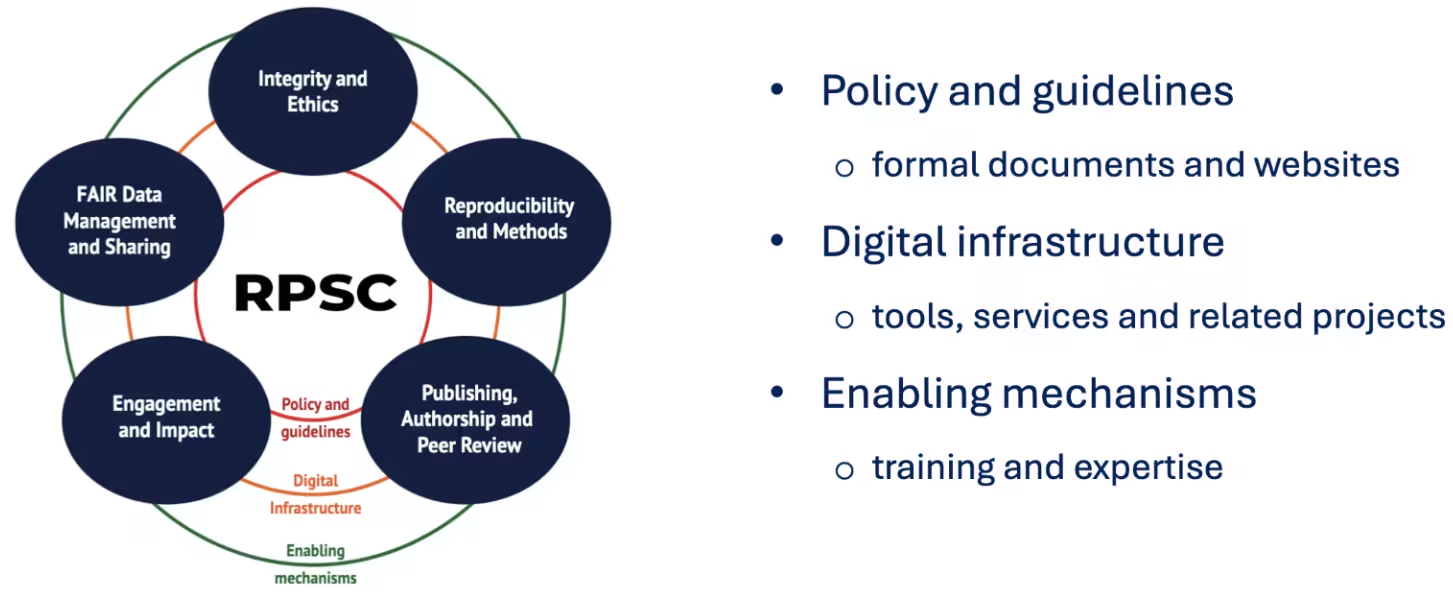
Improving research practice across the whole University is not a distant strategy, and the research practice programme has been developing supporting resources. This section details these resources in the Oxford context, some of which are complete, while some are still in development. Where possible, results and outcomes from these activities have been shared outside the University, with the hopes that they can be used freely by other research institutions.
Power up your learning: resources researchers can use today
The Research Practice e-learning training modules, co-created with Oxford experts, cover best practice in the planning, conduct, and dissemination of research, focussing on: Research Integrity, Ethics and Governance; Open Research Practices; Research Design; Collaboration; Data; Authorship, Publication and Peer Review; and Engagement and Impact. Oxford staff and students can access and take the courses via Canvas, while other institutions will soon be able to access the module materials and assets via ORA. Take the courses.
Building Cultures of Good Research Practice (SSO required) was a webinar focused on the responsibilities of managers to enabling good research practice , leading by example and setting expectations, and delivered within the modular management skills programme the Confident Manager (SSO required) launched by Learning & Organisational Development team. View the slides from a previous webinar (SSO required).
Build your future: reward and career
The Vice-Chancellor’s Research Culture Award has a new category set to recognise individuals and teams who foster a positive, inclusive, and equitable research environment, including strengthening research practices. Register your interest.
The Narrative CV provides guidance on how to use this flexible format for describing contributions and achievements, recognising a broader range of research activities and career paths – including responsible research practices. Check the resources and the webinars.
Reproducible Research Oxford (RROx) is a researcher-led University-wide initiative promoting open research and reproducibility across all disciplines, organising events and initiatives to support robust research practices. Get involved and join in.
We take the pulse: voices and views
The Oxford Forum of Open Scholarship (OxFOS) is a conference that brings together academics, researchers, students, and staff to share ideas, showcase work, and connect with others passionate about transparent, accessible research; organised by the Bodleian Library with the RPP and the RROx teams. Attend this annual event.
The Research Practice Survey is an annual assessment of awareness and use of research practices and resources across the University, tracking progress over time and the impact of RPP and RPSC initiatives. The survey is sent each year to a representative sample of Oxford researchers, so if you are invited to take part, please do, as your opinions are very valuable. Make sure you have your say.
We create guidance you can rely on: practical and authoritative
The Open Research Position Statement provides a framework for conducting and sharing research in ways that support accessibility, trust, and societal benefit; aligned with sector standards, it applies to all researchers at Oxford, alongside any funder and regulatory requirements. Be aware of and adhere to this statement.
The Policy for Using Generative AI in Research is the University’s guidelines for researchers and professional staff for a safe and effective use of generative AI (GenAI) in research, with guidance for researchers and professional staff. Consult the use cases when applying GenAI in your work.
We contribute to research culture: bigger, broader, better
The Research Culture Toolkit (SSO required) is a collaborative, university-wide initiative to support departments in strengthening research culture and mapping the current landscape across units, with research practice as a core component. Join the 80% of departments who have already engaged.
The Oxford Researcher’s Trailmap is a guide for fixed-term researchers to navigate personal, research, and career development opportunities at Oxford, including a pathway to research practice guidance. Make the most of the Trailmap.
We review and monitor to improve: internal reports and tracking
RDM Toolbox (SSO required) maps the University’s Research Data Management (RDM) landscape, providing an inventory of resources, clear criteria to define a core set, and a roadmap with investment priorities to keep them current and effective.
Enhancing Research Practice Findings report (SSO required), delivered by the University’s Focus team, reviews our research practice support, and communities of practice, highlighting levels of uptake, gaps and needs, and informing a deeper analysis of priority areas for improvement.
What is on the way: a more joined-up ecosystem
This section shows the work underway that has started more recently under the RPSC umbrella, as a set of nine prioritised interventions. Initial results will be released in Summer 2026. More importantly, as new services and improvements emerge, there will be opportunity to provide feedback and help refine what comes next.
The Research Practice Companion: an AI-driven navigation assistant. The idea is simple: an AI-assisted, single-entry point that helps you navigate to the right information you need at that point in your research timeline. In the first instance, the companion will signpost you to documents and resources, but will progressively help you to answer questions in context, based on where you are in your research lifecycle, and also by invoking other AI-assisted tools. We are developing the Companion with two different research practice domains to start: Ethics and Integrity and Data and Research Data Management (RDM).
Training that works. We want to develop and provide training in research practice that is better organised, easier to find, and more relevant to your needs Training already exists across Oxford, but it is often hard to find, uneven in coverage, and sometimes duplicated. This intervention will change this by creating a more coherent, cross-disciplinary training offer; improving discoverability through a single access point; filling gaps in provision; and introducing better data and reporting on training uptake. For you, this should mean less time searching for relevant training, and more confidence that what’s available is useful and appropriate to your needs.
Supporting transparency and trustworthiness. There is a growing requirement, from funders, journals, and the wider research community, to ensure that research is transparent and reproducible. This intervention will expand infrastructure to support sharing of code, workflows, and methods; support grassroots initiatives like the Reproducible Research Oxford (RROx) network; and develop a longer-term strategy aligned with evolving expectations. The aim is not just compliance, but enabling research that is more reliable, reusable, and impactful.
Clear and usable policies. Policies are essential, but only if they are clear, aligned, and usable in practice. This intervention will update key policies (e.g. open access, data management, research integrity); improve alignment between them; and strengthen the support available for implementation, including guidance on emerging areas like AI. For the researcher, this should mean fewer contradictions, clearer expectations, and better support in applying policies in real-world contexts.
Making data work: coherent and coordinated RDM services and support. There is also a strong focus on RDM, not as an administrative hurdle, but as a core part of research quality. From support for data management planning, via compliance to ethical, legal and technical requirements, to better storage and data dissemination, the aim is to collect, store, share, and reuse data, as well as other research digital objects (such as code) in ways that meet both funder expectations and scholarly norms.
Our vision is to deliver a RDM that is joined up, where decisions align across the RDM lifecycle, e.g., how researchers collect data supports how it is preserved and shared later. These five linked interventions mark the beginning of our journey, and we aim to deliver:
- A “Research Runway” to reduce friction at the point where research begins by providing a single, integrated pathway to follow ethics approval, data protection, IP considerations, security checks, and more.
- Integrated data management planning support by strengthening tools and guidance for creating data management and stewardship plans, which are better integrated into other planning and compliance services.
- Seamless FAIR compliance to help researchers ensure their data is findable, accessible, interoperable, and reusable, increasingly a requirement from funders and a marker of research quality. The initial focus is the integration between the Oxford-based FAIRsharing services and the Oxford Research Archive (ORA), with a broader community participation.
- Improved storage interoperability to move data securely between internal storage systems, reducing duplication and reliance on ad hoc solutions.
- Coordinated support by reviewing and improving how this is delivered across the University, reducing gaps and overlaps.
Why Research Practice matters: the bottom line
Research practice shapes all parts of research: the quality of outputs, the success of funding applications, the integrity of results, and the reputation of both researchers and the institution.
This programme is, at its core, an investment in making that invisible infrastructure work better. Our aim is to make research practice stop feeling like an obstacle and start functioning as what it should be: infrastructure that supports, accelerates, and enhances the work we care about.
And if it succeeds, most researchers won’t need to think about it very much at all, which may be the clearest sign that it’s working!!
The current team behind this work: a collective effort across organisational units
The activities have also been shaped by the contributors from Departments and Divisions, including the Divisional members of RPSC and the Research Culture Facilitators, as well as with the support of Jolyon Harris (Research Services, Research Portfolio Lead), and the advise of Professor Patrick Grant (Pro-Vice-Chancellor for Research, and the Research Culture Programme Lead)
Leadership
- Professor Susanna-Assunta Sansone (OeRC, Engineering Science): Academic Lead for Research Practice, and Research Practice Subcommittee (RPSC) co-chair
- Dr Tanita Casci (Research Services): Director of Research Strategy and Policy Unit, Research Services; RPSC co-chair
Delivery
Research Services
- Dr Sarah Callaghan, Research Practice Manager (Intervention Lead)
- Dr Mónica Palmero Fernández, Research Practice Coordinator (Intervention Lead)
- Kate Dunbar, Research Policy Manager
Bodleian Libraries
- Dan Crane, Open Scholarship Lead (Intervention Lead)
- Jason Partridge, Collections Support Senior Manager
- Tom Mitchell, Open Access Service Manager
- Dr Thomas Wrobel, ORA Development Lead
- Dr Jackie Thompson, Open Research Project Officer
IT Services
- Rowan Wilson, Head of Research Computing and Support Services (Intervention Lead)
- Cristina Iturralde and Natalie Burrows, Research Portfolio Managers
- Dr Sarah Williams, Programme Manager, Research Practice
- Jigmet Yanchan, Business Analysis Lead, Research Portfolio
Other units
- Alok Sahu (AI Competency Centre), Senior Research Software Engineer
- Dr Milo Thurston (OeRC, Engineering Science), FAIRsharing Technical Coordinator
- Dr Allyson Lister (OeRC, Engineering Science), FAIRsharing Community and Content Coordinator