Cover letters
A well-written cover letter helps explain your motivation, demonstrate your suitability for the role, and complement your CV. This page provides guidance on writing effective cover letters, including academic cover letters and statements, Junior Research Fellowship (JRF) applications, example cover letters, and further resources.


A cover letter tells your story by highlighting your relevant strengths and motivation for the organisation you are writing to, rather than listing all the things that can already be seen on your CV.
Always take the opportunity to submit a cover letter if you are given the chance.
The cover letter gives you scope to showcase what interests and drives you and your enthusiasm for an organisation and the role. You can use it to align yourself with the organisation’s strengths, values and culture, and highlight in a targeted way your knowledge and strongest, most relevant skills for the position.
The content and style are up to you, but a logical and engaging structure is key. Below are some guidelines.
How to Write a Cover Letter
Style
Aim for a professional tone that conveys your message to the reader succinctly - remember it's not an essay or dissertation! Write in clear, concise English – take care not to overwhelm the reader with too much detail and avoid jargon they may not understand, such as Oxford specific terms like "prelims" - it's best to explain what these are e.g. "1st year exams".
Layout
Structure it like a business letter, brevity adds power and aim for no longer than 1 side of A4 in length. However, if the organisation gives you very specific instructions about the structure, length and content, follow their guidance.
Content
Introduction
Introduce yourself and explain why you are writing. If you are responding to an advertisement, state where you saw it. This tells the recruiter why they are reading the letter, and it gives them feedback on which of their advertising sources are working. You need to think about how you would like to introduce yourself; it could be that you mention the course you are studying and when you plan to finish it along with your place of study.
Why this job?
Explain why you are interested in the job and the organisation. Tailor the letter to the organisation and job description to make it clear that you haven't sent out multiple copies of the same letter to different employers.
Draw on your research, especially what you have learned from other resources in addition to their website. For example, speaking with their staff at a careers event or reading reports they have written etc. as this will demonstrate an awareness and understanding of them that goes beyond the basics. Be specific about why the firm/position is particularly attractive to you - think about examples of the work they have done, their clients, their position in the market that makes them unique.
Why you?
Explain why you are well-suited to the position. Refer to the most relevant skills, (c.3-5), experience and knowledge you have and match what you say to the requirements outlined in the job description. Make sure you read our guidance on demonstrating you fit the job criteria for more advice.
As your aim is to convince the recruiter that you are a suitable candidate for the job, focus on your accomplishments and the transferable skills that are relevant to the role. State explicitly how you match the job criteria – don’t expect the person reading your letter to infer your skills or experiences for themselves.
Conclusion
Reiterate your desire to join the organisation and end on a ‘look forward to hearing from you’ statement, followed by ‘Yours sincerely’ if writing to a named individual and ‘Yours faithfully’ if you have not been able to find a named contact.
Use of AI tools when writing cover letters
For further guidance read our information page on the Use of AI in Job Applications and Assessments.
In summary we advise the following:
- Check the stance of companies you are targeting. Many have published their policies on AI on their websites. Our Internship Programme hosts may also indicate their stance on AI in their internship vacancy descriptions.
- Keep in mind that recruitment teams want you to be honest and authentic in your applications and it is difficult to achieve that if you use AI to draft your answers. In using AI tools, you risk sounding generic and uninteresting.
- The view on AI varies greatly between employers. In the Careers Annual Employer Survey conducted in May 2025, we asked recruiters: ‘Do you allow or encourage the use of AI tools in the application or assessment process?’. Only 15% answered “Yes”: half of employers replied “No”, they do not want you to use AI in your applications.
- People hire people who demonstrate and articulate the skills outlined in their job descriptions – have faith in your own skills and be authentic.
General guidance
If you do choose to use AI tools, think about how you can use them effectively and ethically:
- Think of it as an assistant, not a complete solution: AI can help to get you started, do initial research on a sector, offer a broad structure/framework, or help to “polish” your applications. However, it is never a substitute for well-researched, tailored and personal content.
- Make it your own: AI-generated content is built on what others have written in the past, and will tend towards the most likely words and structures. This makes it more likely to be generic and lacking the personal touch that only you can provide. Customise the output to reflect your unique experiences and personality.
- Check references and sources carefully: AI tools can generate inaccurate or outdated references. Always verify the information and ensure it aligns with your own research.
- When in doubt: You will need to make your own judgement about whether or not it’s ethical and advisable to use AI tools. A question you should ask yourself:
“If the employer asked you whether you used AI tools, would you be comfortable telling them how and where you used them in your application/assessment process?”
Top tips
- Write to a named person if you can
- If you have not been able to find a named contact, you could use ‘Dear Recruitment Manager’ or ‘Dear Recruiter’.
- Check your spelling and get someone else to review it.
- Check that it says clearly what you want it to say. Are there any sections that are hard to read, overly long sentences? If yes, try to simplify the language, avoid jargon, use shorter sentences or take out that section completely.
- Make the letter different each time. If you insert another company name, does the letter still read the same? If so, tailor it more specifically to the firm - you may need to do further research.
- Don’t start every sentence with “I”.
- Give evidence for all your claims.
- Be enthusiastic and interested.
- Don’t repeat your whole CV.
- It’s normal to find cover letters tricky to write. Give yourself plenty of time before the application deadline to re-draft.
- A careers adviser can give you feedback on the content and structure of your cover letter and CV, and advise you on how best to target particular sectors – write one first, book an appointment and ask a careers adviser for feedback.
Further information
Video
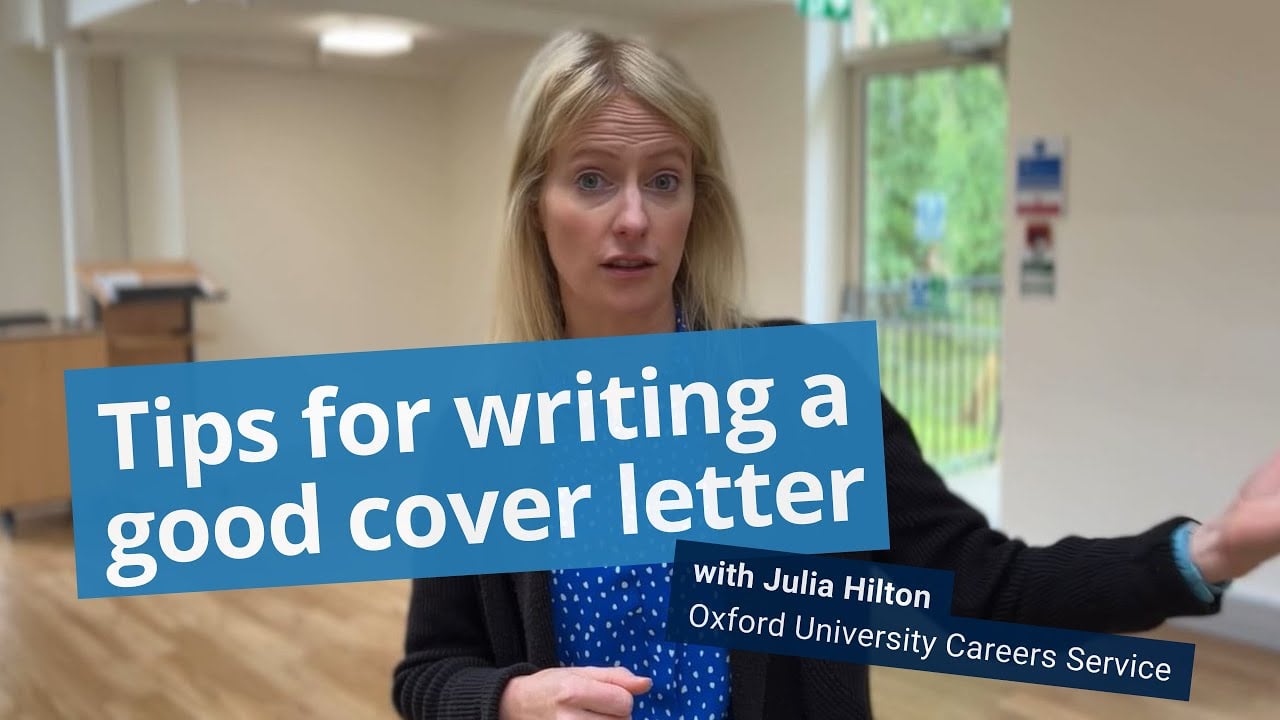
In this video, Julia Hilton, former Oxford University Careers Adviser, shares her tips for writing a good cover letter.