
Trade restrictions on clean technologies risk slowing global climate action, Oxford research finds
Trade restrictions on electric vehicles, batteries and renewable energy technologies could make the global transition to cleaner energy slower and more expensive, but may be necessary for economic and security reasons, according to new research published during COP31.
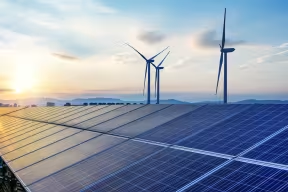

A new policy brief from the Blavatnik School of Government’s Professor Thomas Hale and Dr Claas Mertens, based on data from the Oxford Climate Policy Monitor, reveals a growing divide in how countries approach trade in clean technologies. Major economies are increasingly restricting imports to protect domestic industries, while many smaller economies are removing trade barriers to make cleaner energy more affordable.
The findings come as governments at COP31 consider how to accelerate climate action while addressing concerns about economic competitiveness and energy security.
Drawing on new data from the Monitor, the researchers examined trade policies covering electric vehicles, batteries, wind turbines and solar panels in 31 countries representing 90% of global GDP.
Their analysis finds that countries introducing at least some restrictions account for 58% of global GDP, while the economies pursuing more open trade outside China account for only around 8%.
The researchers warn that growing restrictions could increase the cost of clean technologies and slow their adoption. However, they argue that carefully designed measures to support domestic industries may also be important for maintaining political support for the transition.
A growing divide in clean technology trade
China's dominance of clean technology manufacturing is a major factor behind the shift towards more restrictive trade policies.
In 2025, China produced around 75% of the world's electric cars, more than 80% of battery cells and 79% of solar panels.
This manufacturing strength has helped reduce the cost of clean technologies worldwide, but has also raised concerns among governments about dependence on Chinese imports and the implications for domestic industries and supply chains.
Dr Claas Mertens, Leverhulme Early Career Fellow at Oxford's Blavatnik School of Government, said, ‘China has established a commanding position in the global clean technology market: in 2025, it produced around 75% of the world's electric cars, more than 80% of its battery cells and 79% of its solar panels.’

“Its dominance has helped drive down the cost of renewable energy technologies. Countries want to reduce their dependence on imported oil and gas, both for the climate and for geoeconomic security, which the energy shocks caused by the 2022 Russian invasion of Ukraine and the 2026 US–Israeli war against Iran threw into stark relief.”
‘However, governments are concerned that relying too heavily on China could create both economic and security vulnerabilities. Excessive dependence on another country’s manufacturing could leave them vulnerable to future supply disruptions, while undermining domestic industries and employment’ he adds.
The United States has introduced tariffs of 100% on Chinese electric vehicles, alongside substantial duties on batteries and solar technologies. The European Union has imposed duties on Chinese electric cars, while India, Canada and Türkiye are among the countries introducing measures targeting Chinese products.
Other countries, including Brazil and South Africa, have introduced restrictions without explicitly targeting China.
Smaller economies take a different approach
In contrast, a number of smaller economies are reducing trade barriers to encourage the adoption of clean technologies.
Argentina, Australia, Costa Rica, Egypt, the Philippines, South Korea and Thailand are among the countries introducing measures to encourage imports of electric vehicles or renewable energy equipment.
The UK has also removed import duties on components used in offshore wind projects.
Together, these countries are creating what the researchers describe as an informal free trade area for clean technologies, although they are not part of a formal trade agreement.
The largest number of governments are pursuing a combination of approaches, seeking to make clean technologies more accessible while developing their own manufacturing industries.
Indonesia, for example, temporarily removed import duties on fully assembled electric vehicles for manufacturers that committed to producing an equivalent number locally.
Nigeria and Kenya have introduced policies designed to encourage access to clean technologies while supporting domestic manufacturing and assembly. Brazil has restricted imports of finished products while making it easier to import components.
The researchers suggest these approaches could offer a way to balance the need for affordable clean technologies with the economic benefits of domestic production.
Balancing climate action, economic growth and security
The researchers argue that governments do not necessarily have to choose between completely open markets and extensive trade restrictions.
Instead, they suggest that major economies could adopt more selective trade measures, while smaller countries could specialise in particular stages of manufacturing rather than attempting to produce entire technologies domestically.

“When governments think about clean technologies, they are navigating between three goals – effective climate policy, economic growth, and geoeconomic security. The solution lies in combining international trade with targeted support for domestic industries and safeguards against the use of technology supplies as a source of geopolitical pressure.”
They also identify opportunities for China to address concerns about dependence by investing in overseas manufacturing, sharing technology and providing assurances about future supplies.
Dr Mertens added, ‘Smaller countries could specialise in particular stages of manufacturing, allowing them to participate in global supply chains without having to produce every component themselves. Our findings show that many countries have begun to implement this strategy.’
The researchers conclude that international cooperation could help prevent economic competition from slowing the transition to cleaner energy, including through agreements to reduce tariffs on selected technologies and safeguards against the use of supply restrictions for geopolitical leverage.
For more information about this story or republishing this content, please contact [email protected].


