
Only one in six UK adolescents is active every day, major new report finds
Only one in six (17%) of UK adolescents (11-17 year olds) is active for a total of 60 minutes on all seven days of the week. This is according to new global estimates released by the World Health Organization (WHO) and published in The Lancet Global Health today, with Oxford researchers supporting the modelling and analysis.
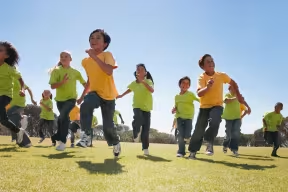
According to the latest estimates, on average, UK adolescents are active on only four days a week. Image credit: Martin Barraud, Getty Images.

The findings reveal that the UK is above the global average (14%), behind Finland (28%) and Canada (25%), level with Sweden and Norway (17%), and ahead of Germany (13%), France (11%) and Italy (9%).
On average, UK adolescents are active on only 4 days a week. Just under 40% of UK adolescents report three or fewer active days.*
The study also revealed stark differences between genders: 21% of UK boys are active for 60 minutes every day, compared with 13% of girls.
Activity levels also declined with age. On average, 11-year-olds reported 4.6 active days per week while 17-year-olds reported 3.6.
Professor Seth Flaxman (School of Geography and the Environment, University of Oxford/ RPTU University Kaiserslautern-Landau), a computer scientist who led the statistical modelling, said: 'Globally and in the UK, too many teens are not active enough. One in four teens worldwide are not active for even one hour on any day of the week. We know this affects their physical and mental health today and for the rest of their lives. We have the power to change this as a society. We can empower teens to be active every day and create inclusive policies to reach that 25% of teens who are not active on any day.'
Physical inactivity is a major risk factor for heart disease, type 2 diabetes and some cancers. Helping young people develop active habits early in life is critical to protecting their health and reducing the global burden of these diseases.
The study was based on 389 population-based surveys from 140 countries and territories, involving 3.2 million adolescents.
In almost every country and region in the study, girls were less active than boys. Globally, 28% of girls reported no active days, compared with 22% of boys. Only 11% of girls reported being active every day, compared with 17% of boys.

“In the UK, initiatives like ‘This Girl Can’ in England and ‘Fit for Girls’ in Scotland have tried to close the persistent gap between boys and girls in physical activity. We need to redouble our efforts, and extend them throughout society.”
There were also stark differences between countries. In some, less than 4% of adolescents reported no active days. In others, the figure exceeded 40%.
The findings point to a lack of global progress over the past 15 years, with levels of physical activity among adolescents virtually unchanged during this time.
According to the WHO, the challenge is not simply to persuade adolescents to move more. It is to create environments that make being active a normal and easy part of growing up. They are now calling for stronger action across the education, transport, urban planning, sport and health sectors, alongside efforts to address the multiple barriers faced by girls.
Lead author Dr Tessa Strain (University of Edinburgh) commented: 'We need to make being active the easy and enjoyable choice. Adolescents need safe routes to walk, cycle, wheel or scoot to school. They need green spaces to explore. They need opportunities to be active throughout the school day, not just in PE.'
* The study defined an “active day” as a day involving at least 60 minutes of moderate-to-vigorous physical activity, the kind that gets you out of breath. Teenagers were asked to report how many of the past seven days they had been active in this way for a total of 60 minutes.
The study 'National, regional, and global trends in adolescent physical activity from 2010 to 2025: a pooled analysis of 389 surveys with 3.2 million participants from 140 countries' has been published in The Lancet Global Health.
For more information about this story or republishing this content, please contact [email protected]


