
Nearly half of young children in developing countries are undernourished, multidimensionally poor, or both
New research from the Oxford Poverty and Human Development Initiative (OPHI) finds that 252 million of the 518 million children under five across 97 developing countries are undernourished, multidimensionally poor, or both. It is the first global analysis to look at both individual children’s circumstances and the multidimensional poverty of the households they live in.
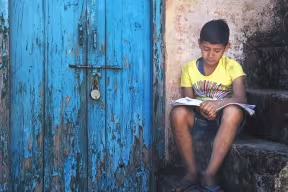

The report also finds that over a third of poor children live in households where some children are undernourished while others are not, and some attend school while others miss out.
The study draws on the Global Multidimensional Poverty Index (Global MPI), produced by OPHI and the United Nations Development Programme, and covers 97 countries for undernutrition and 108 for school attendance. It also looks at whether children are multidimensionally poor: that is, whether their household is deprived in at least a third of the Global MPI’s 10 weighted indicators of health, education and living standards, such as nutrition, schooling, clean water and electricity.
“We were shocked by how tightly clustered the intensity of poverty is for children. The 96 million children under five who are both undernourished and multidimensionally poor experience, on average, four to five deprivations in addition to undernutrition. Similarly, the 110 million children who are both multidimensionally poor and out of school experience, on average, five additional deprivations across the other nine Global MPI indicators. The data reaffirms the need for multisectoral approaches to development programmes such as social protection.”
Inequality within the home
Over one-third of poor children under five live in a household in which at least one child is undernourished and another is not. Similarly, over one-third of poor children live in households where some school-aged children are going to school and others are not. The researchers say this points to a need for programmes that recognise that children in the same household can experience poverty differently.
Women’s education and gender gaps
- Over two-thirds of poor children, whether well-nourished or not, live in a household where no woman has completed six years of schooling. Just over half live in a household where no man has. The gap is wider still among poor children who are out of school: around 82% live in a household where no woman has completed six years of schooling, compared with 62% where no man has.
- While more boys are undernourished than girls, and globally more girls are out of school than boys, the gender gap in school attendance varies widely across countries. The largest gap is in Afghanistan, where 67% of girls are out of school, compared with 47% of boys.
First-generation learners
- Across 108 countries, 71 million children aged 10–17 are ‘pioneer children’: the only ones in their household to complete six years of schooling. Half live in South Asia (35 million), where one in nine children aged 10–17 is a pioneer child. India alone accounts for 28 million.
- In India, Bhutan and Bangladesh, girls aged 10–17 are more likely than boys of the same age to be pioneers. Only in Afghanistan are boys more likely than girls to be pioneers (7% of boys compared with 4% of girls).
Professor Alkire added: ‘This is the first study that demonstrates at scale the possibility and importance of using existing individual data alongside household data to inform evidence-based programmes that meaningfully address cycles of poverty seeded by undernourished and out-of-school children. We must work together at the local level in the fields of measurement and policy to address these systemic deprivations that threaten to trap generations of children in poverty.’
The report, ‘Multidimensional Poverty and Individual Child Disadvantages in Nutrition and School Attendance: Gendered and Intrahousehold Patterns’, is available on the OPHI website.
For more information about this story or republishing this content, please contact [email protected]


