
Study finds that long-distance flights can throw seabirds' internal clocks out of sync, causing navigation errors
A study led by Oxford University has found that seabirds flying long distances across the Atlantic can experience a mismatch between their internal body clocks and local time (the same process which leads to jet lag in humans), causing them to make predictable errors when navigating by the sun. The results have been published in the journal Science.
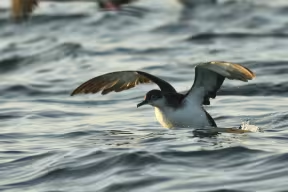
A Manx shearwater flying around Skomer Island, Pembrokeshire, Wales. Credit: Dr Joe Wynn.

Many animals, including birds, use the sun to find their way. But because the sun moves across the sky throughout the day, they need an accurate internal clock to interpret its position correctly.
Normally, birds reset their internal clocks using sunrise as a cue. However, when they travel rapidly east or west during the day, their internal clocks may temporarily become out of sync with local solar time. This could cause them to misjudge the sun's position and fly slightly off course.
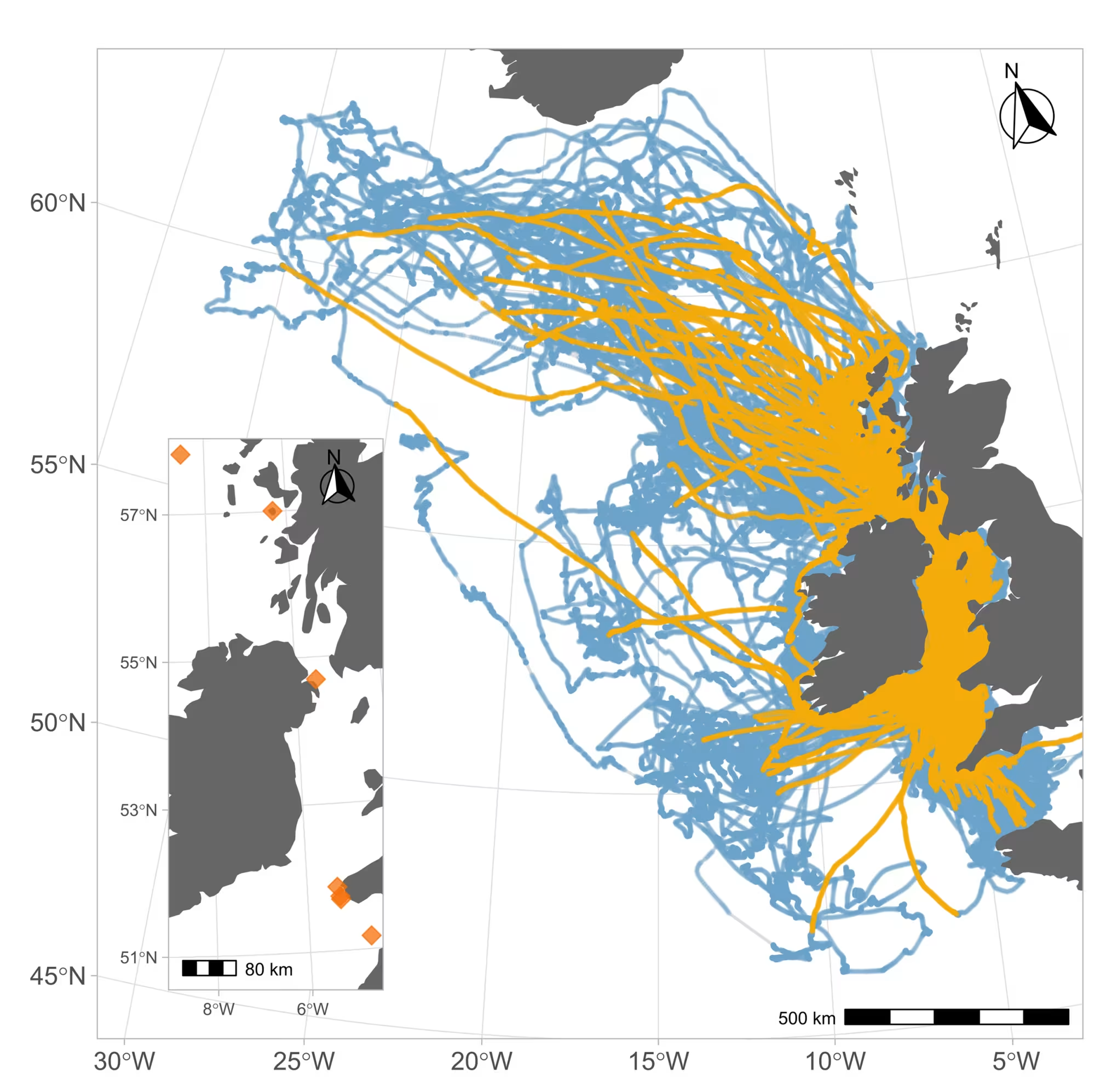
To investigate whether this happens in the wild, researchers led by Oxford University's Department of Biology analysed 20 years of GPS tracking data from 1,045 Manx shearwaters, covering 3,688 foraging trips.
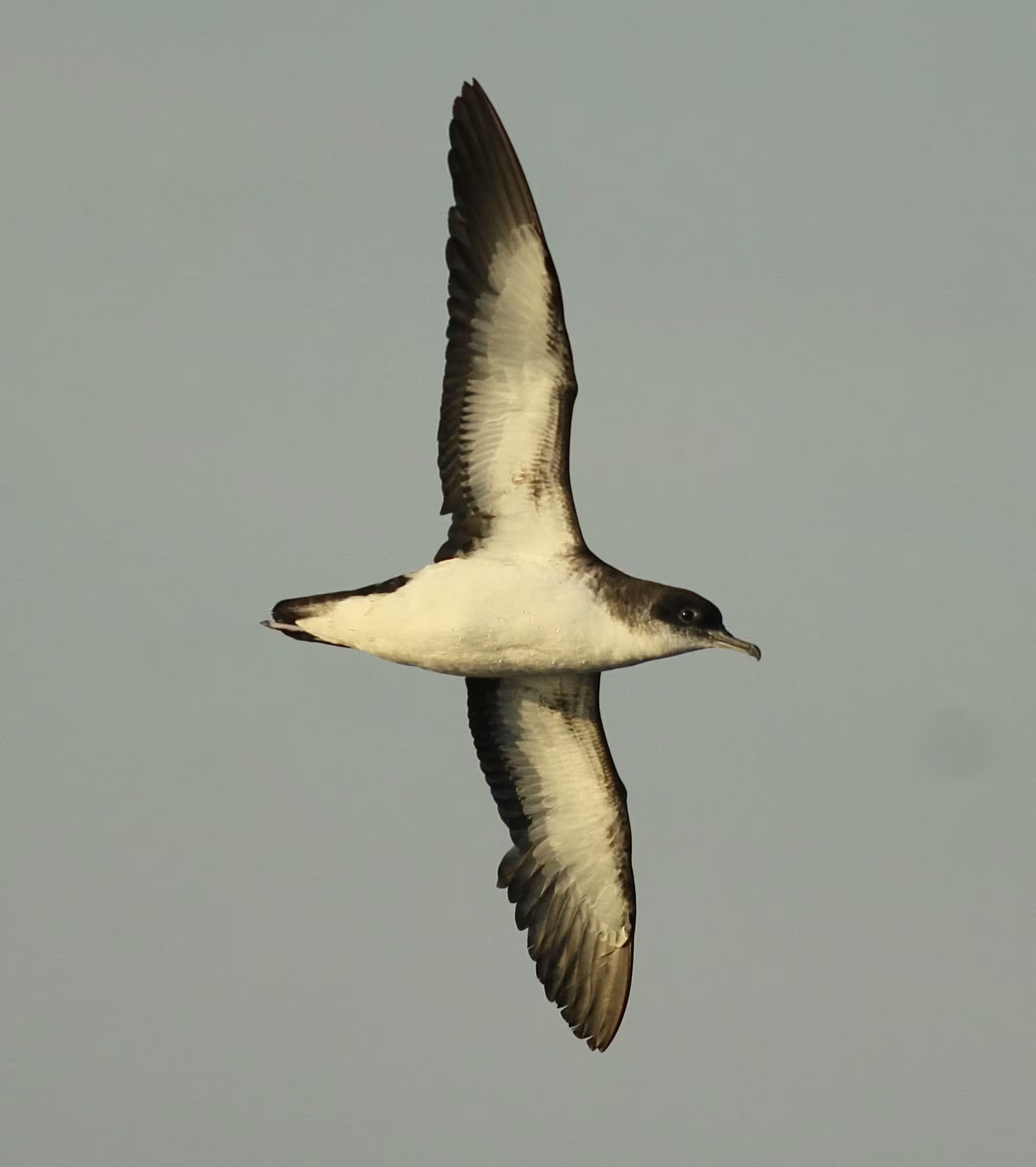
Manx shearwaters (Puffinus puffinus) breed on islands off the western coasts of the UK and Ireland. They regularly travel hundreds of kilometres out to sea in search of food, sometimes reaching feeding grounds around 1,000 km west of their breeding colonies.
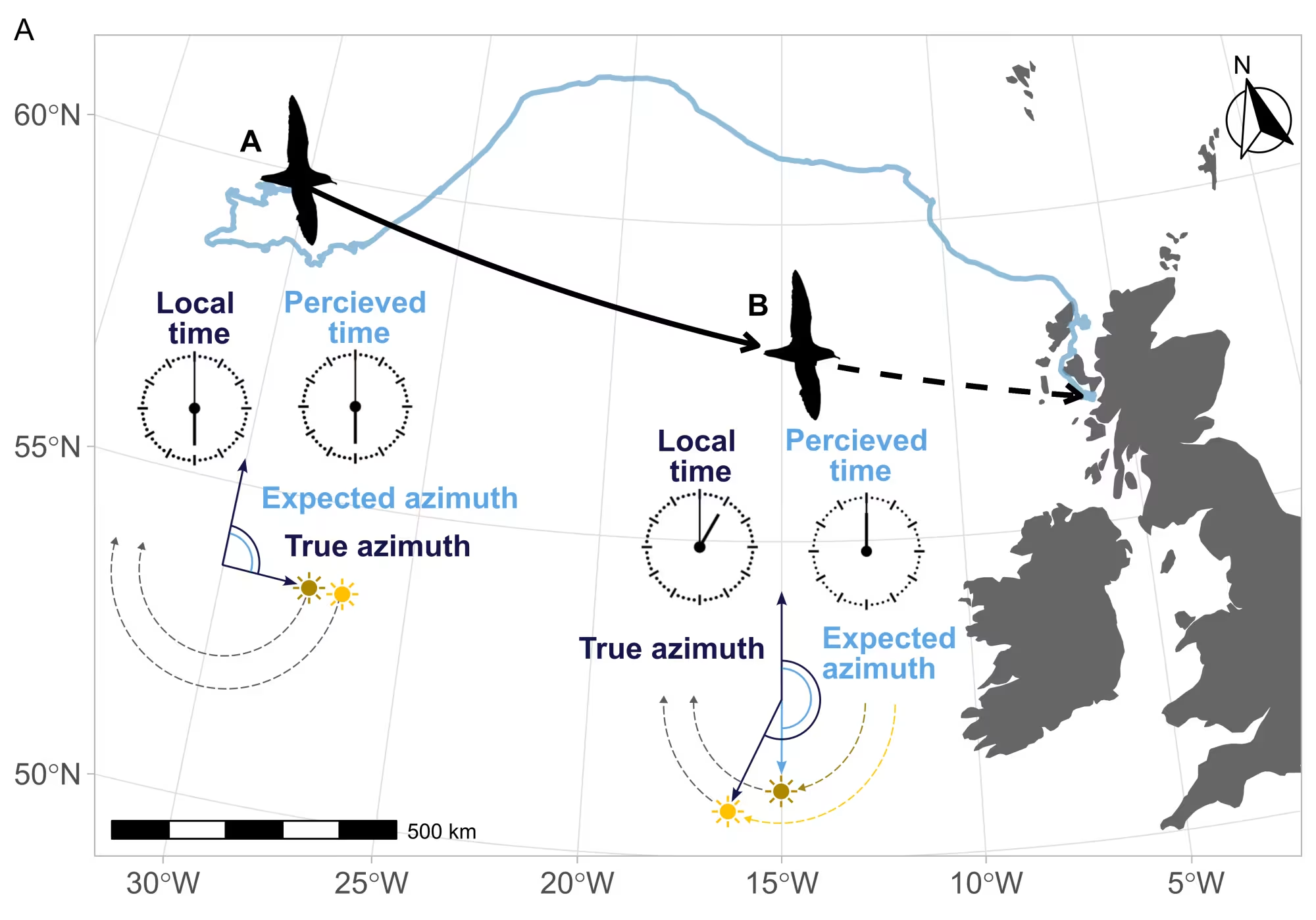
When returning to their nests, the birds can travel rapidly eastwards across lines of longitude, moving into places where the sun rose earlier (just as we do when we fly into earlier time zones). As a result, their internal clocks may lag behind local solar time by up to around one hour.
The researchers found that the birds' flight directions showed systematic deviations consistent with the predicted effects of these time shifts on their sun compass. As the birds travelled eastwards, they tended to deviate clockwise from their expected direction, as would be predicted if their internal clocks were running behind local time.

“It’s amazing to think that billions of migratory animals look up to the sun for direction, relying on clocks silently ticking away inside them, and that errors in those clocks can cause them to take tiny shifts off course.”
The team used statistical models to compare the observed deviations with those predicted from the birds' movements and the changing position of the sun. The results supported the sun-compass explanation, which also fitted the data better than an alternative explanation based on changes in the Earth's magnetic field.
Remarkably, the researchers found that these navigational errors persisted even when the birds were flying along visible coastlines, where landmarks could help guide them. When the predicted compass error pointed towards land, the shearwaters tended to fly closer to the coast. When it pointed away from land, they tended to fly further out to sea.
This suggests that the birds continued to rely on their sun compass even when other navigational cues were available, rather than simply following the coastline.
The navigational errors were relatively small, reaching approximately 15° in the shearwaters studied. Because these birds appear able to reassess their position and adjust their route home continuously, the additional distance travelled is likely to be modest.
For example, the researchers calculated that a shearwater returning from 1,000 km away, with an average compass error of 7° and continuously correcting its course, would travel only around 5 km further to reach within 5 km of its colony.
However, the findings could have wider implications for animals that travel long distances without being able to correct their position continuously. For example, in birds undertaking their first migration, small compass errors could potentially accumulate, shifting their eventual destination by hundreds of kilometres.

“It’s inherently difficult to study the cognitive processes of animals in the wild, so it’s exciting to realise that if we measure their natural movements carefully enough we can reveal the underlying behavioural mechanisms.”
Because internal clocks regulate many aspects of animal behaviour and physiology, the researchers suggest that similar time shifts could potentially have effects beyond navigation. In humans, travelling rapidly across time zones can cause jet lag, which involves a mismatch between the body's internal clock and local time and can lead to disturbed sleep, fatigue and other symptoms. Further research is needed to establish whether similar effects can occur in wild migrating birds and whether this has consequences for their health, behaviour or survival.
Lead researcher Dr Patrick Lewin said: ‘Our results show that animals experience the same internal clock mismatch as we do during jet lag. The next step is to understand how that affects them. Do they mistime critical behaviours? Do they experience physiological side effects like we do? And is this mismatch as damaging to their health as jet lag is to ours? Perhaps these birds that routinely travel long distances could help teach us how to cope with and treat jet lag to avoid the really negative effects it can have on our health.’
The study ‘Rapid longitudinal flights cause time-shifts and sun compass error’ has been published in Science.
For more information about this story or republishing this content, please contact [email protected]
Media coverage
- The Guardian: Why jet lag throws even foraging seabirds off course
- New Scientist: Birds can get jet lag on long, fast flights and then fly off course
- BBC Wildlife: Seabirds can suffer jet lag that throws them off course, say experts
- Washington Post: Seabirds get jet lag, and it can throw them off course, study shows
- NPR: Even birds get jet lagged, study shows


