
New study reveals metal alloys that unexpectedly resist extreme cold, staying tough at -253°C
An international team led by the University of Oxford, University of California, Berkeley, and Lawrence Berkeley National Laboratory has uncovered a novel microscopic mechanism that allows two metal alloys to remain remarkably damage-tolerant at just 20 kelvin, or -253°C. The findings, published today in Nature, point to new principles for designing materials for cryogenic environments.
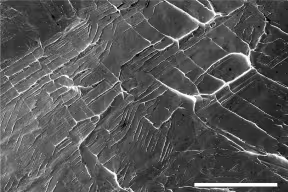
Electron microscopy image showing new defects forming between neighbouring crystals of the niobium-titanium-based alloys. Image credit: Cook et al. 2026

Most metals become stronger when they are cooled, but some pay a price. The class of metals called body-centred cubic metals (such as iron, tungsten and chromium) have a particular atomic structure which can make them increasingly brittle as temperatures fall. At extremely low temperatures, a crack that might normally be absorbed by the metal bending or deforming can instead cause it to fracture.
The new study discovered that two experimental niobium-titanium-based alloys can avoid this problem even at just 20 kelvin, or -253°C. The metals remained remarkably resistant to cracking, with no measurable transition to brittle behaviour at the lowest temperature tested. The researchers found that this is due to the alloys effectively switching how they deform as they enter the deep freeze.
Normally, bending and deformation of body-centred cubic metals relies heavily on the movement of line-like defects in their crystal structure known as dislocations. At low temperatures, these become increasingly difficult to move, restricting the material's ability to deform around a crack and making a fracture more likely.
In the alloys studied, however, a different process takes over. The researchers observed nanoscale ‘twinning’, in which small regions of the crystal reorganise into mirror-image orientations, coupled with a local transformation of the crystal structure. When these newly formed structures reach the boundaries between neighbouring crystals, they create concentrated points of stress that trigger new defects in the metal. These defects then allow the material to keep deforming rather than cracking.
The process is a little like a road network responding to frozen, blocked roads by opening new routes. As the conventional routes for deformation become increasingly difficult to use, the formation of twins creates new sites from which the defects needed for deformation can emerge. This helps the metal to absorb the forces building up around a crack, rather than breaking.
The discovery could provide scientists with a new strategy for designing metals capable of operating in exceptionally cold environments, including for energy, transport and aerospace sectors.

“What surprised us is that these alloys remain remarkably damage tolerant even at 20 kelvin. By uncovering how twinning and phase transformation work together to generate plasticity before conventional dislocation motion, we identified a new pathway for designing structural body-centred cubic metals that can operate in extreme cryogenic environments. This class of materials will be extremely useful for components experiencing extreme hot and cold temperatures in one application.”
Lead author Dr David Cook (University of California, Berkeley at the time of the study, now University of Cambridge) said: "Our results suggest we should change how we think about what governs the transition to brittleness for these metals. Traditionally, the focus was on how readily existing dislocations can move through a metal but now it appears that the ability to create new dislocations at interfaces may also be critical. Using these insights, we may be able to design underlying microstructural conditions that allow a material to create its own routes to remain ductile at extreme temperatures.”
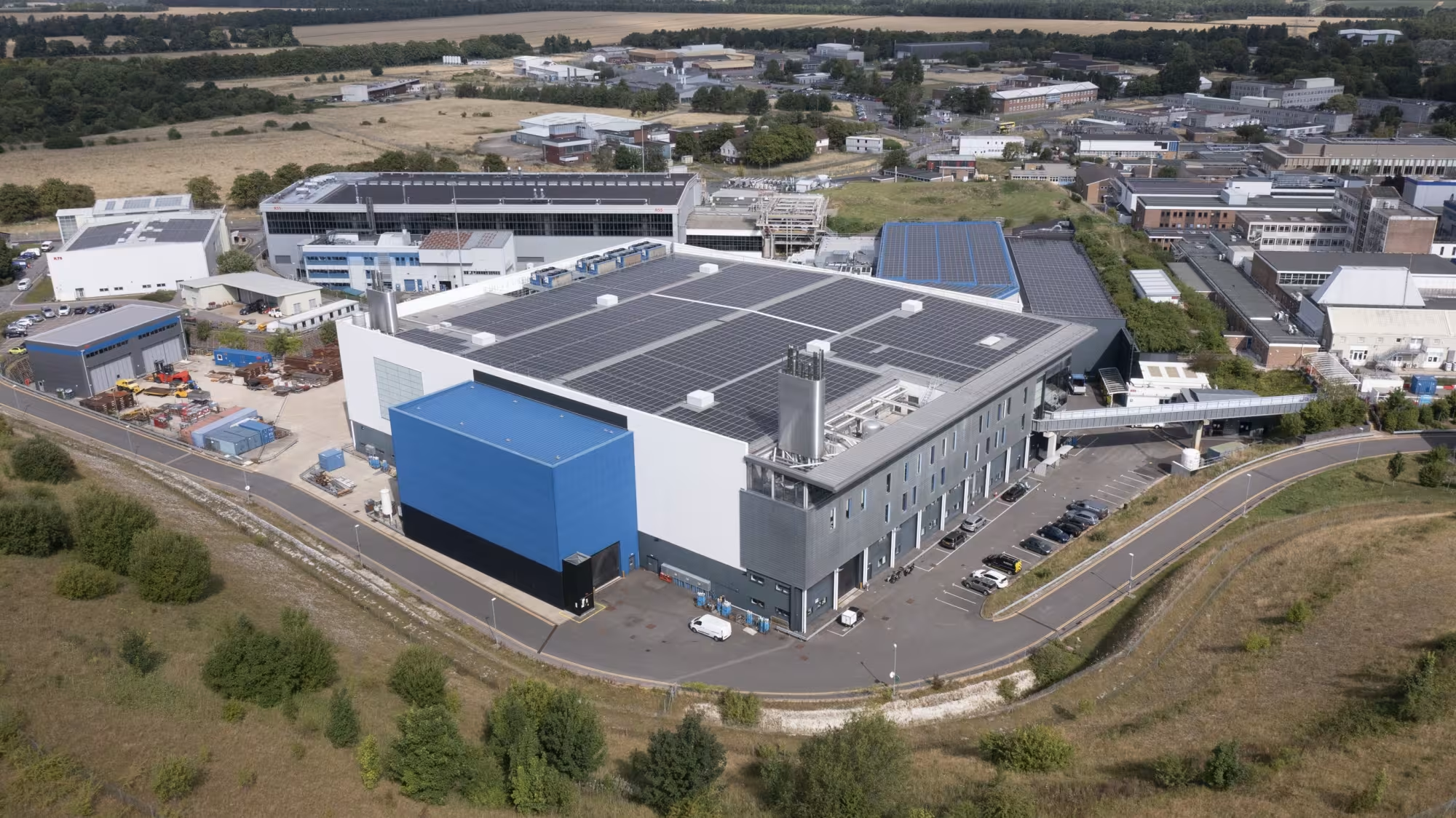
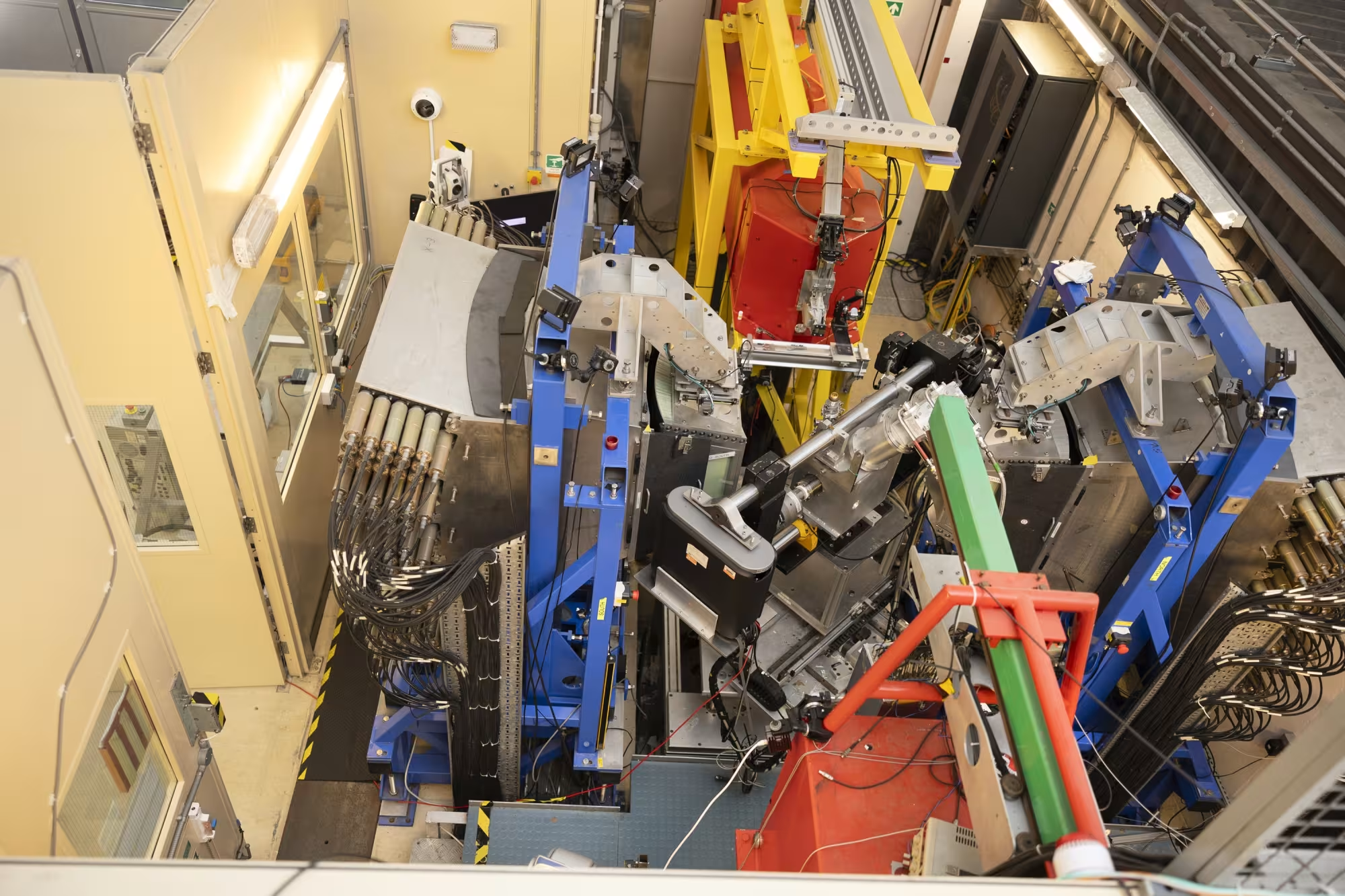
To find out how the alloys behaved in such extreme cold, the researchers used the Engin-X instrument at the ISIS Neutron and Muon Source in Oxfordshire. They cooled samples to around -253°C using gaseous helium. They then exposed the samples to a beam of neutrons while a testing machine pulled them from either end, precisely measuring how much force they could withstand and how far they stretched before breaking.
The team then used powerful electron microscopes to examine the tested metal at extremely small scales, allowing them to see the tiny structural changes that had taken place around cracks and inside the material. They also used atom-probe analysis to map the distribution of individual elements, alongside computer modelling to understand how the different mechanisms worked together to prevent brittle failure.
The paper ‘Competing mechanisms toughen bcc binary and medium-entropy alloys at 20 K’ has been published in Nature.
The study involved researchers from the University of California, Berkeley; Lawrence Berkeley National Laboratory; the University of Oxford; the University of Bristol; the ISIS Neutron and Muon Source, Science and Technology Facilities Council; the University of California, Irvine; Pacific Northwest National Laboratory; Texas A&M University; and Nanyang Technological University in Singapore.
For more information about this story or republishing this content, please contact [email protected]


