
Oxford physicists help uncover ‘spooky’ quantum effect in the Large Hadron Collider
Physicists at the University of Oxford have helped confirm that one of the strangest phenomena in physics - quantum entanglement - occurs even among some of the heaviest and most fleeting particles ever created. The discovery, made using the world’s most powerful particle collider at CERN, has been published today in Physical Review Letters.

Quantum entanglement is the phenomenon in which two particles from the same origin remain connected, even if they move far apart in time and space. Image credit: koto_feja, Getty Images.

Entanglement is the phenomenon in which two particles from the same origin remain connected, even if they move far apart in time and space. If something affects one particle, it will also affect all the particles with which it is entangled. This means that measuring a property of one particle instantly tells you something about its entangled partner/s, no matter how distant they are.
Albert Einstein famously called entanglement ‘spooky action at a distance,’ and the phenomenon has been demonstrated in a range of systems, including photons, electrons and trapped ions. Today, entanglement is no longer just a curiosity: it underpins emerging technologies such as quantum computers, ultra-secure quantum communication networks and next-generation sensors. For instance, in quantum computing, entanglement is used to manipulate multiple qubits in a single operation, rather than individually. This allows multiple calculations to be performed simultaneously.
However, it was unknown whether quantum entanglement remains intact under more extreme conditions – such as the short-lived particles produced during highly energetic collisions. To test this, an international collaboration used the ATLAS experiment at CERN’s Large Hadron Collider (LHC) near Geneva, Switzerland. The team looked for entanglement in an entirely new setting: pairs of Z bosons that exist for only a fraction of a second before decaying.

“Quantum mechanics underpins computing and security, besides many areas of physics. However, quantum mechanics has mysteries and puzzles that have not yet been fully understood. Using particle colliders allows us to test quantum mechanics at a trillion times higher energies and over distances smaller than the size of the nucleus. This probes some of the extreme conditions where quantum mechanics might break down, which would have profound consequences for the foundations of science.”
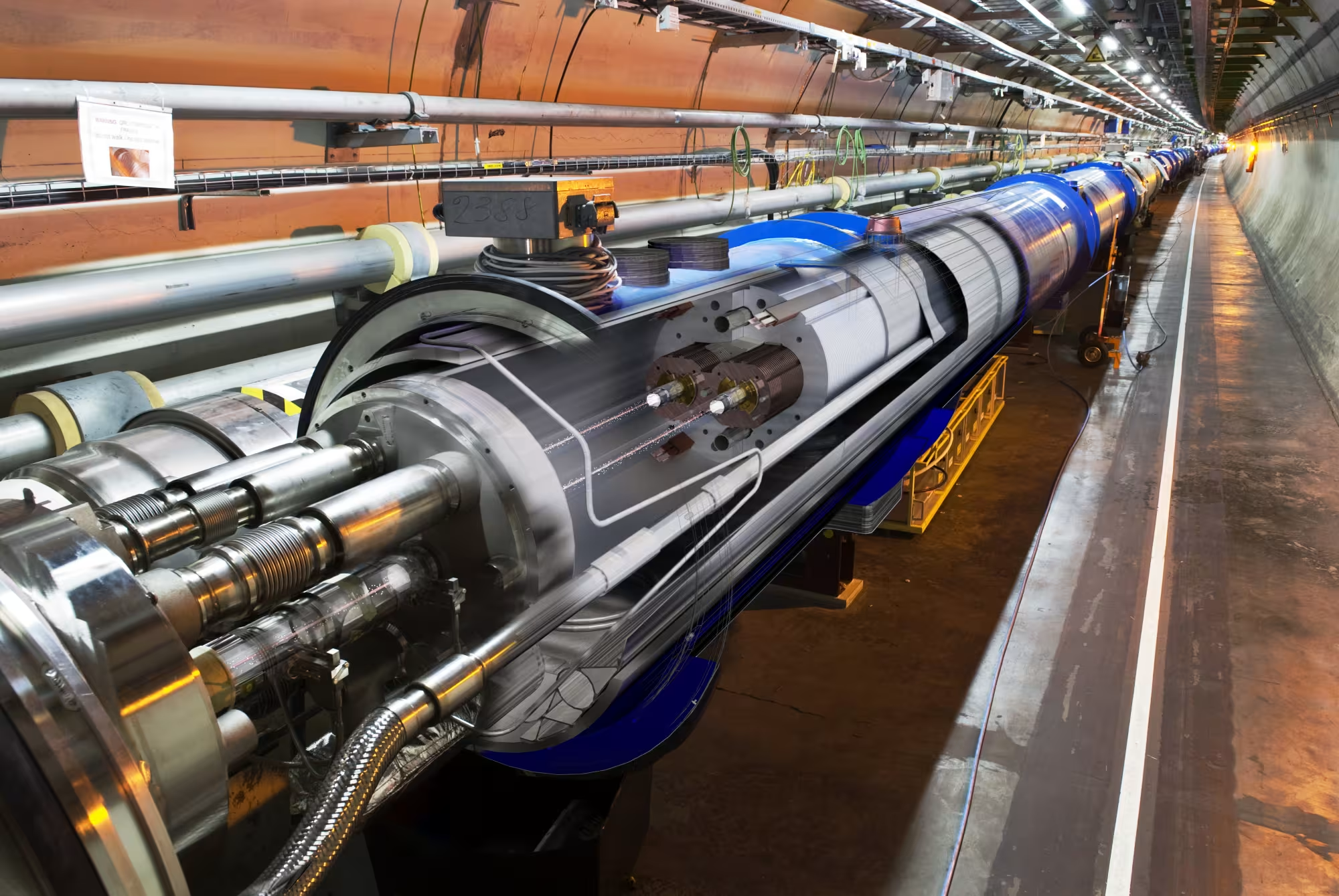
The Z bosons studied were produced in the decay of a Higgs boson - the particle discovered at the LHC in 2012 - which briefly splits into two Z bosons before each one decays further into pairs of electrons or muons. The Higgs bosons are generated by smashing together protons travelling at 99.99% the speed of light: collisions that have energies of thirteen trillion electron volts.
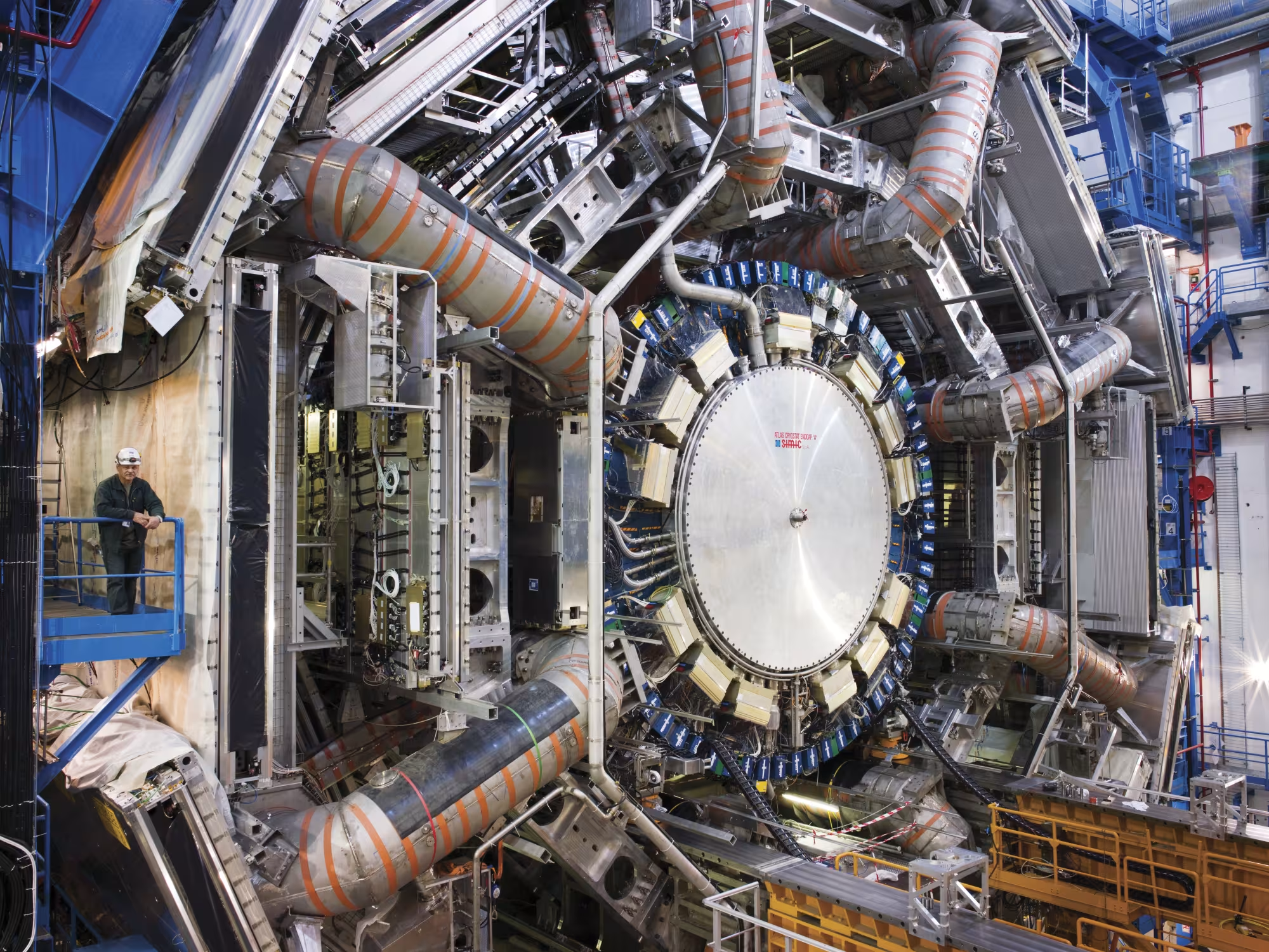
Although the Z bosons vanish almost instantly, the ATLAS detector can precisely track the electrons and muons they leave behind. By reconstructing the angles at which these particles were emitted, the researchers could infer the spins of the original Z bosons and test whether they were linked by quantum entanglement. The results showed strong evidence that they were. This makes it one of the highest-energy confirmations of quantum entanglement ever recorded.
Study co-author Professor Alan Barr, at Oxford’s Department of Physics, was one of the first to propose that particle colliders could be used to investigate quantum entanglement at vastly higher energy levels than all previous tests. Having been involved in the construction of the LHC, he realised that the colossal apparatus could be used for more than discovering new particles. His ideas informed a 2023 experiment, also using the ATLAS detector, which demonstrated entanglement between pairs of top quarks, the heaviest known elementary particle.
Professor Barr said: ‘We’re used to thinking of entanglement as something delicate, seen in laboratory experiments with single photons. Finding it alive and well among particles as heavy and short-lived as Z bosons, created in some of the most violent collisions we can produce on Earth, shows just how fundamental and robust this quantum effect really is. It’s a nice reminder that the same strange rules of quantum mechanics that may one day power quantum computers are at work everywhere in nature, even at the extreme energies of the Large Hadron Collider.’
“It has been gratifying to see that the use of particle colliders to test quantum effects has now become a major sub-field in physics, with more than a hundred researchers working on it worldwide.”
Beyond its fundamental significance, the research adds to a growing effort by physicists to borrow tools and ideas from quantum information science (the field behind quantum computing) and apply them to particle physics. This cross-pollination is helping scientists develop new, more sensitive ways of analysing collider data, with the potential to reveal subtle effects that might point to physics beyond our current understanding of the universe.
At Oxford University, Professor Barr co-leads a major interdisciplinary project exploring the foundations of quantum mechanics at high energies. Besides empirically testing quantum effects at the smallest possible scales and highest energies, the project is also investigating the philosophical implications of these measurements and what they may tell us about the fundamental nature of reality.
Project co-Principal Investigator Professor Chris Timpson (Faculty of Philosophy) said: ‘Entanglement is both the most promising and the most puzzling aspect of quantum reality; these collider experiments detecting entanglement present a new frontier in investigations of the foundations of quantum mechanics.’
Oxford University researchers are also involved in the upgrade currently taking place on the ATLAS detector. Combined with the upgraded High-Luminosity Large Hadron Collider, this will allow researchers to undertake even more profound explorations of quantum phenomena and apply novel quantum information techniques to exploit the huge data sets that this machine will deliver.
Professor Daniela Bortoletto (Department of Physics, University of Oxford), who is the UK coordinator for producing the modules for the upgraded ATLAS detector’s pixel system, said: ‘This measurement demonstrates the scientific power of the ATLAS collaboration and the unique capabilities of CERN's Large Hadron Collider. Oxford researchers have played a leading role in developing these new approaches to studying quantum phenomena at the highest energies, and we are proud to contribute to an international effort that is opening new ways to explore the fundamental laws of nature.’
The study ‘Measurements of Z-boson pair entanglement in decays of Higgs bosons at the ATLAS experiment’ has been published in Physical Review Letters.
For more information about this story or republishing this content, please contact [email protected]


