
Expert Comment: In Brazil’s elections, who controls the budget and who benefits?
Dr Amanda Domingos, Postdoctoral Researcher and Policy Associate with the Lemann Foundation Programme for the Public Sector at the Blavatnik School of Government, explains why Brazil’s congressional elections matter more than ever as Congress gains control over how federal money is spent, and why areas with large Indigenous and quilombola populations are not receiving more of it.

On 4 October, 158.7 million Brazilians are eligible to vote in the first round of elections to determine the country’s leadership for the next four years. The spotlight is mainly on President Luiz Inácio Lula da Silva being re-elected to a fourth term. That race remains on a knife-edge between Lula and Flávio Bolsonaro, likely heading to a run-off on 25 October. Yet, the presidency is only one part of what is at stake - voters will also elect governors, state legislators, all 513 Federal Deputies and two-thirds of the Senate. And this year, who wins those seats in Congress matters more than ever.
Despite having a presidential system, Brazil's legislative elections have never been this consequential; in the last decade, Congress has gained increasing influence over the allocation of federal resources, particularly through budget ‘amendments’ which allow legislators to direct public funds towards particular projects, such as medical equipment, or funding infrastructure in a particular municipality. As an increasing share of the budget is allocated this way, the executive’s control over how and where public money is spent has weakened. To complicate matters, many amendments no longer require presidential approval to be implemented – a tool historically used by Brazilian presidents to steer Congress towards their own priorities.
Who is Congress going to steer these resources towards?
The question is particularly relevant for geographically concentrated minorities. These groups should, in theory, be an easy target for lawmakers: send the money, benefit those populations, and get their votes in the next election. But this is not what is happening.
The Brazilian context
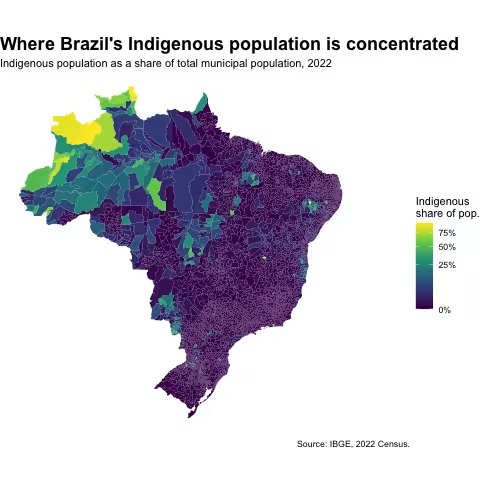
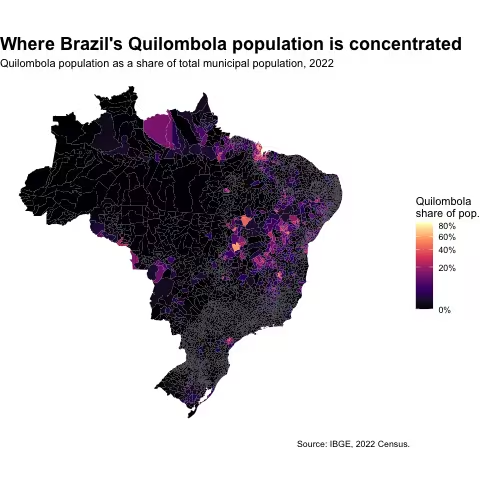
Brazil is a country shaped by centuries of slavery and 19th-century European immigration, alongside significant Indigenous populations. The 2022 census shows that most people self-identify as White or Mixed, with 10.2% identifying as Black, 0.6% as Indigenous, 0.6% as quilombola and 0.4% as Asian. Indigenous peoples are protected by specific laws, which provide for the demarcation of parts of the national territory designated for their possession and use. Quilombola populations are communities mostly formed by descendants of enslaved people who share a common environment and preserve their culture, language, and religion, and whose right to the land is guaranteed by law.
Figures 1 and 2 illustrate the distribution of the Indigenous and quilombola populations across Brazil, respectively.
Who benefits from Congress’s spending power?
Each of the 594 legislators can allocate 25 amendments a year, directing public money to particular communities. In theory, areas with concentrated ethnic minority populations could therefore attract more funding as politicians seek their votes. But our analysis of ten years of data – as part of a wider project in collaboration with João Pedro Caleiro and Anna Petherick looking at how political decisions around the allocation of public resources affect the coordination of public services across the territory - finds no significant evidence that areas with larger minority populations receive more funding.
Areas with no Indigenous or quilombola populations have the highest level of funding. For the quilombola population, the pattern is particularly striking: in areas with no quilombola population (71.7% of municipalities), the median annual value of budget amendments is R$52.4 per capita. This falls to R$30.4 where less than 1% of the population identifies as quilombola (13.6%) and to R$9.67 in areas with the highest quilombola concentrations (1.5%). For Indigenous populations, areas where 1 to 5% of the population identifies as Indigenous (5.7% of municipalities) have particularly low levels of funding, although values rise again at higher levels of concentration.
Nevertheless, areas with the highest Indigenous concentrations (1.5% of municipalities) still have lower levels of funding than those with no Indigenous population (39.6%): R$45.9 versus R$62.5 per capita, respectively.

“Despite having a presidential system, Brazil's legislative elections have never been this consequential; in the last decade, Congress has gained increasing influence over the allocation of federal resources, particularly through budget ‘amendments’ which allow legislators to direct public funds towards particular projects, such as medical equipment, or funding infrastructure in a particular municipality.”
Two factors might help explain this. First, Brazil’s electoral system creates large electoral districts. Voters across an entire state can vote for the same candidates, so politicians’ electoral incentives are not necessarily tied to a particular town or community. Second, minority political representation differs between Indigenous and quilombola populations. Despite Brazil having, for the first time, a Ministry of Indigenous Peoples, only seven Members of Congress (including two Senators) self-identify as Indigenous.
In contrast, no federal legislators self-identify as quilombola, despite this group making up around 0.65% of the population.
So political representation does not necessarily translate into more public funding. Areas with larger Indigenous populations don't consistently receive more money despite having some Indigenous representation in Congress. But quilombola communities have no federal representatives at all, and areas where they are concentrated tend to receive less funding, suggesting that having no political voice may still matter.
For voters, the implication is clear: we should focus not only on the presidential contest. As Congress increasingly controls federal resources for public policy, there is even more reason to pay attention to who sits in its chambers and the decisions they make about public money. So, while October’s headlines might be dominated by who wins the presidency, who wins a seat in the Congress will also matter for how fairly public funds are distributed across Brazil over the next four years.
For more information about this story or republishing this content, please contact [email protected]


