
Expert Comment: More extreme weather is coming – can AI help us to better prepare for it?
How can we better predict ‘extreme weather events’ in a world where these are no longer so exceptional? Dr Shruti Nath, from Oxford University’s Department of Physics, argues that AI-powered forecasting could be an invaluable tool if experts can co-develop methods to address their limitations.
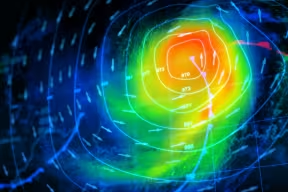
AI forecasting systems could offer faster, cheaper and more locally tailored weather forecasts - but these currently have significant limitations that must be overcome first. Image credit: Petrovich9, Getty Images.

As of August 2026, the world is bracing for what forecasters describe as one of the strongest El Niño events on record. The US National Oceanic and Atmospheric Administration (NOAA)’s Climate Prediction Center has put the chance of a very strong event this fall and winter above 90%, with a 69% likelihood that it will exceed every El Niño since 1950.
This isn’t just a ‘curious weather phenomenon’, but a major global shift that we must start preparing for now. In Kenya, for instance, high-risk urban centres have already been flagged where poor drainage and strained infrastructure could turn heavy rainfall into a humanitarian emergency, while coastal counties face the added threat of storm surges and coastal erosion. Kenya's 1997 to 1998 El Niño remains one of the country's most devastating episodes, and subsequent events in 2006 to 2007, 2015 to 2016 and 2023 to 2024 each brought heavy rains, flooding and landslides that killed hundreds and caused extensive damage to infrastructure, agriculture and livelihoods.
This pattern of escalating rainfall extremes is not confined to East Africa, or to El Nino events. In September 2023, Storm Daniel brought catastrophic flooding to Derna, Libya, collapsing two dams and killing at least four thousand people in a single night. The following April, the United Arab Emirates recorded its heaviest rainfall in 75 years, bringing Dubai to a standstill. That same summer, the Arba'at Dam in eastern Sudan burst under floodwaters, destroying twenty villages and affecting fifty thousand people already suffering a brutal civil war.
With a historic El Niño now underway, the urgency of forecasting systems capable of anticipating such extremes before they strike has never been greater.
“With a historic El Niño now underway, the urgency of forecasting systems capable of anticipating such extremes before they strike has never been greater.”
Coincidentally, it is at this moment that Artificial Intelligence (AI) has emerged as a compelling solution, offering faster, cheaper and more locally tailored weather forecasts without significant infrastructure requirements.
Unlike traditional forecasting systems, which produce a forecast by integrating complex physical equations, AI models learn a direct statistical approximation that links current weather conditions to the future. Learning these approximations requires heavy-duty training on masses of historical weather data, however once complete, these models are much cheaper to run and well within the reach of ordinary computing hardware.
But when societies are under pressure, taking the easiest solution without fully understanding its limits can be more of a gamble than a rational choice. While machine-learning models like GraphCast can outperform traditional physics-based systems in speed and general accuracy, AI tools come with a critical caveat: the reliability of these systems has not been properly vetted for extremes, specifically under conditions of a changing climate.
This challenge is known as the ‘extrapolation problem’. While AI excels at identifying patterns in historical data, it can struggle to predict ‘unprecedented' events: the record-breaking heatwaves, floods and storms that fall outside its training set. Studies have also demonstrated that, compared with a leading physics-based model, AI systems tend to underestimate the intensity and frequency of record-breaking heat, cold and wind events. But as the past few years have demonstrated, due to the accelerating influence of climate change, these ‘out-of-sample' extremes are no longer statistical outliers; they are our new reality.
“While AI excels at identifying patterns in historical data, it can struggle to predict ‘unprecedented' events: the record-breaking heatwaves, floods and storms that fall outside its training set.”
The extrapolation problem is particularly acute in regions such as Africa that lack historical weather data to train AI models. Because today's AI weather models are trained overwhelmingly on analyses from observation-dense regions such as North America, Europe and East Asia, Africa is structurally under-represented in the data that shapes what these systems learn to expect. These are also, almost exactly, the regions facing the fastest-rising exposure to extreme weather. This means that the data gap is most dominant precisely where the highest vulnerability gap is.
This matters because for areas facing rising fatalities from climate extremes, an AI model that underestimates a one-in-a-thousand-year event due to a lack of historical data is not just a technical failure; it is a humanitarian risk.
Here in Oxford, we are addressing this through our partnership with AfriClimate AI, a grassroots African research initiative building Forecast4Africa: an AI-powered forecasting system designed to localise global AI weather prediction models for African regions. This work is not importing AI weather models wholesale, but benchmarking and calibrating them against African observations and operational needs.
This builds on Oxford's earlier work on SEWAA (Strengthening Early Warning Systems for Anticipatory Action) with the UN World Food Programme across Kenya, Ethiopia, Uganda and Rwanda. This showed how much value AI-based post-processing can add to rainfall prediction once it is properly evaluated against a region's own data and needs. Through joint workshops and knowledge exchange, we are working to ensure Africa isn't just a passive recipient of AI weather technology built elsewhere, but an active shaper of how it gets adapted for the extremes that matter most locally.
“For areas facing rising fatalities from climate extremes, an AI model that underestimates a one-in-a-thousand-year event due to a lack of historical data is not just a technical failure; it is a humanitarian risk.”
More generally, AI should act as an information broker rather than an autonomous pilot. For instance, AI forecasting tools should contain ‘flagging' mechanisms: automated triggers that alert human experts when a model encounters atmospheric conditions that deviate significantly from its training experience.
Another requirement is to establish rigorous, standardised evaluation protocols. This is imperative since the performance of AI weather forecasting models is very sensitive to how extreme events are defined, where they occur and which hazards are considered.
AI forecasting models are trained using a reconstructed record of historical weather patterns over the past 50 years, with data provided by weather stations, satellites, ships and aircraft. Our group at Oxford propose that this training dataset should withhold a designated set of globally representative ‘iconic’ extreme events and reserve these solely for testing. These could include, for instance, the Great Storm of 1987 in southern England, and Hurricane Sandy, which struck New York City in 2012.
The decision on inclusion would not be whether the event was forecast well or poorly, but whether it genuinely broke a record or was highly unusual. This could be in terms of the amount of rainfall, the highest temperature reached, wind speed or a uncommon storm trajectory.
Events such as the floods that devastated Derna, overwhelmed Dubai and burst the Arba'at Dam are becoming more likely under a changing climate. It is imperative that the tools being built today to anticipate extreme weather events are ready for a world where these are no longer exceptional. By embedding community-driven vetting of AI forecasting models and transparent processes for defining training data sets, we can move away from the ‘black box' model of AI. Ultimately, this will enable more resilient systems that help societies to act early and with confidence to safeguard lives.
For more information about this story or republishing this content, please contact [email protected]


