
Oxford to host new UK AI Research Lab
The University of Oxford has been selected to host a new, cross-university government-backed UK AI Research Lab. The new lab is part of a £60 million investment announced today by the UKRI's Engineering and Physical Sciences Research Council (EPSRC) to support two pioneering AI labs over the next six years.

The University of Oxford has been selected to host a new, cross-university government-backed UK AI Research Lab. Image credit: da-kuk, Getty Images

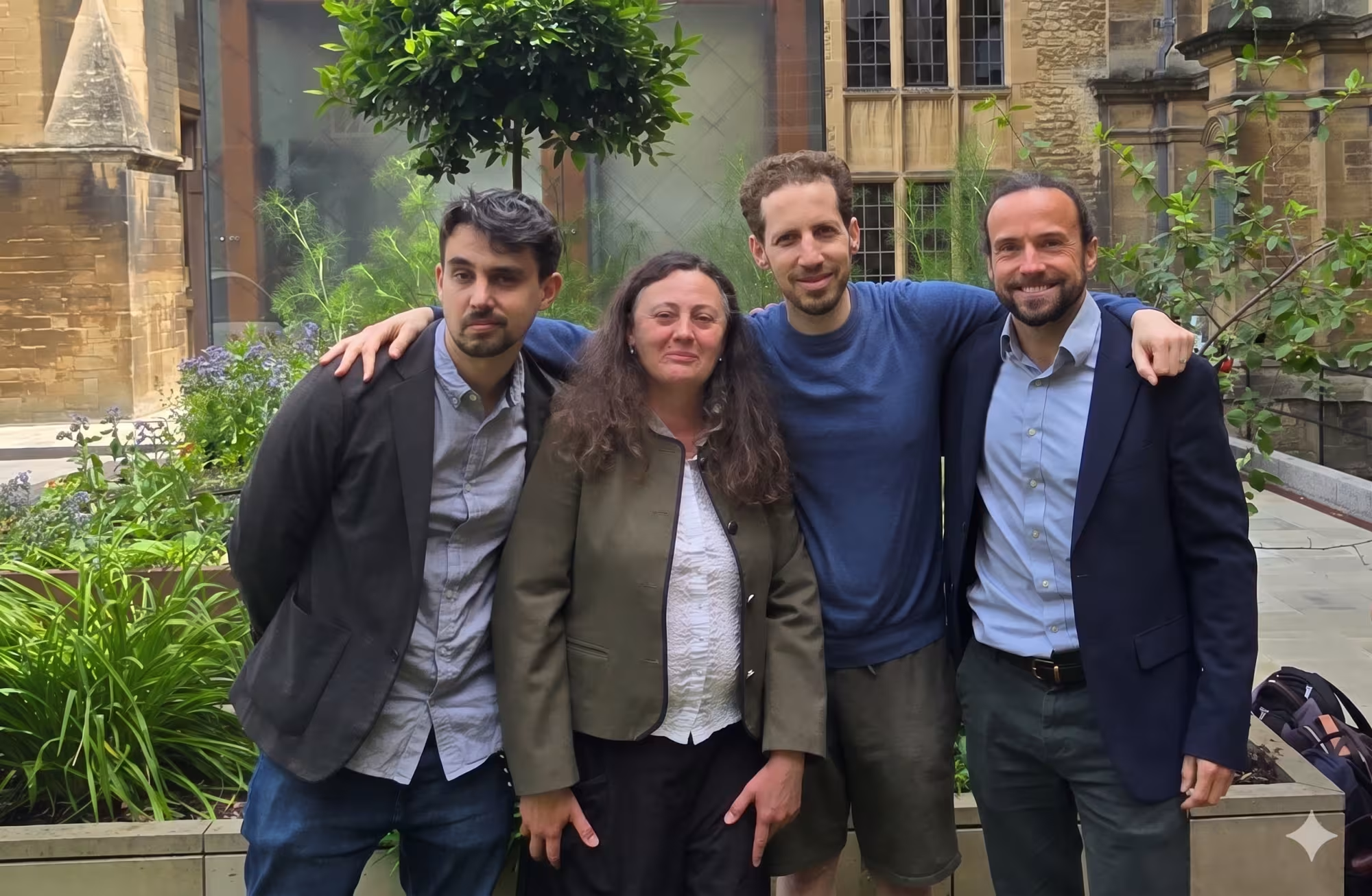
Led by Associate Professor Jakob Foerster at Oxford’s Department of Engineering Science, the British Open-ended Learning and Discovery Lab (BOLD) will develop open, human-centred, resource-efficient AI systems that can operate safely and effectively in the real world. This will ultimately help turn research into tools that can be used in workplaces, infrastructure and public services - supporting wider adoption across the economy.
Crucially, the lab will move beyond the standard recipe that has driven recent progress in AI: training ever-larger neural networks on increasingly vast datasets. Instead, BOLD aims to develop new, scalable AI technologies that will unlock socially vital applications, from education and transport, to healthcare and scientific discovery.
The award recognises the University of Oxford's world-leading, interdisciplinary strengths in AI research, spanning fundamental machine learning, AI safety, ethics and robotics. As host institution, Oxford will act as an integrator between academia, industry and the wider UK AI landscape. The lab will bring together researchers from Oxford, UCL and Imperial College London, alongside industry and technology partners.
Besides exploring new breakthroughs in AI, BOLD will also innovate on the mode of research itself. To maximise impact, the academic leads at each of the three universities will combine their individual labs to operate BOLD together as one focussed entity.
The lab will also benefit from Oxford's AI@Oxford initiative, which helps coordinate AI research, engagement and collaboration across the University, connecting expertise from multiple disciplines and fostering links with external partners.
Professor Antoine Cully (Imperial College London) said: 'BOLD is an extraordinary opportunity to bring together the best research talent across the UK, deliver impact at real scale, and strengthen the UK's position at the forefront of global AI research. I'm proud that Imperial is part of that journey.'
“The UK cannot win the global AI race simply by trying to outspend the largest technology companies on data and compute. BOLD is about a different route: discovering fundamentally new ways to build AI that are more efficient, more open and better aligned with human needs. By focusing on new paradigms for learning, rather than only scaling existing methods, we aim to help secure the UK’s sovereign capability in AI and ensure that academic research can shape the future of the field.”
The research programme will be built around three pillars.
- Beyond backpropagation will explore new ways to train AI that could require less computing power, memory and energy, while making systems more stable and adaptable.
- Human-centric learning and discovery will train AI systems to work with people, including as ‘co-scientists’ that can help research teams generate ideas, test hypotheses and accelerate discovery.
- Embodied learning will enable robots and other physical systems to learn and adapt under real-world constraints, with limited data and onboard computing power.
BOLD is looking to multiply the Government’s investment via industry partnerships and support. DPhil student Samson Donick, who played a leading role in canvasing industry support for BOLD, said: 'Given the scale of our ambitions, we intend to form a wide range of industry partnerships across the breadth of the AI sector. This will enable a high-risk, high-reward research model, where many early-stage ideas are rapidly tested and the most promising taken forward to be scaled up.'
By working with Oxford Science Enterprises and Oxford University Innovation, the team will facilitate translation of fundamental AI breakthroughs into real-world applications and spin-out enterprises.
Professor Tim Rocktäschel (UCL) said: ‘I am excited to see BOLD brought to life—an ambitious cross-university lab that equips academics with the resources and collaborative framework to reinvent the AI stack of the future.’
“AI has huge potential to grow our economy and improve public services – but right now it’s often too expensive, complex or out of reach for many organisations. These new labs are about changing that – making AI cheaper, more practical and easier to adopt so more businesses and public services across the UK can benefit. And by building this capability here at home, backed by our world leading universities, we’re strengthening our own expertise, reducing reliance on others and securing Britain’s place at the forefront of this technology – fittingly announced on what would have been Alan Turing’s 114th birthday.”
Open science will be central to the lab’s approach. BOLD will release open-source model training software, model weights, benchmarks, evaluation data and software, helping widen access to frontier AI research and accelerate progress across the wider community. Its researchers will also explore more decentralised approaches to AI development, so that individuals, universities and organisations can contribute to and shape AI systems that reflect their own needs, rather than relying only on models trained behind closed doors.
The project will also create a major training environment for the UK’s next generation of AI researchers, with £2 million dedicated for hiring doctoral students. In its first phase, BOLD plans to recruit an initial cohort of 12 BOLD fellows and 18 PhD students, while building a collaborative environment for doctoral students, interns and fellows across Oxford, UCL and Imperial.
Oxford’s role as host builds on its existing strengths across AI research, safety, ethics and translation. The University leads the Laboratory for AI Safety Research, hosts the Institute for Ethics in AI and the Erlangen mathematical foundations of intelligence hub, and has extensive expertise in applying AI across areas including wildlife monitoring, climate-resilient agriculture, autonomous robotics, clinical research and disease investigation.
“The UK is already one of the world’s leading nations in AI research. We are one of the few countries in the world with all the right ingredients, from a deep pool of top AI experts to world-class universities. These labs will put that advantage to work, backing the bold, high-reward ideas that can shape the future of AI. We look forward to working with the labs to maximise the benefits for the UK.”
The Chair of AI@Oxford Research, Professor Sir Nigel Shadbolt, commented: 'Oxford has remarkable strength across the full spectrum of AI research, our involvement in the newly announced labs demonstrates how we can connect that expertise, helping colleagues across the University to coordinate, amplify and communicate our collective ambition.’
Oxford is also involved in the second AI lab announced today: the Science of Fundamental AI Research (SOFAIR) Lab, led by UCL. This aims to develop new open-source AI technologies that can run on widely available hardware, to make advanced AI tools cheaper and more accessible. A collaboration between UCL and the universities of Cambridge, Oxford and Edinburgh, it will bring together researchers from across computer science, mathematics, statistics and neuroscience to explore new ways to design AI systems.
Further information on the new AI labs can be found on the UKRI website.
Learn more about AI research at Oxford here.
For more information about this story or republishing this content, please contact [email protected]


