
How to expand your career horizons
A curious mind and a bit of research can uncover surprising opportunities...

This guide grew out of research by two students who undertook a Micro-Internship at Careers. They investigated openings that emerge from multi-disciplinary teams at Oxford University working across the health and social science spectrum. In doing so, they discovered a wealth of projects and roles they had never even heard of and became increasingly surprised at how a creative and proactive approach can yield exciting career opportunities.
It is too easy to adopt a reactive mindset when looking for jobs, in which we scour existing vacancies or only look at obvious progression pathways. But as our working lives become more fluid, adaptive and multi-faceted, each of us can play a greater part in shaping our future roles.
Our Generating Career Ideas briefing outlines a research-led approach to career planning, to enable you to generate insights into your personal career drivers and tie these into your thinking.
This resource will help you see the less-visible openings and show you how you can uncover opportunities. To quote Gem Barton: “Don’t Get a Job…Make a Job”.
Read the full report: Unveiling careers at the interface of academia and policy
One big learning outcome was the importance of being aware of what is going on in your fields of interest. For example, knowing about evolving collaborations between health and social or STEM science disciplines, and being ‘in conversation’ with people who are active at such interfaces.
The techniques outlined in the guide can be applied to many sectors and roles, including work across disciplines.
This guide will show you how to explore beyond the obvious, specifically how to:
- extend your understanding of roles and organisations (linked to your degree/research area);
- develop your networks, and connect to people you can continue to learn from.
We believe it could be particularly useful if you are:
- wondering what avenues are open if you love your subject yet may not want to do pure academic research;
- considering whether to do a Masters or PhD;
- keen to see where your current study and/or research might take you, either within academia or in linked policy or practice areas.
The guide
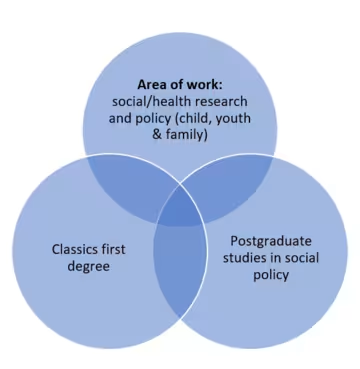
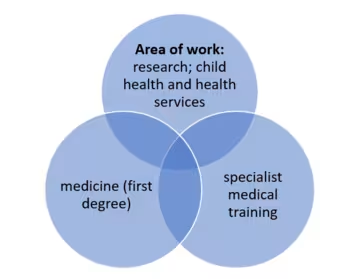
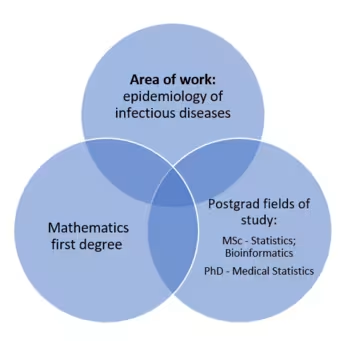
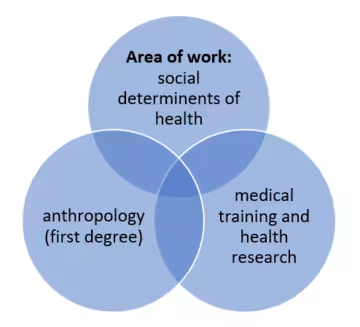
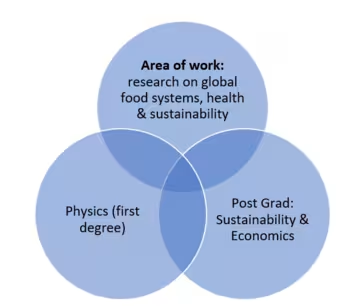
There are also some easy, practical things you can do to make the most of being in a world-leading University for your career development. Around you are tutors, supervisors and other senior researchers who will be eager to share their experiences and insights. Do speak to them, or to junior academic staff who are involved in research that connects to organisations beyond this university.
“Be brave, reach out, and ask questions of people who know more than you do. I'm naturally quite shy (terrible characteristic for an anthropologist), but the single best thing I've done in terms of career move was just march up to the head of Medical Anthropology one day (I'd totally never spoken to him before) and say, 'Hey! Where do I start reading?' He remembered that interaction, and some months later when he had an opening for a Research Assistant he got in touch to say, 'I remember you wanted to learn more; here's an opportunity to learn while doing, why don't you apply?'I got the job, and now here I am a year later unexpectedly having become a Covid researcher. If you don't ask questions and you don't put yourself out there, it's hard to cultivate your own opportunities. Very annoying for shy people, I admit! Just learn some breathing exercises so you can calm down after you've done the brave talking-to-people thing.”
Check the people section of your departmental website to find out what the DPhil students, postdocs, research assistants, junior research fellows are working on, and get in touch via email.