Generating Career Ideas
Effective career planning emerges from combining self-awareness with research into industries and roles to find a fit that is right for you.
A degree opens up a wide variety of potential career directions and it can be hard to decide what you want to do after graduating. This briefing will help you make a start in exploring your personal preferences and researching the roles and sectors that you might enjoy working in. It should be useful whether you are:
- beginning to think about possible future roles for the first time;
- assessing ideas and alternative directions, including options around further study; or
- revisiting ideas, or even considering a change of direction.
The simple idea at the heart of career planning is that people often find greatest career satisfaction when their work reflects their personal ‘career drivers’ and offers scope both to apply their knowledge and skills and continue to learn and develop.
When generating ideas it helps, therefore, to look inwards as well as outwards.
- Creating a grounded understanding of who you are and what your ‘career drivers’ look like is one piece of the puzzle.
- Researching roles and opportunities that could be a good ‘fit’ for your knowledge, skills and personal preferences helps link this to the job market.
DPhils and research staff should also read our web page What’s Next for You?, which examines future scenarios for people with research backgrounds, whether or not they intend to stay close to their academic roots.
Further information
Your ‘career drivers’ reflect your values, motivations, strengths and work preferences. They grow from your underlying beliefs and personality, and relate to the ways that you like to think, work and apply your skills and knowledge. They will have guided many of your past decisions and choices, underpinning your successes and are probably reflected in your proudest achievements. They also determine which working environments, people and relationships can help you to be productive, happy and successful.
Understanding your career drivers can help you think more clearly and productively about possible career directions and so is important for effective career planning. As you research options around further study and possible work choices, this self-awareness can keep you focused on what is most important to you when evaluating options. It is relevant to both:
- What the role involves, the nature of the work, and the knowledge and skills you will be applying and developing; and
- How you will be working, especially the working environment and culture of the organisation and how this might be a good 'fit' for you and your working style.
Lastly, it will make you a stronger applicant if you can articulate clearly why you are interested in and well suited to a particular role alongside the evidence you present on the essential skills and knowledge you have for a role.
But career drivers can be difficult for us to identify because they are often hidden from us: that is, they tend not to sit on the surface and nor do you consciously apply them in most situations. To begin to uncover your career drivers you can use the clues found in:
- what you enjoy doing most
- what helps you to succeed and to feel successful, and
- understanding why you choose to do the things you do.
Oxford students can also speak with a Careers Adviser to discuss their insights and questions.
A good job description and person specification will set out the knowledge, skills and attributes that an organisation is looking for in a good candidate. These criteria provide the basis for making initial judgements on a candidate’s suitability throughout the application process, and are an important part of the recruitment mix. It is therefore important for you to be aware of your relevant knowledge and skills, both to help you make better career decisions and to showcase these effectively in applications.
At Careers, University of Oxford we focus on a framework of nine transferable employability skills. You can use this framework to evaluate the skills you have and find ideas for how enhance these and develop new skills through our employability programmes and extra-curricular activities.
A degree programme will support development of subject specific knowledge and related technical skills (e.g. expertise in a foreign language; learning MATLAB, Python of programming skills; using statistical software tools; laboratory techniques; correct way to reference for academic writing). In addition, all Oxford students will acquire, develop and enhance some core employability skills such as self-management; communication; initiative; planning and creativity through their research, academic writing, lab's, and tutorials. However, other employability skills, such as business awareness, teamwork and leadership, may not be easily developed within an Oxford degree programme.
The good news is that all the leading transferable employability skills can be developed in many different ways, whether through volunteering; research placements or work experience; and extra-curricular activities with student clubs and societies. On top of this, the Careers team runs skill sessions and employability programmes, and coordinates Oxford's micro-internship and summer internship programmes to supplement the work experience opportunities available with companies and organisations of all kinds.
Lastly, employers understand that graduates may have little or only limited experience at the time they apply. You are not expected to be ‘the finished article’ and recruiters evaluate candidates’ ‘potential’ and ‘ability to learn quickly’. It can be highly persuasively to demonstrate a genuine interest in the organisation and for the work. The evidence needed to do this persuasive comes from:
- examples which demonstrate how you have explored your ideas and begun to build relevant knowledge and experience;
- signalling interest, drive and enthusiasm not only through the words you use but also by 'bringing energy into the room' during interviews; and
- asking questions that build on your research to show your curiosity about the work, the company and its culture.
Nearly all jobs involve a wide variety of situations and activities, and finding a role aligned with your personal ‘career drivers’ is one of the keys to long term career satisfaction.
The UK graduate employment market is very flexible and a substantial majority of advertised jobs are open to applicants from any discipline. This means the breadth of opportunity for most graduates is huge and an unfocused approach can be both time consuming and ineffective. Time spent thinking about and researching options is likely to be time well spent, and will help to break the inertia and fear that can build up for students who feel they have ‘no idea’ of what kind of job(s) might be interesting for them.
The approaches outlined here offer a variety of starting points to generate ideas and assemble a meaningful list of options that might match your interests, strengths and personal preferences.
Using your degree
Many graduates want to use the knowledge and skills developed through their degree in their work. A good degree in a relevant discipline will help ensure that you have appropriate knowledge, some of the skills needed, and the capacity to learn quickly and grow into the role. The following resources can help you follow-up this line of research.
- See our advice on Using Your Subject.
- Research What can I do with my degree? online at Prospects, or with Target Jobs – Degree Subjects: Your Career Options.
- Explore what alumni have done, and use contacts from your College and Department. See our advice on Networking and use resources such as LinkedIn and the Oxford Alumni Group Network to make connections.
- Explore your options for Further Study alongside our other advice and industry briefings.
Starting from your work experience or hobbies
First hand work experience allows you to try out both the content and type of the work, whether paid or unpaid. A summer internship lasting a month or longer can provide you with rich insights in the work itself and the working culture of your host organisation. It is also an opportunity to meet a wider range of people you can ask for advice and support. Even short-term work-shadowing and micro-internship experiences can help you experience different work environments and to test out whether the industry sector and role might offer the kind of opportunities, challenges and projects that you would find interesting.
Assuming you enjoy your work experience, you can generate leads directly linked to the sectors, organisations and roles that you have tried. You can expand your thinking by looking at similar or adjacent fields. Once you have identified possibilities, you can:
- use job descriptions to explore the skills and knowledge required and begin to consider how best to prepare and position yourself for applications;
- examine job profiles, such as those listed on both Prospects and TargetJobs to:
- deepen your understanding of the roles;
- understand whether further study would be useful or necessary;
- find suggestions about ‘adjacent careers’ and alternative roles to consider which require similar skills and knowledge.
Using a similar logic, you can also reflect on what you do in your own time - your hobbies; the clubs and activities you enjoy; what you volunteer to do in your free time. For example, it might be that you:
- enjoy being highly skilled and like to pursue technical mastery needed for success (e.g. in sport or music, or working as a research assistant)
- thrive where the people and environment(s) help you feel engaged and valued (e.g. singing in a choir, being part of a campaign, or putting on a play)
- value being able to see tangible results in the things that you do and the impact that you make (e.g. as an ambassador, fundraiser or volunteer, helping to lead a society or JCR/MCR)
- a motivated to seek out and take on significantly challenging roles for the satisfaction of achieving something that may at first feel out of reach (leading TED-X Oxford; putting on a college ball for 1000 guests; training hard to break into the Blues squad or taking on an extreme challenge to raise money for your favourite charity).
All and any of these can help you to understand the things that drive and sustain your interest, motivation and joy. There may not be a direct link to a career, but there is a genuine opportunity to begin to understand what might fuel your future success.
Remember to dream
You can also gain insights by blocking out real-world constraints and fears and allowing yourself to dream about the possibilities as if there were no barriers in your way.
- Interview your younger self: Was there something you really wanted to do when you were much younger? Even ideas that seem wildly out of reach now can still offer insights into what remains attractive to you and what you hope to achieve.
- Dreams for your future: Take time to look ahead and dream. Try to paint a rich picture for yourself of the work you would do. Don't limit your thinking to what you do in the role(s), but consider also:
- who are the people around you?;
- what is working space like. Indoors or outdoors?; In an office? Is it formal and quiet, or relaxed and perhaps chatty? What are people wearing?
- how you feel about yourself and the results or impact you are able to achieve?
You can use the following prompts to create two or three future scenarios.
- What is your current first choice career?
- If this first choice job or field simply did not exist, what else might you do?
- If there were no constraints, and anything and everything was possible, what would you choose to do?
- Looking five years ahead, what would you most like to have experienced, learned or contributed?
Career planning tests
In the section on building self-awareness we mentioned the use of personality questionnaires to help you understand your personal preferences and the pattern of traits that you tend to use most frequently. Many personality based tools will also generate a long list of options to consider, and these can be a valuable starting point when seeking inspiration. Curiously, it is recommended that companies should be cautious about using personality based tools to make 'selection' decisions because personality on its own is a poor predictor of future performance (see, for example, Barrick & Mount, 1991 and Murphy, 2005). A number of these test and personality tools are listed under External Resources (below).
You may have already used some of these, for example, if you used the Morrisby Test or similar at school. Also, a few companies include a personality questionnaire embedded in their career pages which can be used to understand which of their roles might be the best match for your work style preferences.
The range of career ideas suggested by these tools is still likely to be very varied, with perhaps 20 or 30 different roles suggested. So, when reviewing any results, follow your instincts and use your intuition to choose where to start researching the options that most appeal to you: explore what these roles involve and why each particular option might be a good fit for you.
Browsing and scanning the horizons
Browsing industry sector briefings, our career fair booklets and job boards/vacancy listings needs a degree of focus to be productive. However, once you start to clarify and define for yourself what might be ‘right for you’, your sub-conscious mind can be a powerful ally if you pay attention to your instincts and become aware of what ‘catches your attention’. Potential starting points include:
- The Oxford Guide to Careers, published annually, includes introductions to more than 20 sectors and over 50 alumni profiles as well as recruitment advertisements;
- Employer directories and rankings can be found online. Look for leading graduate employers in listings such as The Times Top 100 and the UK 300, or if you already have a specific industry or professional focus, consider looking at the relevant industry bodies, royal societies and professional institutes for company directories, and rankings and award listings.
- Profiles of DPhils and postdocs who have developed careers outside of academia on research- careers.org
For avid readers, natural networkers and thorough researchers, the ideas outlined in the next section can also all be enlisted as ways to scan the horizon to add to your emergent careers thinking, but it pays to be purposeful and directed with these approaches.
To make strong, well-targeted, applications you will need to do your research. There are no short-cuts here.
Demonstrating 'fit' with the company culture is a great way to differentiate yourself at the application stage. Focused research will enable you highlight how your interests, motivations and drive align to the company's values, working style and ethos. This content address "why" you are interested in the opportunity, and is complementary to the evidence you present on your relevant knowledge, skills and competencies which begin to address the questions of "can you do the job?". Both elements are needed to show that you are an outstanding candidate for that firm.
Once you have created some focus, read widely and seek out the information and roles that speak to you loudest. Start by reviewing relevant content within:
- the Sectors and Occupations briefings
- the 100s of job descriptions on Oxford's our vacancies board (see CareerConnect, and use the Opportunities tab) graduate websites such as Prospects and Target Jobs.
Deepen your research by using the dedicated career pages on company websites. In addition to information about the application process you will find advice and profiles of recent graduate hires to help you understand the firm, the work and the reasons their employees enjoy and value their roles. You can also follow firms on social media and register to receive email alerts to stay up to date.
We recommend that you go beyond the carefully manicured ‘marketing’ content of the careers pages however. Seek opportunities to talk to people with relevant knowledge and experience, for example by meeting firms and alumni at career fairs and other on-campus events, and connecting with current employees (see our advice on Networking).
The Careers team provides access to hundreds of companies through our Career Fairs, company presentations, workshops and employer led events listed on the calendar on CareerConnect. Many of the company representatives you can expect to meet will be recent graduates with clear memories of being in your position only recently. Use the opportunity to ask them about:
- What worked for them when they were applying.
- What they like most about their current role and organisation.
- How useful their degree is in relation to their day-to-day work.
- What kind of learning and personal development opportunities they have.
- What their options for the next 2 or 3 years look like.
If you are uncertain about where to start, consider starting with people who you can reach relatively easily:
- Family and close friends – people you know well, but do you know who else they know and what those people do?
- People around you at University, from lecturers to classmates.
- For business careers, there may be final year students on your course, in College or involved in a student society who have recently interned in the sector or perhaps with firms you are most keen to research.
- If you are considering an academic post-graduate route, approach current students on the Masters courses you are considering, talk to DPhils in your Department and seek advice from your tutors.
We encourage all our students to explore and to think beyond the obvious when consider their next steps.
Whilst it is true that some industry sectors are very visible on campus, the destinations for our students on graduation are many and varied. A quick look at Oxford’s Graduate Outcomes data reveals some fairly consistent patterns in the sectors chosen by our new graduates.
Furthermore, there is no need to limit your thinking to the sectors on our website or the individual roles that carry the title ‘graduate jobs’. Every year a substantial number of our graduates take roles in other sectors, such as ‘logistics & transport’, ‘religion’, ‘sports & tourism’ or choose to work freelance or start their own ventures. In addition, the team of Careers Advisers are asked about a wide variety of quite different roles and fields, including: climbing instructor; conference production; design; fashion; fine art conservation; property development; stand-up comedian, uniformed forces and – occasionally – even working as a Careers Adviser!
Luck favours the prepared mind
Lastly, although this briefing recommends a process based on reflection and research in order to create a focused approach for career planning, it is worth remembering the aphorism that "all models are wrong, but some are useful". Many successful careers include important or unexpected events, such as newly discovered interests and chance meetings, that have proved pivotal.
This idea is reflected in ‘Planned Happenstance Theory’ which suggests that students’ can prepare themselves for and even construct ‘unexpected career opportunities’ by their own actions. Trying out different activities, getting involved in societies and volunteering, or actively exploring ideas and talking with a wider variety of people will bring you into contact with the people, ideas, opportunities and knowledge that can help you move forward purposefully. It also increases your visibility and the chances that one day it will be your time to be ‘in the right place at the right time’.
You can book an advice appointment with a careers adviser to talk through your ideas, questions and concerns, wherever you are in your career thinking.
Video resource
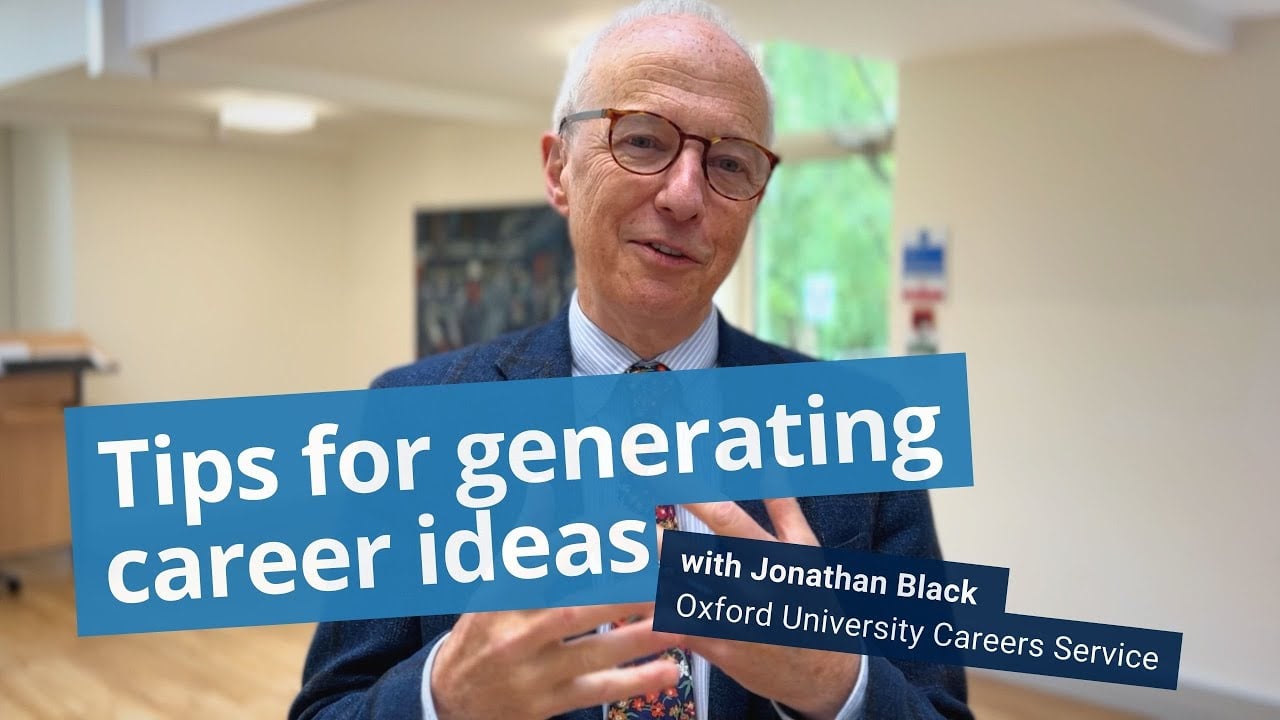
Tips for Generating Career Ideas | with Jonathan Black, Director of Careers, University of Oxford
Choosing a career path can be overwhelming, but reflecting on your skills, interests, and values is crucial. In this video, Jonathan Black - Director of Careers, University of Oxford - shares some tips on how to generate career ideas.
Personality based assessments
We provide access to the Myers-Briggs Type Indicator (MBTI) and the DISC behavioural assessment tools for a small fee. Full details are included in our briefing on Services for Alumni. Current matriculated students and research staff may also secure a free referral onto these programmes following discussion with a career adviser.
See a careers adviser
Oxford University students can book an appointment with a careers adviser.
Our website covers a very wide range of relevant ideas, advice and resources to help you research and evaluate potential career paths. Start with the following:
Books
There are many self-help books (and their related websites) to support personal reflection and career planning. Here is a selection of just some of the books that we like:
- The Squiggly Career, Helen Tupper, Sarah Ellis (2020)
- How to find the career you’ve always wanted, Jonathan Black (2019)
- How to get a job you’ll love, John Lees (2014)
- How to Find Fulfilling Work, Roman Krznaric (2012)
- What Color is your Parachute?, Richard N. Bolles (revised annually)
- Build your own Rainbow: a workbook for career and life management (4th ed), Barrie Hopson, Mike Scally (2009)
- Strengthsfinder 2.0, Tom Rath, which will include an access code to the online CliftonStrengths assessment.
Web-based tools and resources
You might find the resources listed below useful, however, the Careers team does not provide assurances on accuracy, validity and reliability of these tools and resources. Use your judgement on the quality of any tools you try and please make an appointment with a Careers Adviser if you want help to interpret the results or to discuss any questions that you may have once you have completed any of the tests.
Please note, in the following introductions, any text in italics has been copied from the sites themselves.
Free resources on graduate careers websites
Prospects, the national graduate careers website from AGCAS (Association of Graduate Careers Advisers) offers a wide range of resources and advice, including:
- Prospects Career Planner and Job Match: ‘Job matching’ tools based on a personality questionnaire
- What do graduates do? – National survey of over 250,000 graduates and their work destinations, including subject-by-subject data, analysis and commentary.
- Prospects: What can I do with my subject?
- targetjobs.com: A second comprehensive graduate website offering careers advice, including advice on knowing your options; exploring your skills and motivations; how to look for graduate opportunities, job descriptions and advice on what you can do with your degree.
Free tools
- O*NET: The Occupational Information Network, a free service supported by US government funding, provides a short assessment tool and links to a comprehensive database of almost 1,000 occupations covering the entire US economy. Its core methodology is a Career Interests Inventory, detailed in the O*NET Content Model. O*NET is constantly updated and provides a wide range of information and interpretive tools.
- 16 Personalities offers a free personality type questionnaire in more than 30 languages. The model is based on the Big 5 model of personality, and the website provides both explanations of their method, your profile and links to other resources.
- CareerRadar is a free personality test for use by students and young people as “a smarter way of getting careers advice, and more generally to provide an intelligent toolset for personal development. It provides insights to your personality type and possible career direction based on the MBTI framework.
- FindMyWhy .com: "helping people make positive change, find personal purpose and create a life they love", and all for free.
- The Hexaco Personality Inventory: A six-dimension personality tool developed by researchers in Canada. A free test (about 15 minutes) that provides a personality profile and supported by some limited explanatory content.
Tools offering initial free access and additional fee-based resources
- VIA Character: VIA stands for Values in Action and the VIA Institute is a not-for-profit that aims to help people change their lives by tapping into the power of their own greatest strengths. The VIA Institute offers a free 10 minute test, and additional fee based resources.
- Kiersey Temperament Sorter offers a 70-question personality test linked to 16 categories that match-up with the MBTI test. The free test results provide only a limited amount of information and additional fee-based resources.
- Strengths Profile is an online assessment that gives you a unique profile "to reveal and develop your passions further". The free starter profile is easily digestible and provides your assessed top 3 Realised Strengths; top 3 Unrealised Strengths, 2 Learned Behaviours and 1 Weakness.
Fee-based resources
- Clifton Strengths Assessment, developed by Gallup. The Gallup book ‘Strengths Finder 2.0’ {referenced above)also introduces the CSA and each book includes a free access code for the assessment in the purchase price.
- The Morrisby Test is a personality based tool used quite often by schools for careers advice. It is marketed as an impartial decision making companion and offers insight into multiple aspects of personality and includes pathways and advice for further study and career options.
- Profiling for Success provides an extensive suite of tests, including a Career Interests Inventory to help people explore their personality preferences and how these relate to the world of work.