
Faculty of Theology and Religion
The Faculty of Theology and Religion at Oxford is a global centre for research in a wide range of fields. There are over 150 graduate students currently studying within the faculty.
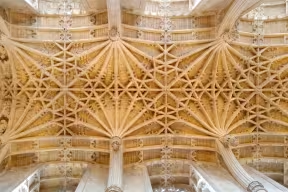
Cathedral ceiling, Christ Church College. OU Images / Susanne Heinrich

Overview
Postgraduate study at the University of Oxford places you within an internationally recognised centre for the study of theology and religion. The faculty's academic staff consists of more than 80 scholars and nine senior professors who are leading figures in their fields and are committed to advancing understanding across biblical studies, early Christianity, modern theology, philosophy of religion, ethics, science and religion and the study of religions globally.
Supervision is rigorous and attentive. Students work closely with supervisors while participating actively in seminars, research colloquia, and lecture series that sustain a lively and demanding intellectual culture.
The faculty’s work is further enriched by Oxford’s wider theological and religious landscape. The city’s churches, religious centres, societies, and academic networks regularly host distinguished scholars and public thinkers from around the world, offering exceptional opportunities to engage with contemporary debates at the highest level.
A graduate degree in theology and religion from Oxford cultivates highly transferable skills, including analytical precision, advanced research capability, intellectual independence, and the ability to communicate complex ideas with clarity and authority. These qualities are valued across professions worldwide.
Our graduates pursue careers in academia, humanitarian activism, law, politics, public service, NGOs, business consulting, accounting, higher education management, teaching, the charity sector and local community engagement among many other fields.
The faculty offers master’s degrees in all major areas of theology and the study of religions. A postgraduate diploma (PGDip) is recommended to those who wish to study theology and religion at graduate level but do not have a first degree in theology or religious studies. A doctoral degree (DPhil), is offered in all areas of theology and study of religions.
Courses offered
The courses shown below are offered at postgraduate-level.
- PGDip in Applied Theology (full time and part time)
- MPhil in Judaism and Christianity in the Graeco-Roman World (full time)
- MTh in Applied Theology (full time and part time)
- MSt in Philosophical Theology (full time)
- MPhil in Philosophical Theology (full time)
- MSt in Study of Religions (full time)
- MSt in Theology (full time)
- MPhil in Theology (full time)
- PGDip in Theology and Religion (full time and part time)
- DPhil in Theology and Religion (full time and part time)
Humanities Division
Oxford is at the forefront of international research in the humanities, with five subject areas judged to have the highest volume of world-leading 4*-rated research in the UK in the 2021 Research Excellence Framework.
The Humanities Division comprises around a third of the University's community of staff and students, offering taught graduate and research degrees in a very wide range of subjects. Humanities departments and faculties attract outstanding students, academics and researchers from across the globe. As a result, graduate students have the opportunity to undertake their studies and research in a stimulating, challenging and highly rewarding intellectual environment.
Some of these subjects are relatively new, and cross the boundaries of traditional disciplines. Others are areas of academic research that have long been recognised as of central importance, and they include some that few other universities are still able to support. In each case, the objective is to sustain and to teach the highest standards of scholarship. The dynamism of intellectual activity is evident in the wide variety of open lectures and seminars, in addition to those for specific courses.
You will have access to an immense range of research material, including digital resources. These resources are provided through Oxford’s impressive library system, based on the central Bodleian libraries, through the work produced by the University's research projects, and through the rich and diverse holdings of its museums.
In addition to materials and support focused on conveying subject-specific knowledge, there are a wide range of facilities aimed at the personal and professional development of students, strengthening their existing skills, developing new skills, and preparing them for careers after they have completed their studies.