
Inside an Oxford tutorial
As the doors to Oxford’s Museum of Natural History opened for the start of the new term, five first-year undergraduate biology students arrived for their weekly Biology tutorial.

They met Professor Lindsay Turnbull, a tutor at The Queen’s College where the students all lived and studied. She is also Professor of Plant Ecology in the University’s Department of Biology and author of ‘Biology: The Whole Story’, published in 2023.
Founded in 1860 as the centre for scientific study at Oxford, the Museum holds the University’s internationally significant collections of geological and zoological specimens. It was the perfect place to think about the animal kingdom – the purpose of the tutorial – and the different phyla or groups that make it up.
On the Museum’s ground floor, in front of eye-catching displays of colourful butterflies, spiders and fungi, parades of mammals, and replicas of dinosaur skeletons, Professor Turnbull outlined the plan for the next hour. The group was given a quiz based around key areas of study for the term, and the students split into two teams and headed off to find the answers within the collections.
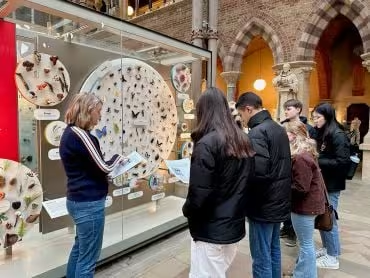
Tutorials – a meeting between an academic and a small number of students – are the cornerstone of the highly personalised undergraduate teaching and learning experience at Oxford. “A tutorial should be a chance for the students to air their views and to discuss openly what they don’t understand.” said Professor Turnbull.
“They allow tutors to interact regularly with students and to monitor their development closely and are different from other forms of university teaching because of their personal nature and the way that you can fine-tune your teaching to suit different groups. They encourage students to talk about their work and to share their ideas. Ideally, they also allow students to gain in confidence.”
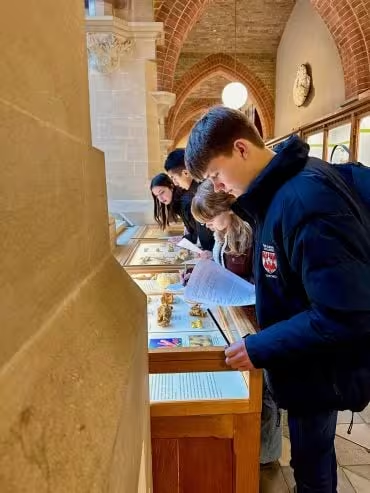
So, what did the students think of them? First-year Biology student Eunice said, “Tutorials allow us to explore a topic in much greater detail than lectures. A concept may only be briefly touched on during lectures, so the discussions during tutorials help reinforce our understanding, and also push us to think more deeply about the topic.”
For fellow student Austin, tutorials offered a more fun and conversational experience than a lecture: “What I enjoy the most is breaking down a big problem gradually as a group, bouncing off each other's ideas to solve something that you couldn't sit down and do in an hour.”
The five Biology students met once a week, usually at The Queen’s College, but Professor Turnbull’s tutorial locations varied. On an earlier tutorial, they hunted for tiny tardigrades (or moss piglets) in the University’s Botanic Gardens; “although we completely failed to find them!” she said.
Professor Turnbull believes it is important that the students get out and about, and she took her group to gain a greater familiarity with the natural world: “In the practical tutorials I’m trying to achieve a few things. First, to get to know them better, because there’s no pressure on them to perform. Second, to give them exposure to natural history. Some of our students have incredible knowledge about nature, and others have very little. It can be a real advantage to have some of that knowledge, so it’s good to share it around.”
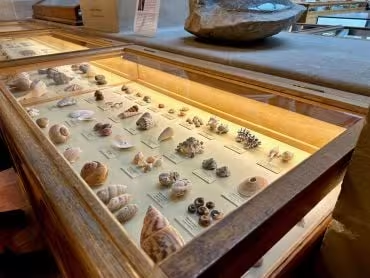
In the Museum’s display cases, the tutorial group explored a variety of specimens of varying sizes, shapes and colours, many discovered hundreds of years ago and some as close to home as the University Parks – millions of years ago the site of a tropical sea.
“Being able to see the animal models and fossils helps me to better visualise what we are discussing” said Eunice, “rather than trying to describe the organisms in words or through pictures on a slideshow”.
Fellow Queen’s College student Oliver, said, “Being out and about, and interacting with things that we have learnt about in lectures is immensely valuable. I think it grounds you and reminds you that what you are learning about is real and affects creatures in their day-to-day lives.”
Reconvening in the Museum’s café, the five students came back together to share and discuss what they’d found, from a platyhelminthes – a flatworm that can grow to 12 metres and can regrow any body part – to squirting sea cucumbers.
Professor Turnbull described the Museum session as a great experience: “I love the museum and I’m keen for students to use it more. By showing them what’s there, I hope they’ll be more likely to return on their own and use it for themselves.”