

Professor Sir David F. Hendry, Kt
Deputy Co-director, Climate Econometrics, Nuffield College
Climate Econometrics focuses on impacts to change human behaviour, complementary to climatological models.
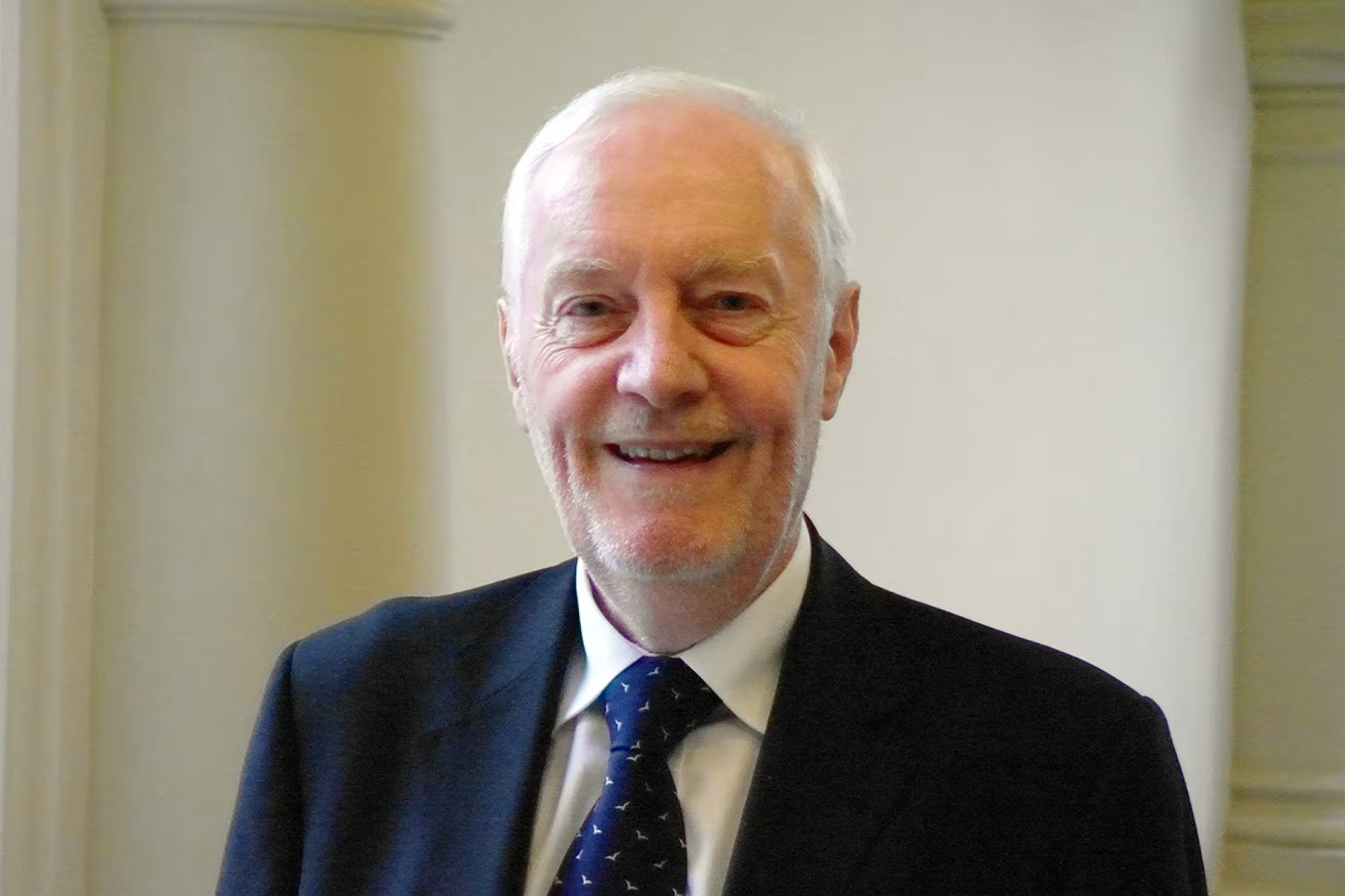
About
Professor Sir David F. Hendry's research vision has been to improve empirical evidence by better econometric tools, methods and data, implemented in widely available computer software and applied to important issues in economics and climate change. These powerful econometric modelling and forecasting tools for rapidly changing processes have proved invaluable to forecast the evolution of the Covid-19 pandemic and the recent upsurge in UK inflation as well as to model climate change,
He was previously Professor of Economics at Oxford (1982-2018), Professor of Econometrics at LSE and a Leverhulme Personal Research Professor of Economics, Oxford (1995-2000).
Professor Sir David was Knighted in 2009; is an Honorary Vice-President and past President of the Royal Economic Society; Fellow of the British Academy, Royal Society of Edinburgh, Econometric Society, Academy of Social Sciences, Econometric Reviews and Journal of Econometrics; Foreign Honorary Member of the American Economic Association and American Academy of Arts and Sciences; Honorary Fellow, International Institute of Forecasters and Founding Fellow, International Association for Applied Econometrics.
He has received eight Honorary Doctorates, a Lifetime Achievement Award from the Economic and Social Research Council (ESRC), and the Guy Medal in Bronze from the Royal Statistical Society. The ISI lists him as one of the world’s 200 most cited economists, he is a Thomson Reuters Citation Laureate, and has published more than 200 papers and 25 books on econometric methods, theory, modelling and history; computing; empirical economics; and forecasting.
Expertise
- Econometric modelling and forecasting in macroeconomics and climate change
Selected publications
- `A Novel Approach to Forecasting after Large Forecast Errors', Journal of Forecasting (with J.L. Castle and J.A. Doornik, 2025)
- Five Sensitive Intervention Points to Achieve Climate Neutrality by 2050, illustrated by the UK, Renewable Energy, 26, 120445. (with J.L. Castle, 2024)
- `Econometric Forecasting of Climate Change', 361--395 in M.P. Clements and A. Galvo (eds.) Handbook of Research Methods and Applications in Macroeconomic Forecasting, Edward Elgar (with J.L. Castle and J.I. Miller, 2024)
- Can the UK Achieve Net-zero Greenhouse Gas Emissions by 2050?' National Institute Economic Review, special issue on Climate Change, 266, 11–21 (with J.L. Castle, 2024)
- ‘Improving Models and Forecasts after Equilibrium-Mean Shifts’, International Journal of Forecasting, 40, 1085–1100 (with J.L. Castle and J.A. Doornik, 2024)
- `Common volatility shocks driven by the global carbon transition', Journal of Econometrics, 239 (with S. Campos-Martins, 2023)
- ‘Robust discovery of regression models’, Econometrics and Statistics. (with J.L. Castle and J.A. Doornik, 2023)
- ‘The Historical Role of Energy in UK Inflation and Productivity with Implications for Price Inflation’, Energy Economics, 126 (with J.L. Castle and A.B. Martinez, 2023)
- ‘Analyzing Differences between Scenarios’, International Journal of Forecasting 39, 754–771. (with F. Pretis, 2023)
- `Econometrics for Modelling Climate Change', Oxford Research Encyclopedia of Economics and Finance, Oxford University Press (with J.L. Castle, 2022)
- `Forecasting Facing Economic Shifts, Climate Change and Evolving Pandemics', Econometrics, 10: 2 (with J.L. Castle and J.A. Doornik, 2021)
Recent media work
- Cimate Econometrics (Royal Economic Society Newsletter, 2025)
- The global carbon transition is driving oil and gas extreme volatility (VoxEU, 2023)
- Decarbonising the future UK economy (VoxEU, 2020)
- How the Bank of England could have avoided mis-forecasting UK inflation during 2021–24 (VoxEU, 2025)
- Why did the Bank of England need a review of its forecasting record? Economics Observatory, 2024
- Bashing the Bank, Letter in The Times, 27 May, 2023