
Dear Jonathan, how can I stay resilient when career prospects feel bleak?
Welcome to Dear Jonathan, where the Director of Careers at the University of Oxford answers Oxford students’ career questions.
Tags:


Dear Jonathan,
“We’re being told we should be “resilient” but right now with rejection from micro-internships, the miserable geo-political situation, and AI taking graduate jobs, I’m not feeling very positive. I don’t want to seem negative but where is the silver lining in the clouds?”
- 1st year postgraduate, Social Sciences
Jonathan's answer
“Apophenia” is the human tendency to join the dots between separate events to satisfy a desire to find a meaningful pattern or connection. This can help create a coherent story which gives you the chance to explain a recent negative occurrence. The items you mention are, at best, loosely connected, and actually all of them are out of your control. It was the recruiter’s responsibility who to employ on the micro-internship (sadly not you this time), geo-politics is beyond most of us (though we hope Oxford graduates will one day soon be able to be involved) and as for AI’s threat to jobs – this is a moving target, but one that can be prepared for.
You’re hearing about the message to be “resilient” as it is the ability to weather adverse events and forces, for example, a lack of money, conflicting deadlines, negative reviews of your work, or lab research not going as hoped or planned. Look around and you’ll see that plants don’t stand straight all the time, they bend with the wind; aircraft wings are designed to flex up and down in turbulent air. If plants or wings stayed stiff and unmoving, under increasing load they would snap. With humans, resilience is bending in reaction to unfavourable events, learning what we can from them, and then bouncing back. Rather than staying stiff and unbending before snapping.
What employers look for is that ability to react well to seeming “failure”; it is perhaps part of the human condition, to be ambitious and not achieve everything we dream of. You can learn a lot from things not going well, not just about how you reacted, but also if there were specific actions you could have done differently.
It’s much easier to manage a business when things are going well and money is plentiful; what’s more interesting is what someone can do when money is scarce and external forces have turned against the business. Why might you have failed to get the micro-internship? Why was the essay a 2:1 not a 1st? and why hasn’t the lab experiment worked? It can be interesting to explore this, perhaps with other people to challenge you – as that way may lie some enlightening views.
Talking of other people, discussing anything other than success can be difficult in a high achieving environment. But it can be OK, maybe beneficial, to show vulnerability. Brené Brown’s TEDx talk explores this and she claims from her research that vulnerability can “serve as a foundation for trust, joy, creativity, and authentic human relationships.”
Once you get over the emotional shock of not getting the internship/job/results you wanted, reflect on what you might have done differently, perhaps reveal your human vulnerability with trusted friends – doing that might be the silver lining you seek.
If you’re feeling discouraged and want to talk through your next steps, you can book an advice appointment with a Careers Adviser.
For additional practical tips on bouncing back when things don’t go to plan, sign up for the How to Build Lasting Career Resilience talk on Tuesday 24 November 2026, 13:00 - 14:00.
About the Dear Jonathan column
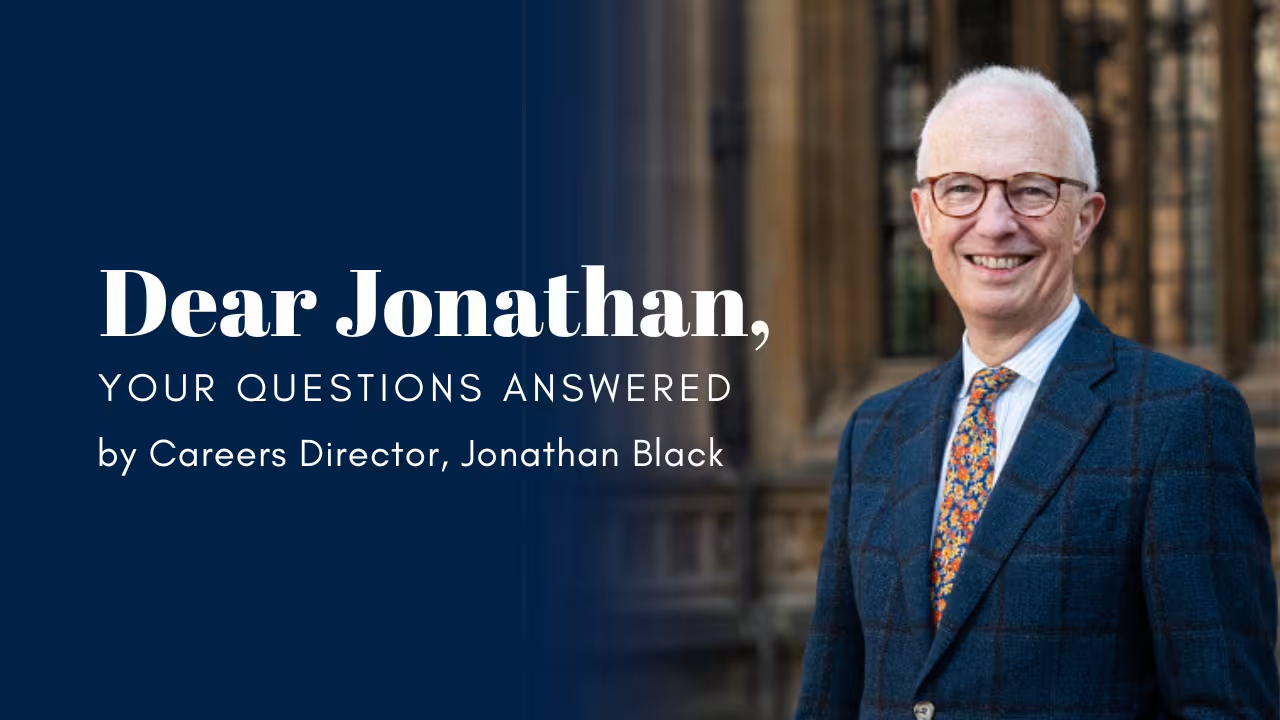
For six years, the Careers Director at the University of Oxford, Jonathan Black, wrote a fortnightly column for the Financial Times answering readers’ careers questions - you can still find it here.
Now, the “Dear Jonathan" column has come to Oxford.
If you are an Oxford University student, send in your career question to [email protected] and each week of term, he will answer one of the questions in this feature. We’ll anonymise the author (but please tell us whatever is relevant) so you can be sure that readers won’t know it’s you.


