
From Mexican Fields to Danish Labs: How one researcher turned a farming problem into a career and a company built on Danish soil
A biotech engineer from northern Mexico, a PhD at Oxford, and a startup in Aarhus: Dr Marcela Mendoza's career has followed the same problem across three countries, taking her from academic research towards practical application in Denmark.
Tags:

A problem worth crossing borders for
"I grew up in northern Mexico and trained as a biotechnology engineer at Tecnológico de Monterrey," says Dr Marcela Mendoza. Collaborating with Mexican farmers, she saw the limitations of existing solutions.
"I could see how chemical fertilisers polluted the land while the biological alternatives worked only sometimes. I was frustrated that I didn't understand the biology well enough to fix this problem. That frustration is really what sent me abroad."
That journey took her to Oxford for a PhD and later to Aarhus.
"Moving so far from home was frightening," she admits. "I still remember how much I missed, and still miss, important moments with my family. But the chance to actually solve a problem real for farmers was worth trying."
From research to real-world application
"At Oxford I finally understood the biology and developed a way to identify the right soil bacteria quickly and affordably," she explains.
"What I wanted next was to see that work reach real fields and real farmers, and I started looking for the right environment to take it there. Denmark, and Aarhus University in particular, turned out to be exactly the bridge between the lab and the real world” she says.
Presenting her research at a conference proved to be the turning point.
"I met Professor Stig U. Andersen at a conference where I presented my research, and a few months later he contacted me for a meeting where he offered me a postdoc position," she says. "That first postdoc contract, which I thought would last just two years, became a defining moment in my academic life. It led to a position as assistant professor at Aarhus University and then to co-founding a company with Stig, SymbioMatch."
Looking back, Mendoza sees it as one route among several she could have taken. "There are many paths from research to real-world impact, and mine happened to run through Aarhus. What mattered most was staying open to an unexpected opportunity and following the work to wherever it could grow."
Turning research into impact
"Certain soil bacteria take nitrogen from the air and feed it to the plant, so the plant needs far less chemical fertiliser," Mendoza explains.
"The problem is that a bacterium that works well in one field can do nothing in another, because it has to compete with the local bacteria, so generic biofertilizers are unreliable and the farmer carries all the risk."
Her research at Aarhus University uses molecular tools and AI to match plants, soils, and bacteria. SymbioMatch turns this research into customised, non-GMO biofertilizers.
"This matters because it lets farmers grow more food on less land with fewer chemicals, reduces water pollution, and helps make our food supply more secure and sustainable," she says.
Spin-outs Denmark's bridging funding, she says, made the difference between having a company or not. "The full year of Spin-outs Denmark's bridging funding was, quite simply, the difference between having a company or not, since it paid my salary for a full year so I could focus completely on developing the business idea," she smiles.
"That shift in mindset, from a researcher to an entrepreneur solving a customer's problem, is what turned a decade of research into a real company with field trials, a patent, and interest from agricultural companies," she adds.
Advice for the next generation
Asked what confirmed she had made the right decision, Mendoza doesn't hesitate. "For me it is standing in a field and seeing, with my own eyes, a higher yield thanks to a bacterium we identified in the lab."
Her advice to Oxford students is direct:
"Don't be afraid of dreaming and be patient. If something is worthwhile it will be difficult to get, but the reward of getting it will be priceless."
She is candid about moving abroad.
"Moving countries is genuinely scary." But living in three countries, she says, "has helped me grow in ways I could never have planned: new cultures, new ways of thinking, and people who opened doors I didn't know existed."
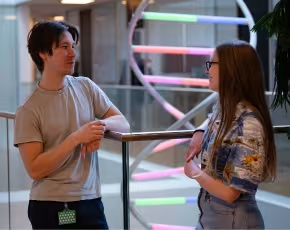
Living in Denmark has also brought everyday advantages. "There are cycle paths everywhere, and I can safely cycle wherever I need to go. Public transport is also excellent. I was also surprised by how little bureaucracy there is. Most administrative tasks can be completed online, which makes life simple. These things may seem ordinary to Danes, but for someone arriving, they make a huge difference to quality of life. Few places invest so deliberately in helping researchers turn their ideas into real-world impact, and the ecosystem here is unusually generous with support, funding and trust," she adds.
Mendoza returns to the idea driving her science. "We are not inventing new microbes; we are learning to find and use the ones evolution has already perfected."
Her ambition extends further. "I want to help build more bridges between universities and industry, because if there is a bridge, the journey from research to real impact becomes shorter."
Interested in learning more?
Come and meet Marcela at the A State of Denmark stand at the University of Oxford Science, Engineering and Technology Fair on Saturday 24 October 2026.
Find out more about your own career opportunities in Denmark at research.state-of-denmark.com.


