
Student story: The experience has been enriching and exciting beyond my wildest expectations
Jeremy Leslie-Spinks is an alumni of Green Templeton College. In this student story, Jeremy shares his journey so far at Oxford, his career in dance, experience of degenerative illness and research into clinician-dancer communication.
Tags:

The journey so far
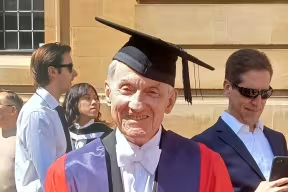
I’ve had the life-changing opportunity to spend the last five years as a DPhil student at beautiful Green Templeton College in the Nuffield Department of Primary Care Health Sciences. I’ve now graduated as a DPhil; my doctoral degree was conferred in the age-old ceremony at the Sheldonian Theatre a few days ago. That moment, for me, was unforgettable.
What has your time at Oxford been like?
I’ve always loved the idea of Oxford. In my first year, I was still living in Germany, where I had worked for a long time – I very much wanted to be here, but the pandemic made it impossible to travel here, so I had to work remotely, and it wasn’t really until 2021 that I was finally able to get to the University in person. I’ve loved every second of my time here, working with and among these amazing people, amid surroundings that leave me speechless with astonishment every time I pass by.
It was my immense good fortune to work with the unique and extraordinary Trish Greenhalgh, my indomitable Supervisor, who together with my co-Supervisors, Dr. Marta Arnaldi and Prof. Caroline Potter, illuminated the path I had to tread, and rescued me from many rabbit-holes. To them, and to my infinitely patient wife, must go much of the credit for this doctorate.
What are you involved in outside of your studies?
Before I came to Oxford, I was a classical ballet dancer, rehearsal director, Ballet Master, choreographer, Artistic Director and researcher. It’s been a highly rewarding career, taking me to some of the greatest ballet and opera theatres in the world, and I’ve been privileged for over 60 years to work with some major stars and companies.
How did you get involved and what has it brought to your personal/ Oxford experience
I was diagnosed with a degenerative spinal condition which would stop me from doing the job I had done and loved for decades. Until that moment, my life had been all about dance. Clinicians couldn’t seem to understand the trauma inherent in loss of dance, and I was neither willing nor able to abandon my lifeworld and retire into a state of sedentary monotony. Over the years I had known countless ill or injured dancers, and witnessed their unsuccessful attempts to explain what they needed to clinicians who lacked dance knowledge. So many of these injured dancers lost their careers, their livelihoods, their social contexts, and their identities through these largely avoidable failures of dialogue. It was clear that modifications were urgently needed, both to professional dance training and to academic clinical education.
By chance, I heard of the Rosamund Snow Scholarship for Patient-Led Research, and realised that my experience of clinician-dancer communication problems was not unique, and that there was valuable research to be done in this relatively unexplored field. Although I feared my chances might be slim, I applied for the Scholarship, and to my amazement, was accepted. The experience has been enriching and exciting beyond my wildest expectations, and I remain profoundly grateful for this remarkable opportunity.
Looking to the future
What are your future aspirations for yourself?
In the first place, I must finish the book which I am writing, which presents my thesis, findings and recommendations, couched in terms accessible to the general reader. I’m also working to establish a framework with other people who work in Dance Medicine and Science, which I want to use to implement my proposed interventions in real time, with real dancers and real medical professionals, and monitor the results to see how I can mitigate the damage and enhance dancer-clinician dialogue on a larger scale.
I’m also keen to explore (and produce a blueprint for) the use of dance as a potential intervention in public health. I think this idea, if properly researched, can have real potential, and I’d love to develop it.
Both of these projects will need funding, so my next priority will be to organise that.
What opportunities are there for other students to get involved?
Once the project is on its feet, there should be opportunities for both qualitative and quantitative researchers, for focus groups of clinicians and dance people, for patient involvement and engagement, for administrative co-ordination and in many other areas.


