
Student story: bringing research and policy together for educational equity
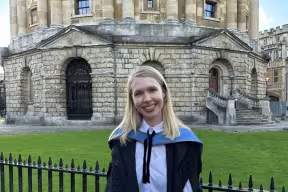
Sophia Mai Andresen is a first-year DPhil student at Lady Margaret Hall and a Clarendon Scholar, studying Social Intervention and Policy Evaluation. She was recently selected for the Europaeum Scholars Programme, joining a small cohort of doctoral researchers from across Europe in the Future Leaders of Europe Initiative. In this student story, Sophia shares her passion for educational equity, her experiences building community at Oxford, and her commitment to bridging research and policy.
Tags:

The story so far
Tell us about yourself
My name is Sophia, and I am a first-year DPhil student at Lady Margaret Hall studying Social Intervention and Policy Evaluation.
My research focuses on AI and educational equity. I am interested in how artificial intelligence can be integrated into education in ways that are ethical, evidence-informed, and equitable. In particular, I investigate whether AI tools can improve learning outcomes while helping to reduce, rather than widen, existing educational inequalities.
Before coming to Oxford, I worked in education policy, statistics, and research across several public institutions, including the Norwegian Ministry of Education and Research, the Office for National Statistics, and the European Union Agency for Fundamental Rights. What has consistently motivated me is the belief that good data and rigorous evidence can help create better policies and improve opportunities for those who face the greatest barriers.
What has your time at Oxford been like?
Oxford has been a wonderful experience.
When I first received my offer, I had an irrational fear that it might somehow be taken away if I said the wrong word. In fact, I was so nervous that I did not attend an open event for incoming students at my college. Those feelings disappeared as soon as I arrived.
From the very beginning, I felt at home. What has struck me most is how Oxford enables you to build a full life, where academic work exists alongside vibrant communities, friendships, and opportunities.
Within my department, there is a strong commitment to research that has a positive impact on society, which makes the work feel especially meaningful. There is also a genuine sense of being supported and encouraged by colleagues and fellow students.
As one of my supervisors once warned me, by the time I finish my DPhil, I will be thoroughly familiar with life at serene Oxford. A word of warning: it does make it rather difficult to feel content anywhere else.
What are you involved in outside of your studies?
I have facilitated discussions as part of the Vice-Chancellor's Colloquium on AI and led seminars at Lady Margaret Hall exploring artificial intelligence through conversations that bring together perspectives from both the sciences and the humanities. These discussions have focused not only on technological developments but also on broader questions around ethics, society, and education.
I have also been selected for the Europaeum Scholars Programme: Future Leaders of Europe. The programme brings together doctoral researchers from across Europe to collaborate with academics, practitioners, and policymakers on projects addressing some of the continent's most pressing challenges.
I was particularly drawn to the programme because it offers a rare opportunity to connect academic research with policy and leadership.
What has this brought to your Oxford experience?
Being selected for the Europaeum Scholars Programme has been especially meaningful because it has connected me with an inspiring group of doctoral researchers from across Europe who are committed to public service and tackling complex societal challenges. It has reinforced my belief that research can play an important role in shaping better policy and creating positive social change.
One of the most rewarding aspects of Oxford has been learning to work across disciplinary and national boundaries. Challenges such as educational inequality and AI governance cannot be solved from a single perspective, and I have benefited enormously from conversations with students and researchers working in very different fields.
Looking forward
What are your future aspirations for yourself?
I hope to continue working at the intersection of research, policy, and education.
My long-term goal is to lead research on educational disadvantage and help translate evidence into policies that improve educational outcomes and expand opportunities for future generations. I would like to work within research organisations, governments, or international institutions, helping to develop policies that advance educational equity globally.
Are there any opportunities for other students to get involved, or advice you would share with other students?
I have enjoyed contributing to college and scholarship communities through welfare, representation, and peer-support roles. Being a Clarendon Scholar has been a particularly meaningful part of my Oxford experience, giving me a genuine sense of connection and belonging and introducing me to scholars I might never otherwise have crossed paths with. I have also been grateful to contribute to this community as Academic Secretary on the Clarendon Scholars’ Council, helping to organise events that create spaces for scholars to connect across disciplines. One highlight was the Clarendon–St John’s Academic Excellence Summit, which we organised to celebrate postgraduate research, creativity, and public engagement.
My advice to other students would be to get involved in the communities around you, whether through your college, department, scholarship group, or wider University networks. Some of my most rewarding experiences have come from conversations and collaborations that began outside my own field of study.


