
‘We’re building a big company’
We visit Alloyed, a splendid example of an Oxford spin-out
Author:
Richard Lofthouse
Tags:

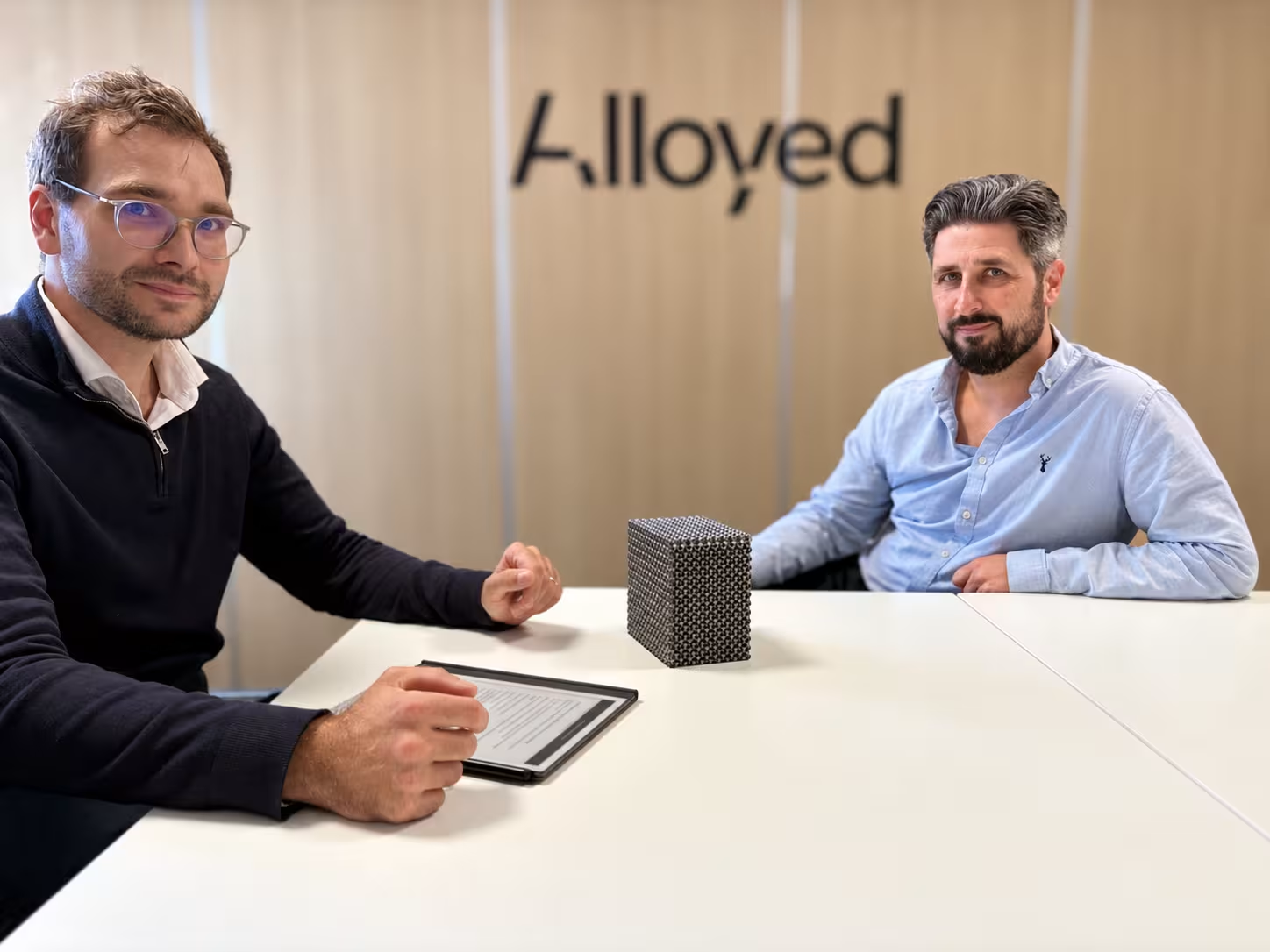
Dr David Crudden (St Anne’s, 2012) talks about ‘physical AI’, by which he means physical artefacts that are manufactured, but in such a computed way that you could not have made them like this at any point in the past.
He is a co-founder with Dr André Németh (Lincoln, 2014) of Alloyed, now with seven separate sites across Oxfordshire and a workforce approaching 300, at least 20 percent of whom are Oxford alumni – a subject we come back to within the broader context of the Oxford-London-Cambridge growth triangle.
A deep tech company growing at a rapid clip, Alloyed specialises in novel metal alloys and their manufacturing via ‘additive’, 3-D printing into intricate parts, or as André characterises the earlier stages of the company and his and David’s doctoral training at the University, ‘our background is in high-temperature materials and computational design.’
These descriptors and characterisations become more important as our conversation progresses. Although not wrong to describe Alloyed as an aerospace company (both founders were sponsored by aerospace behemoth Rolls-Royce, while at Oxford), it’s not the whole story.
In the broadest sense there is huge, emerging world where metallurgy finds itself at the cutting edge of what is physically possible. There is a vast, growing commercial marketplace for such products.
André mentions the joints of a humanoid robot, the site of significant heat build-up. In front of me on a desk are generic, non-branded housings for a smart watch and a single arm for a pair of smart glasses.
‘If you try to pack the computing power of a laptop into these tiny packages you will get heat,' Németh explains. ‘How it is dissipated is a question partly of material science, partly of design. The wearer of these glasses doesn’t want to burn their temples!’
What is immediately striking about the two parts is how ridiculously light they are. The phrase ‘light as a feather’ comes to mind, yet these skeletal forms are made of a magnesium alloy.
Roger C Reed, FREng, Professor of Materials and Solid Mechanics within Oxford’s Department of Materials, built the cluster from which Alloyed sprang in 2015.
‘These metals are not found in the ground,’ he says. ‘You have to mine the ore, refine the ore, and then develop novel alloys.’
The essential insight he had in the years 2012-15 was that an emerging global industry sector would require ‘special alloys that suited the technology of 3-D printing'.
That is what Professor Reed’s research group, including David, and Dr Enrique Alabort (DPhil Oxford, 2011-14), achieved, capturing the patents for Oxford with the help of in-house IP specialist Oxford University Innovation (OUI), then attracting the venture capital of Oxford Science Enterprises (OSE), the venture arm which sits adjacent to the University but in which the University owns a stake.
When we assemble a portrait photograph of David and André for this story, they elect to pose with a gyroid, defined as ‘an infinitely connected triply periodic minimal surface’, originally discovered by Alan Schoen in 1970.
That tells the average reader next to nothing.
The point here, says André, is partly that they have produced it as a physical artefact through additive 3-D printing using their proprietary, nickel-based superalloy, and partly that ‘there is no other way to produce it.’
An evidently complex, brick-shaped object, the gyroid is once again extraordinarily light to pick up and handle, completely defying its appearance.
The penny is beginning to drop, that we’re in a new land of material wonder that no artisan could possibly replicate no matter how dexterous their hands and imaginative their minds, that no previous machine has come close to either.
Of the gyroid, David says, ‘it is a meta-material with a volumetric property, and we can print it in just two hours.’
Furthermore - and this is where the clever stuff ramps up very quickly - the mathematics behind the proprietary software platforms that iteratively commune with the 3-D printers, where lasers melt metal powder and re-form it into scarcely believable material intricacy, allows for great precision, speed, robustness and repetition.
That all matters hugely because cost as much as cleverness drives manufacturing decisions, particularly in the core sectors served by Alloyed, such as aerospace.
Leading the company is another Oxonian, Michael Holmes (Balliol, 1991). He studied Classics; they studied Engineering and Material Science, both within the outstanding cluster led by Professor Reed.
We turn to the aerospace narrative, which in the troubled geopolitics of 2026 is also a defence narrative.
Both André and David’s DPhil research concerned a ‘new nickel-based superalloy optimised for high-pressure turbine disc applications using a novel computational modelling software'.
‘Turbine disc’ means jet engines, and jet engines are big news in 2026.
Previous customers have included Boeing, and the civil aviation applications of Alloyed’s discoveries include potential efficiency savings of up to one percent in fuel usage, claims David, which is a big deal in an industry where the quantum of fuel burned is huge.
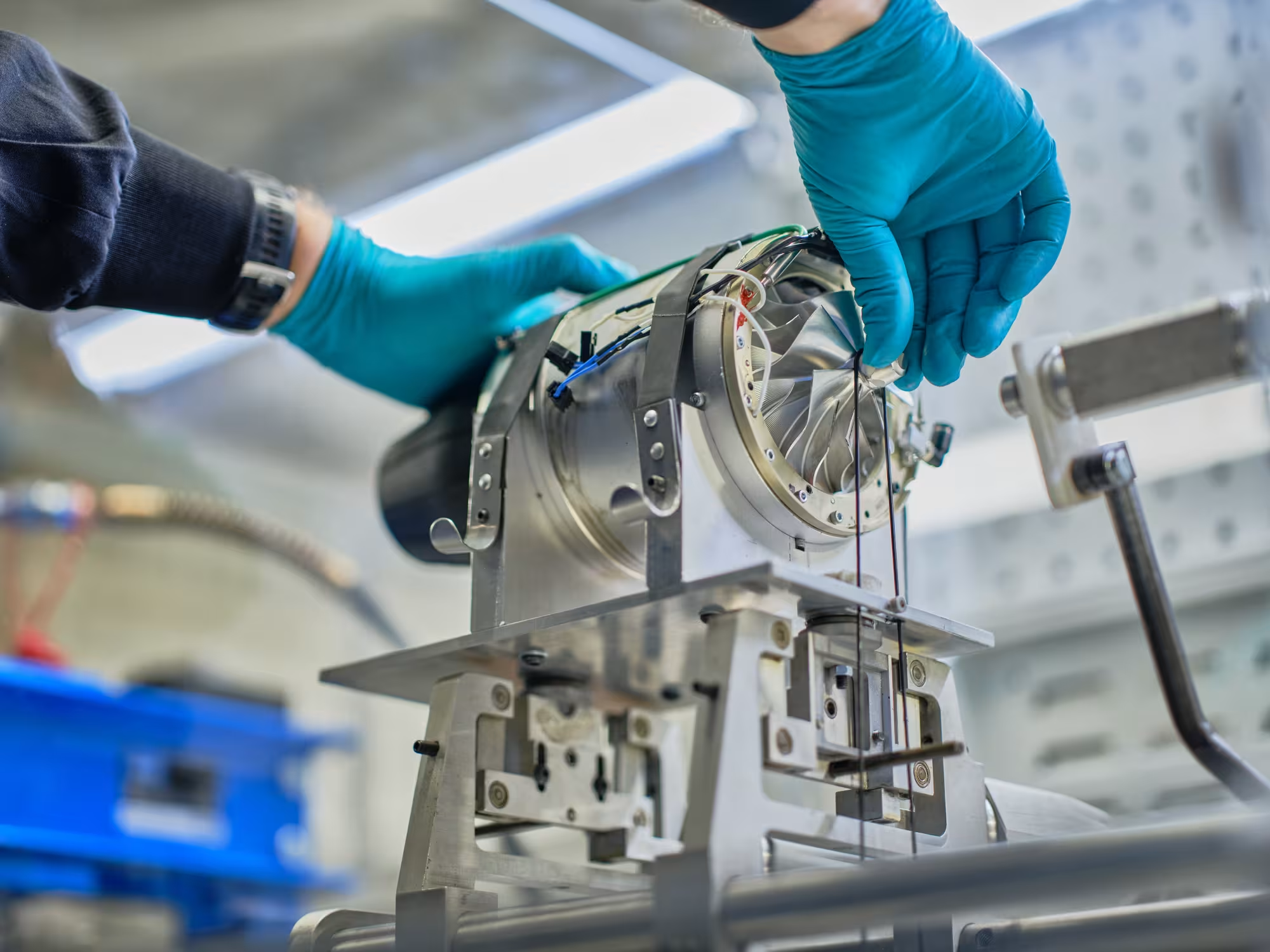
But right now, their halo product is a jet engine so small that it ships in a large shoebox, yet boasts a peak thrust of 300Nm, a perfect application for drones and interceptors that can match the jet- powered missiles and other ordnance being thrown at Ukraine by Russia, and other comparable defensive scenarios such as in the Middle East in recent months.
The subject cannot be discussed beyond generalities, except to acknowledge a partnership with the UK’s Ministry of Defence and a wide network in all directions including Ukraine.
‘This activity is not a pivot for the company, but the defence space is driving our growth and has also become a wider vector for innovation. It has positive implications for our other products and platforms,’ says David.
André reports that there was a good discussion about Alloyed’s propulsion technologies.
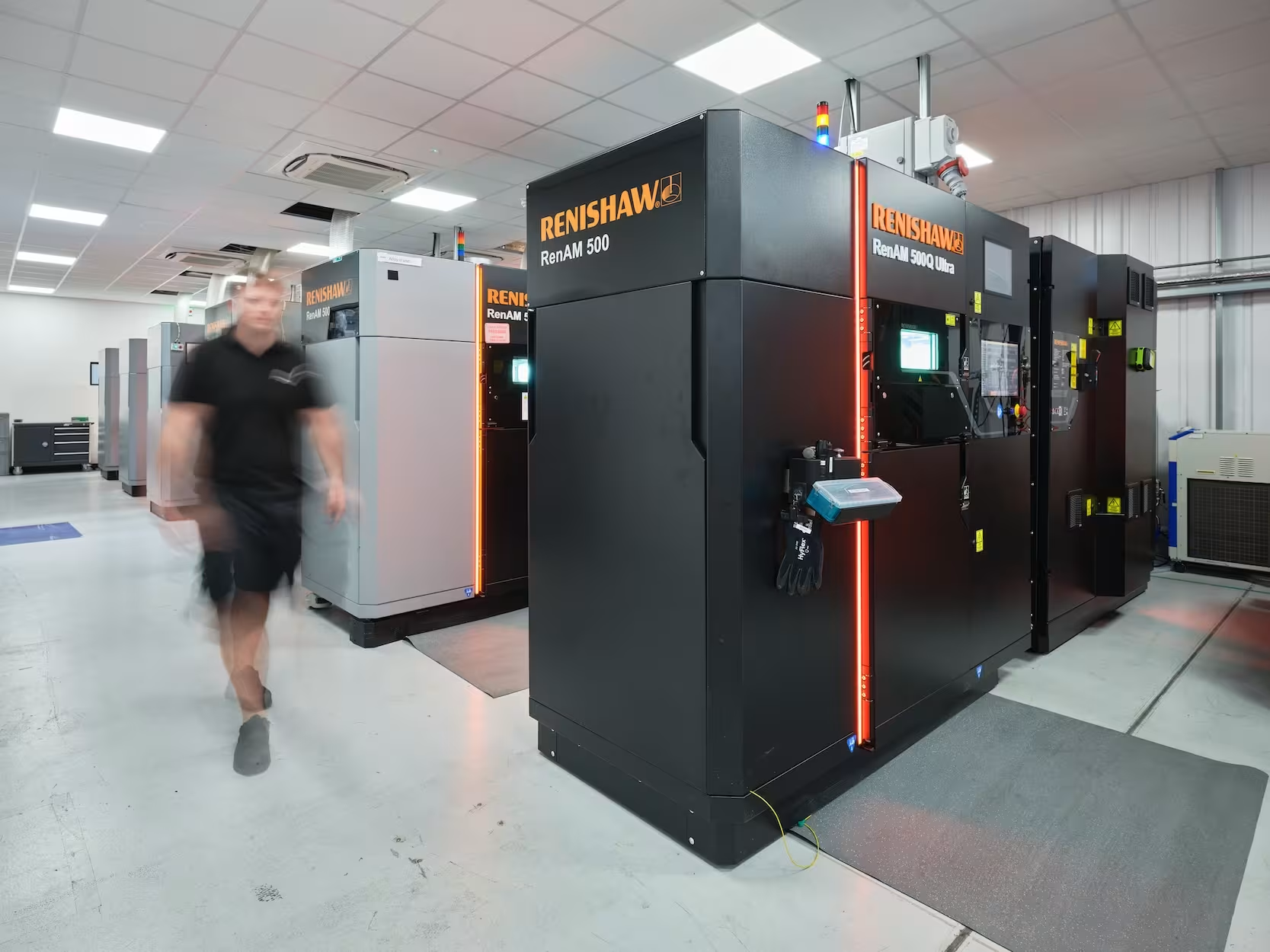
A walking tour takes us around the side of a huge industrial building, lined with air-conditioning units. They are not there because of the recent heatwave but because of the need to cool the housing of the 3-D printers, Renishaw RenAM 500Q Ultras – the size of a small car and each costing the thick end of a million pounds, twenty of them on site, all made by a British FTSE 250 company based in Wotton-under-Edge, Gloucestershire.
André explains that their lasers draw a lot of energy and produce a lot of heat.
The cost and reliability of energy are issues, but not enough to dissuade the company from continuing to expand locally within Oxfordshire.
With no prompting, David returns to the company’s roots in Oxford University’s Department of Materials and adjacent Faculty of Engineering (most of the employees of Alloyed are engineers by degree subject).
‘We have the links. The University produces the talent by educating really, really bright students, they are confident and they are enabled…’
We are introduced briefly to several employees, all of whom seem bright as buttons.
One of them says she went to Cambridge, indicative of the Oxford-Cambridge growth corridor or ‘arc’, these days simply referred to as OxCam. Professor Reed also started his brilliant career at Cambridge, only coming to Oxford in 2013 after stints at three other universities, one of them Imperial College, London.
Go west from today’s Alloyed site in Abingdon and you encounter the Defence Science and Technology Laboratory (Dstl) in Wiltshire, the agency of the UK Ministry of Defence (MOD) responsible for delivering science, technology, and analytical research to support British national security.
There is another engineering company in the same space, over in Bicester, called Aira Technology, that boasts of a Formula One heritage. They too are developing small jet engines.
Rolls-Royce, the original sponsor of David and André’s Oxford DPhils, has a whole programme dedicated to larger but still ‘compact’ turbojets, called Orpheus.
Professor Reed, meanwhile, is Chief Scientist at the High Temperature Research Centre, a joint venture between Rolls-Royce and the University of Birmingham, in Coventry.
Common to most of these programmes is additive manufacturing, that does away with time-consuming metal casting. This allows rapid iteration and supply-chain simplification, where many discrete parts are resolved into one part.
It feels like a fertile, regional and national context for Alloyed.
‘Our ambition is to make Oxford a leading centre for digitally driven propulsion, bringing together a cluster of complementary organisations,’ says André.
Having peered into large rooms and seen intricate data passing across screens, measuring tiny tolerances in the manufacturing process of the printers, we sit down again to dig a bit deeper.
Where exactly does the innovation sit? Is it the novel metal alloys or the manufacturing, or the computing?
The question, to a degree, is a journalistic mischaracterisation, an oversimplification.
André says that superficially you’d be right to think of the company as inventing novel metal alloys, and then 3-D printing clever stuff out of them.
‘That’s easy but it would also be wrong,’ he says. ‘The real story is how you go from a digital design to making the printer print what you intended it to.’
‘What you don’t do is merely upload a programme to the printer and click "go".’
‘How do you instruct your machine to achieve fidelity to the design, plus the lowest cycle time to reduce cost, plus the highest quality?’
In the aerospace sector you might be dealing with mechanical tolerances measured in microns, less than the width of a human hair.
‘Composition and metallurgy are at the core of it, plus repetition and scalability.’
Other sectors served by Alloyed have included intricate titanium ‘scaffolding’ for human joints, in combination with the NHS, and also a brush with the jewellery sector. The power generation sector is also within their portfolio.
But right now it’s the small jet engines that are behind growth that might triple turnover to $100 million in the next financial year 2027-8, spurring Alloyed towards unicorn status.
André says that the small jet engine market is ‘supply-constrained right now’, and that Alloyed is looking at several ‘go faster options’.
Professor Reed, who is a Director at Alloyed, says that the company could become ‘a major defence contractor, wholly owned within the UK'.
Driving the serial production of the A300 and A1100 turbojet engines are large trade contracts. The A300 is already in production.
My tour ends with a trip to Oxford airport to watch a final-stage test of an engine (Alloyed has a facility there).
We study the A300 on a test rig, an unmistakable kerosene tang in the air. 70 different parts at the heart of this engine have been reduced to a single, printed entity, an incredible statement of what the company has achieved.
André adds that Alloyed’s software capabilities allow the performance characteristics of the engine to be changed instantly. ‘It can be tuned to maximum speed or maximum efficiency, for different applications,’ he explains.
Taken straight off a new production line in Oxfordshire, it fires up very quickly, indicating that the traditional issues of difficult ignition in jet engines may have been resolved.
Then we all don ear defenders as the thrust is turned up to maximum, at which point it sounds exactly like a civilian airliner about to take off, only it is three metres away through a thin wall and comparatively tiny.
At full blast, the rear of the engine, which we observe through a camera, glows orange with heat, and a mirage forms in the surrounding air, not unlike a war documentary featuring a clip of a fighter jet taking off from an aircraft carrier.
The company is now looking at a Series-C funding raise, which will likely be a sum in the tens of millions.
David enthuses about Oxford’s Robotics Group with which Alloyed maintains vigorous contact. It is impossible to imagine the company without the University, but it is also impossible to conceive of the University in 2026 without the company and the way in which it illustrates how much has been learned about IP protection, commercialisation and capitalisation, regional growth and innovation, and the sort of very patient capital that OSE has excelled at.
‘Manufacturing is suddenly interesting again as AI has eaten into coding,’ says David. ‘Hardware is the new software!’
Professor Reed says, ‘I’m very proud of what they have achieved – the next stage is going to be very exciting and critical in the company’s development.’


