
The body as an orchestra: Oxford alumni at the Met
Members of the Oxford Alumni Association of New York were given a private morning inside the Musical Bodies exhibition, with curator Bradley Strauchen-Scherer (Somerville, 1995) and artist Saba Qizilbash (Exeter, 2021).
Author:
Vanshika Goel
Tags:

For New Yorkers, few activities mark the coming of autumn like a morning at the Metropolitan Museum of Art. On September 19, an hour before the Met opened to the public, around 30 Oxford alumni came in through a side door on 81st street for a private visit to Musical Bodies, the museum's major exhibition on the relationship between musical instruments, human bodies, and the collective body. As a Board Member at the Oxford Alumni Association of New York (OAANY), I was lucky to host this conversation with curator Bradley Strauchen-Scherer (Somerville, 1995) and artist Saba Qizilbash (Exeter, 2021).
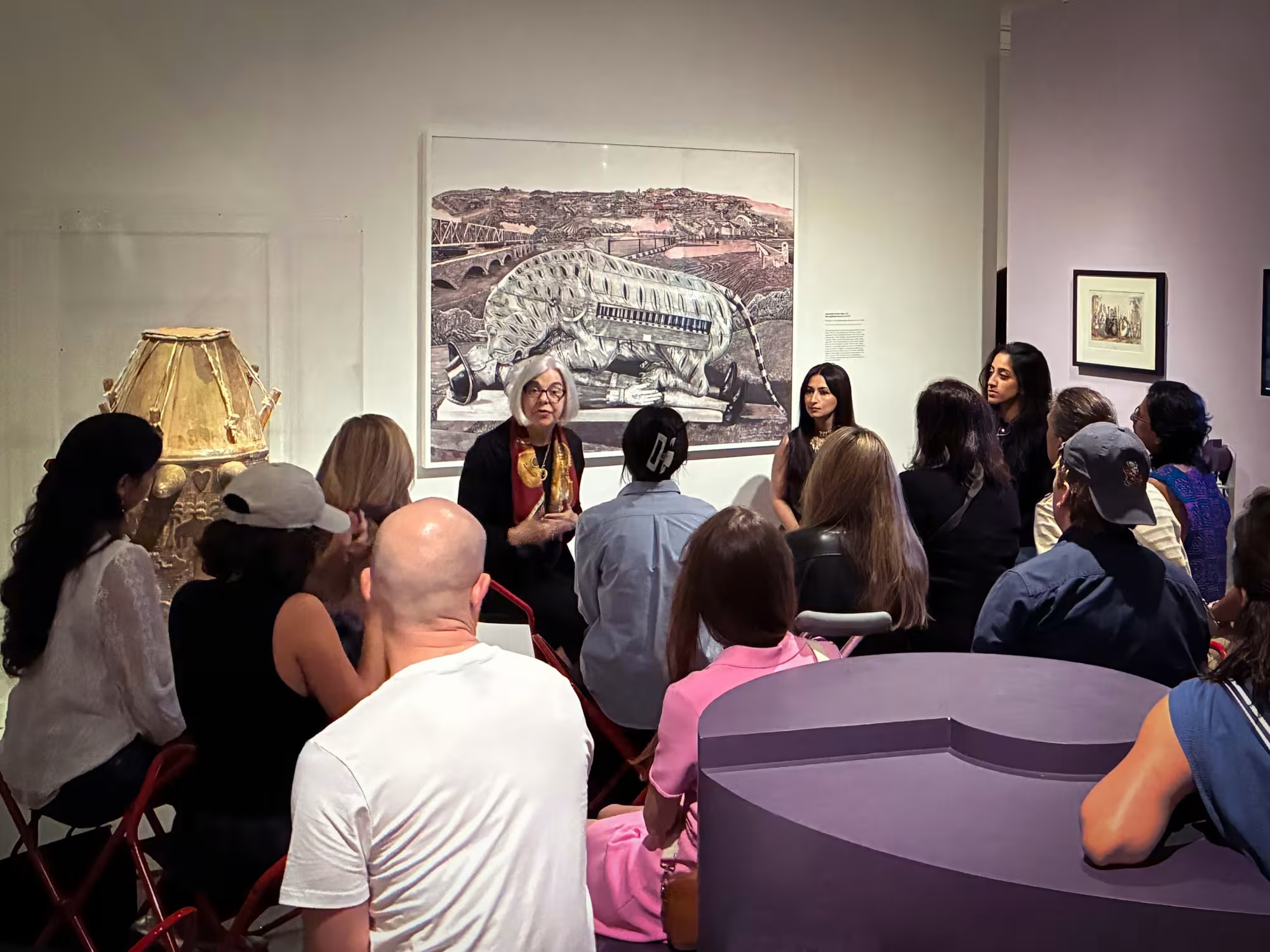
Curated by Dr Bradley Strauchen-Scherer, curator in the Met's Department of Musical Instruments, the exhibition brought together some 130 instruments, paintings, sculptures and drawings spanning 4,000 years. These ranged from ancient Egyptian rattles and works by Titian and Degas, to instrument-inspired clothing and one of pop-icon Prince's most recognisable guitars. Hidden crouching within the immersive soundscape, amidst a maze of purple walls and antique golden frames, lay the Repatriation of Tipu's Tiger.
Rather than gathering in a lecture room, the group sat among the cases and sound installations of the exhibit itself, sharing its soundscape and moving to its rhythm. As our panelists sat and the applause died down, I asked my first question: why the body? To this, Dr Strauchen-Scherer looked around the room and asked us to clap again. 'You're making music' she remarked. Indeed, clapping, stamping, whistling and singing were precursors to modern music. Now externalised into metal tubes and plucked strings, the human body was our first instrument.
Upon introducing the rest of the exhibition, Dr Strauchen-Scherer turned her attention to Saba Qizilbash, a fellow Oxford alumna who travelled from the UK for the event. Born in Lahore, Pakistan, and raised in Abu Dhabi, Saba trained at the National College of Arts in Pakistan and the Rhode Island School of Design before her MFA at the Ruskin School of Art. Her work, shown in the UK, the UAE, Hong Kong, the US and Pakistan, explores partition and the contested borders of the subcontinent.
Taking us first through her creative process, Saba noted that she produced this work as a response, both artistic and visceral, to Tipu's Tiger, a semi-automated musical construction currently on display at the Victoria and Albert Museum in London. The instrument takes the form of a near-life-sized wooden sculpture of a European soldier mauled by a tiger, but uniquely conceals an organ operated by the turning of a handle.
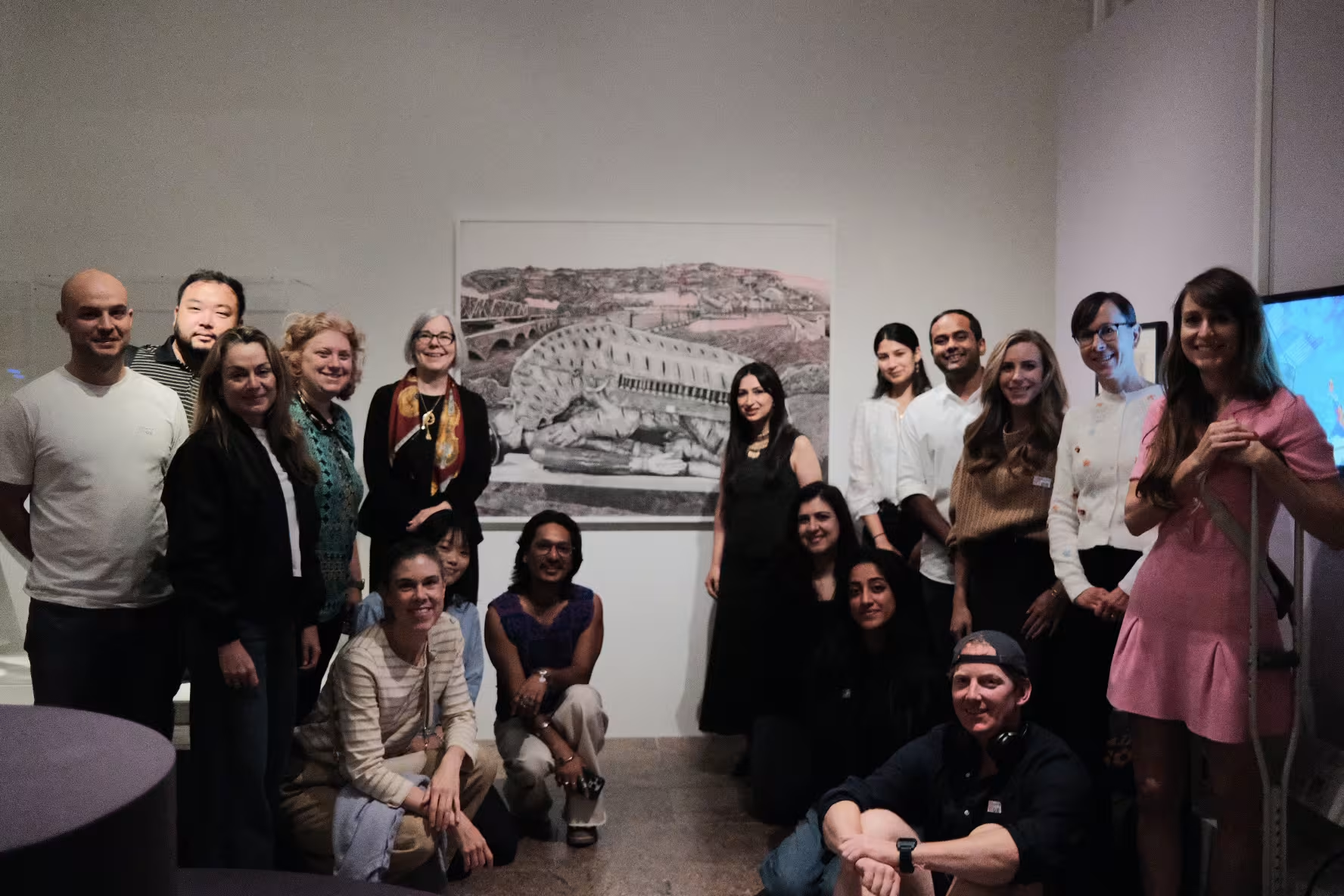
Saba's reclamation (or repatriation) of the tiger emerged as a response to her upbringing in Pakistan and understanding of the relationship between art, colonial legacies and artistic duty. Her piece thus re-contextualises Tipu's Tiger within the landscape of South Asia, through references to architecture at the crossroads of India and Pakistan, both past and present. The significance of this history, at once reclaimed and contested, was re-emphasised by the splashes of red amidst a largely monochrome landscape. Saba encouraged an inquiry into the relationship between colour and emotion and unsurprisingly, red evoked senses of rage and questions of power for most of the audience.
Turning then to New York as a hub of arts and culture, I asked Saba what she would say to busy New Yorkers who believe they are not creative. To this, Qizilbash reminded us that everyone can engage in the creative process through everyday life, from singing in the shower to doodling during Zoom calls. When asked about what she'd consider as the soundtrack to her work, she suggested listening to traditional Qawwali, a form of Sufi devotional music.
Bringing a curator and an artist together with investment bankers, scientists and others, the morning showed how far Oxford's community reaches into New York's cultural life — and offered alumni an unusually close encounter with the oldest instrument of all: the human body.
At ten, the doors opened and the gallery started to fill, and I was reminded of the transformative potential of shared sound. Adults were morphed into children as they jumped to the tune of 'Happy Birthday' on interactive piano tiles. Children sat in silent fixation, in front of brass instruments three times their size. Alumni were free to roam but many, transfixed by the tiger, chose to stay.
The author is Vanshika Goel (St Hugh's, 2020)


