
Oxford’s secret farm
A working farm is now making a splash – right in central Oxford.
Little understood is how transformational the University’s ownership of land can be, the case in point being the ancient meadows opposite the University Parks and Lady Margaret Hall.
Author:
Richard Lofthouse
Tags:

Alumni gathered for a walking tour at the 2026 Meeting Minds, and Conservator of Oxford’s Green Estate Nigel Fisher began by explaining that the type of grassland we were about to stroll around had declined by 92% in England in the past half-century, and was therefore of very high ecological value.
He explained that there is a British National Vegetation Classification system (NVC), and that within it there sits MG4 grassland, ‘a rare, species-rich community officially known as Alopecurus pratensis–Sanguisorba officinalis grassland, representing classic lowland neutral floodplain meadow’.
Park Farm comprises 115 acres, mostly of exactly this classification of water meadow and riparian pasture, a generous braid of greenery between the University’s science area and Marston.
We have just crossed Rainbow Bridge at the very apex of University Parks, turned left and are by the River Cherwell and a towering willow tree, fluttering in a still-summery breeze and warm sunshine.
‘The farm was tenanted for many decades but taken into direct management by the University three years ago. It had been neglected so we have a lot of remedial management to do to bring it back, in particular ditch clearance.’
Nigel then explained that ‘ditches are not to be thought of as “drainage” but “water management”.’
When the seemingly endless rain of recent mild winters comes, it comes quickly. The Cherwell rises rapidly and the excess water fills the ditches and typically floods the meadows.
We learned, however, that too much flooding of the meadows can rot the bulbs of certain flowers such as the snake’s head fritillary (Fritillaria meleagris), one of the rare species associated with MG4 grassland.
The ditches need to be deep and clear to do their job as a compensatory mechanism for absorbing and disgorging excess water.
The c. 30 kilometres of ditches on Park Farm are in the process of being re-profiled, dug out and unclogged, which also means a lot of coppicing and other tree and vegetation management.
Nigel explained that it costs about £30,000 per kilometre to clear these ditches, with a planned expenditure of £350,000 over the first ten years and more over time depending on grant aid.
Why, one might ask, is Oxford University getting into farming? The farm is not of huge commercial value but supports beef cattle and hay production. Nigel explains that it has potential.
But, and this is a huge consideration, the meadows have never been sprayed with industrial chemicals. As riparian grassland habitat they offer one of the finest glimpses into a pre-industrial landscape that you can imagine. This and other factors offer rich pickings for researchers across the University, which today includes the Leverhulme Centre for Nature Recovery, besides the Departments of Zoology and Biology.
Research in the Department of Zoology played a major role in the emergence of modern ecology, especially through the work of figures such as Charles Elton, David Lack, Richard Southwood and Robert May. The department, housed in the recently opened, short-walk-away Life and Mind Building, hosts two research institutes that focus on biodiversity and conservation.
The benefit of Park Farm to researchers is hard to overestimate and it was that research value that drove the University to take up the farm directly rather than re-let it.
Designated also as part of the New Marston Meadows Site of Special Scientific Interest (SSSI), Park Farm features rare lowland neutral grasslands and calcareous clayey soils.
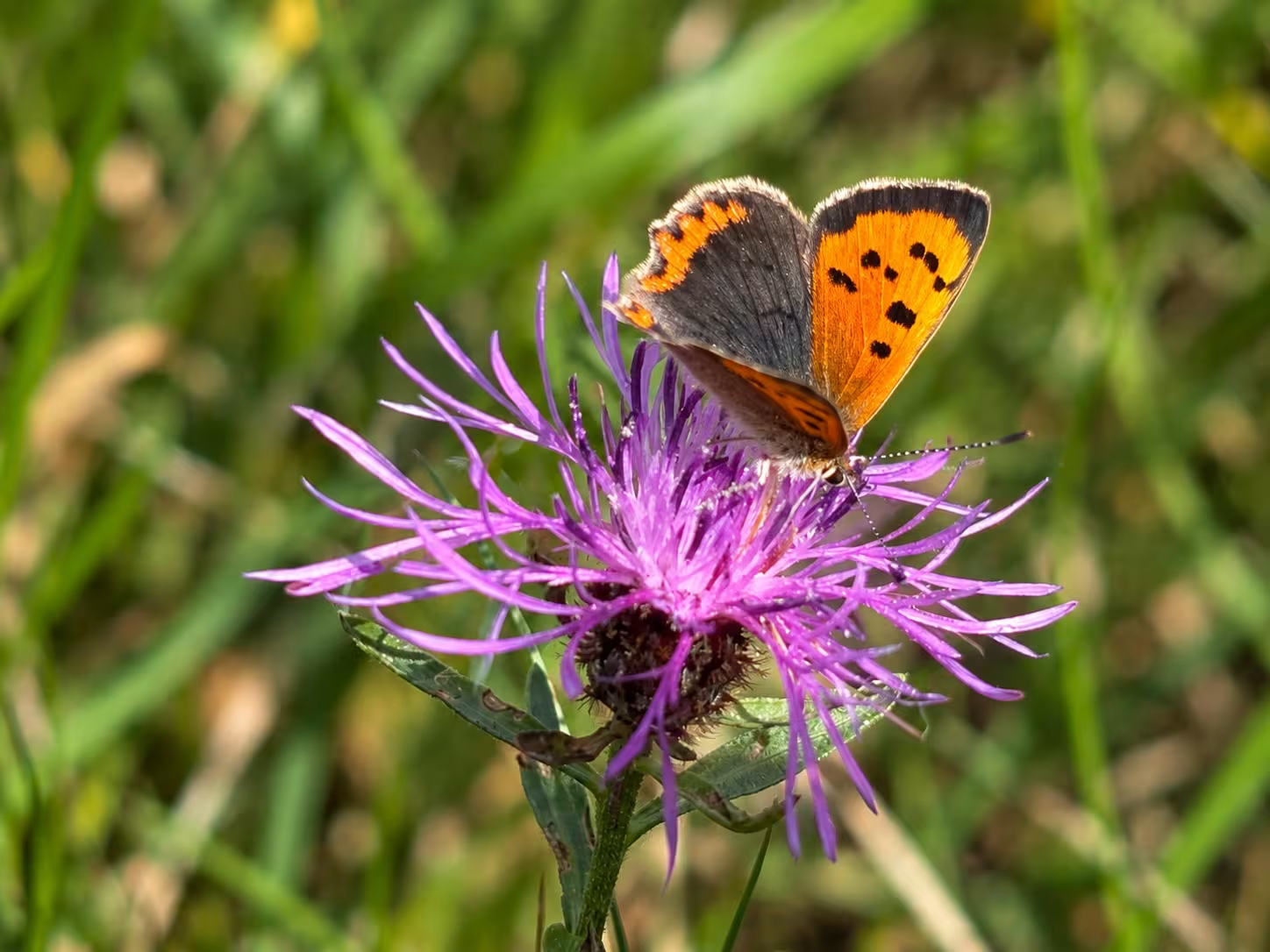
Now in the meadow proper, I crouch to photograph a flowering common knapweed (Centaurea nigra), and am rewarded as a small copper butterfly (Lycaena phlaeas) lands right on it as I stab away at my phone screen.
Lucky or just testament to the habitat? Someone else spots a common brimstone (Gonepteryx rhamni), its lemony yellow form fluttering brightly amongst sunlit September grasses, a late survivor of the drought.
Between us we spot common plantains (Plantago major), meadow rue (Thalictrum), devil’s-bit scabious (Succisa pratensis), meadow buttercups (Ranunculus acris), common sorrel (Rumex acetosa), salad burnet (Sanguisorba minor) and marsh stitchwort (Stellaria palustris).
Evidently there are experts in our midst.
Another butterfly, reasonably in evidence earlier in the year, is the brown hairstreak (Thecla betulae), reports Nigel. That’s important because, unlike the meadow brown (Maniola jurtina), the hairstreaks are now rare while all UK butterfly populations are under pressure.
He says that different researchers have set out to monitor the populations of bats, birds and butterflies in a single transect.
A vigorous discussion erupts about whether the snake’s head fritillary is native to Britain.
Nigel jokes about the difficulty of establishing ‘a single ecological fact’.
‘We play this game with undergraduates. Tell us an ecological fact. You start with something obvious, such as a given plant being “native to England”, and then you encounter caveats and complications because the broader habitat is dynamic both in the immediate, daily sense and across decades, centuries, millennia; and the real truth of the claim becomes elusive or meaningless in any evolutionary sense.’
He adds that ‘we can “wild” but we can’t “rewild”. We can’t return to some former landscape, to the past, say the 16th century.’
That’s not only because of a changing climate, which changed historically as well, but because, for example, Bicester has expanded rapidly, with extensive housebuilding which accelerates run-off, with deep implications for broader water management practices downstream.
‘Downstream’ is where we are standing.
He jokes that there are approximately 30 different parties who all want something different from the Cherwell watershed.
We wander further and we look up at ash trees suffering from dieback, the East Asian fungus named Hymenoscyphus fraxineus that was confirmed in 2012 and is now killing most ash trees in England, not unlike Dutch elm disease in the 1970s.
Nigel shows us a photograph of a 15-ton excavator that nearly disappeared into the gloopy mud last winter. More ditch clearance will commence this coming season.
There are delightful stories that bubble up during the walk, such as one family who expressed their gratitude to the University, recounts Nigel, because their young daughter was having difficulty going to sleep until she was shown the beef herd lying down for the night, and it was cited as a seminal moment. Reference to the livestock going to sleep seemed to provide bovine inspiration for toddler slumber.
Nigel’s job title has changed too. He used to be the Curator of Wytham Woods but is now Curator of the Green Estate. He explains that all the green areas of Oxford under University management have now been amalgamated into a coherent whole, which extends their usefulness to researchers.
The Oxford Green Estate (OGE) was officially launched in 2025 and consolidates 23 University-owned green spaces spanning over 1,300 hectares (more than 3,200 acres) under a unified management strategy.
Among the key locations are Wytham Woods, Northfield Farm (agricultural and environmental land situated near Wytham), Court Place Gardens (a mélange of wet woodland and old punting channels) and where we are standing today, Park Farm.
The entirety of the Green Estate is core to three functions: coordinated land management to achieve the University's 2035 net-zero carbon and biodiversity net-gain targets; academic integration towards climate research, sustainable farming experiments and field-based student education; and finally the opening of natural habitats up to students, staff, alumni and local communities for recreation, volunteering and wellbeing.
Park Farm is serving all three and we meet lots of other people enjoying the footpaths that criss-cross it – no longer the vaguely private mystery it once seemed but a community-facing green jewel valued by all.


