
Off the Shelf: November 2026
Oxford physics, wine science, Black scholars at Oxford, book burning, gay love in the 1950s and the infamous King & Country debate of 1933
Author:
Richard Lofthouse
Tags:


Oxford Physics and the Modern World
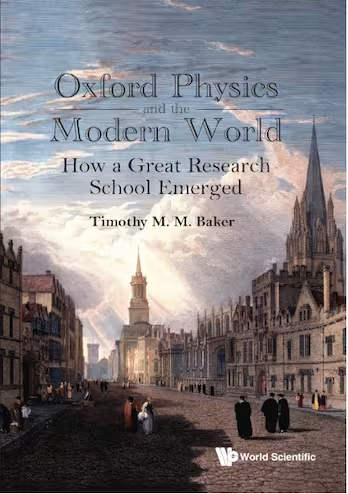
Oxford Physics and the Modern World: How a Great Research School Emerged by Timothy MM Baker, (WSPC, 22 October 2026)
Not only is this elegant, illustrated volume a class act, but it fills an urgent need. The ‘non-medical sciences’ were polished off in just two essays in The Twentieth Century (Vol VIII) The History of the University of Oxford, and that was published in 1994. In this comprehensive narrative by Timothy MM Baker (Corpus, 1979) we get the proper history told from the dawn of the University in the thirteenth century through to a swelling list of Nobel Laureates and Nobel nominees in the 20th Century.
The footnotes are rich pickings too, in the traditional sense, and by being published on the page as they arise instead of being banished to the back, you can maintain dual progress much like having two windows open on a computer. The very first footnote reminds us that the word ‘algorithm’, so ubiquitous today, is a Latinised rendering of the name of Arabic mathematician Al-Khwarizmi, whose book on Indian numbers conceptualised the meaning of zero and was in circulation, via Adelard’s translation, in Oxford in the late 1200s.
Oxford ‘physics’ was bright and brilliant until the Black Death struck in 1349, and according to this rendering also laid the foundation for empirical observation despite a largely theoretical basis built on Aristotle. Come the Renaissance and Oxford had become more backfoot than bright arrow, two dons arguing against Bruno and Copernicus in a staged debate held in the years before 1584. Cue another footnote glint: ‘At least Oxford was less intolerant than Rome, where Bruno was burned at the stake.’
From there on, however, the modern science began to come to life in stages. First there was experimental philosophy and astronomy during the Enlightenment, and the building of the Radcliffe Observatory (1772-94). Then came Robert Clifton’s Clarendon Laboratory, completed in 1872, the first purpose-built physics laboratory in England.
Then the book is off on a gallop that is partly about electricity, partly about particles, and partly about expansions, reform under Frederick Lindemann, and inevitably consolidation. The welcome inflow of continental talent merits devoted sections on Albert Einstein and Erwin Schrödinger, and the much broader narrative concerns low-temperature physics and how it came to Oxford and took root. Several branches of spectroscopy; the theory of superconductivity; particle and nuclear physics; astronomy and astrophysics.
What is lovely about the narrative is that it takes an even approach, rooting the present in the past. The cover image could have been a test tube or other piece of laboratory ware, generic and universal. Instead the author wisely went for the beautiful painting of Oxford’s High Street in 1812, after JMW Turner, showing men on ladders opposite the University Church, readying Robert Boyle and Robert Hooke’s laboratory for demolition. By dedicating the book to the memory of former members of the Clarendon Laboratory, one of whose prominent members was the author’s father, Baker has continued to celebrate the human side of the equation and the way in which the generations still speak to each other despite the otherwise rapid advance of the ‘new’.
Noble Nine
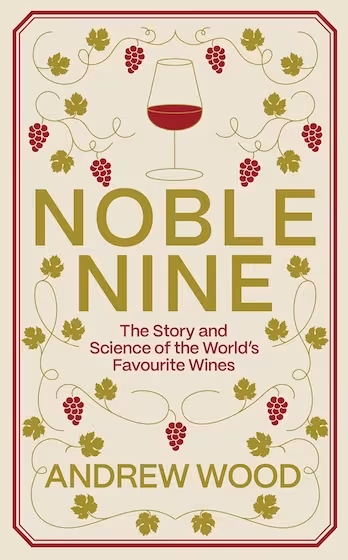
Noble Nine: The story and science of the world’s favourite wines by Andrew Wood (Granta, 5 November, 2026)
The ‘noble nine’ grapes here refer to: Merlot, Chenin Blanc, Cabernet Sauvignon, Chardonnay, Pinot Noir, Sémillon, Shiraz/Syrah, Riesling and Sauvignon Blanc. Chapters are themed by these standard bearers of the global wine trade but told not as grape biographies but with the grapes themselves as actors in a global play. ‘…every chapter uses one of the Noble Nine as a hero, supported by the other eight, to explore a broader theme across the wine industry.’ ‘Thus, merlot introduces us to the traditional origin story of wine…which is then challenged by Chenin Blanc’. It culminates in Sauvignon Blanc, which takes on climate change and the future of wine.
Andrew (Somerville, 2016) tells us, ‘My [Oxford] DPhil was understanding the impact of climate change on wine quality. I looked at how climate changes the flavour of wines, the future impact of climate on wines, and created tools for grape growers on predicting harvests and future planting sites for their wines.’ This book builds on these insights. It embraces and explains how a scientific revolution is taking place both to understand wine and to make it better, even while extreme weather and climate change present huge and unfolding challenges.
In a publishing segment strewn with derivative work this volume commands the attention of everyone in the wine trade while making for a thoroughly good read even if your greatest achievement is picking the winners at Lidl. The author has dug right down into biology and ecology of wine quality, having begun with a fascination in vine botany at both macro and microscopic levels. The result is fascinating and reads like a fine champagne sips.
A wonderfully timely publication as Christmas looms into view again and as the temperatures fall, beckoning the drawdown of big reds and a wood burning stove. But this is no stocking filler, rather the compelling work of a budding world expert on the ecology of grape vines, initially an interest at Oxford, then much more so as a biology DPhil supervised by Professor Tim Coulson and Dr Elizabeth Jeffers.
Black Oxford
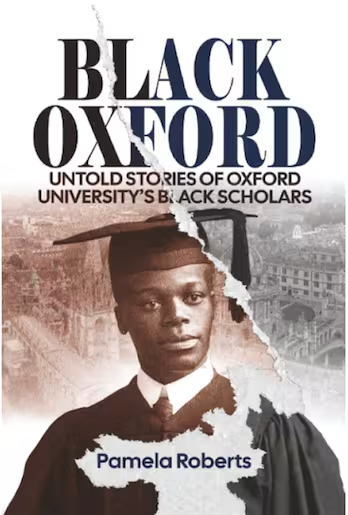
Black Oxford: Untold Stories of Oxford University’s Black Scholars by Pamela Roberts (Signal, 29 October 2026)
Pamela Roberts is an award-winning creative producer, historian and Fellow of the Royal Historical Institute and produced in 2013 a landmark book, Black Oxford. Now in late 2026, she has published an expanded second edition that goes much further in pulling together the temporal geography and prosopography of Black diaspora students and scholars at Oxford, typically but not only of African, African-American or Caribbean descent.
The first edition was a history of pioneering individuals but the second edition adds the intervening 13 years as years of progress for the whole University of Oxford in its attitude to and enrolment of Black students. The first edition played a constitutive role in unlocking that action, but the author has implemented more actions along the way such as establishing a Black History bus tour of Oxford for tourists, which completely changes the cultural geography of the collegiate University and for instance stops at Logic Lane, where a plaque celebrates Christian Frederick Cole (Univ, 1873) (1852-1885), a barrister and the first African to practise law in the English High Court. Only because of Pamela’s lobbying does this plaque exist. It was unveiled in 2017 by then Master of Univ, Sir Ivor Crewe. Now it is a powerful cultural monument of memory in its own right, and perhaps in a small way a corrective to the endemic racial abuse that Cole suffered when at Oxford, now covered much more comprehensively in the new volume, wisely accompanied by a trigger warning because it’s unpleasant and underscores the deeply racist assumptions behind Victorian Empire.
Another star of this revised and expanded edition of Black Oxford is Lady Kofoworola Aina Moore Ademola (St Hugh’s, 1932) (1913-2002). Pamela frames her matriculation with Amelia Earhart’s non-stop flight across the USA the same year, and Hattie Caraway’s election to the US Senate – the first woman. What is striking now is not only that it took 42 years for a women’s college to accept a black woman but that it happened with help from Margery Perham, the colonial historian and alumna also of St Hugh’s; and that Kofoworola came from a pinnacle elite family in Nigeria and had been raised in the strictest way to speak perfect English and basically to assimilate so flawlessly that no one in the English Establishment could fault her. Immediately upon attending Oxford she was besieged with invitations to tea that were voyeuristic in nature, indicating the presence of a Black woman as spectacle. It was shameful but it was also normal for the time. She went on to be a champion of women’s education and there is a lovely picture of her receiving her MBE at Buckingham Palace in 1959.
Chapter 6 ‘The Next Generation’ blows away all the cobwebs with a brilliant series of biographies about current and recent Black students at Oxford and their achievements.
Chapter 3 honours the Windrush Generation, less because of their scholarship and more because of their contribution to the City, whether working in transport or at the Morris Motors Factory. Pamela says that by the late 1960s, as many as four thousand employees at the Cowley plant were of African-Caribbean heritage.
The book in both its editions has served up an invaluable contribution to scholarship and action, and Pamela notes that she is speaking at the Oxford Indie Book Fair on 22nd November.
Ideas in Flames
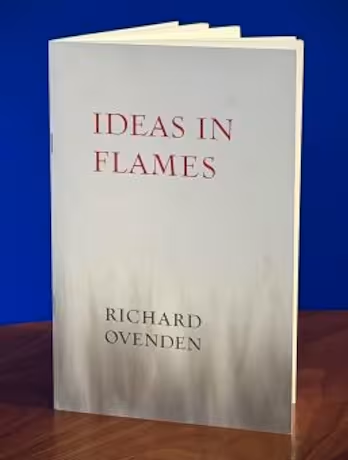
Ideas in Flames by Richard Ovenden (Russell Maret, 2026)
Only available from private printer Russellmaret.com, this is book as objet d’art but in such a way as to privilege the terrible truth of 2026, that free speech is imperilled and in many parts of the world books and the ideas and knowledge they contain are subject to persecution. In this sense this volume continues where Richard Ovenden’s Burning Books: A History of Knowledge under Attack (2020) left off. It details worldwide efforts to destroy or ban books, centring primarily on Afghanistan and the United States. Through stirring portraits of the destroyers, as well as those under threat, Ovenden offers a rousing defence of the importance of literature and libraries. It is a defence that one would hope was unnecessary in the twenty-first century. The fact that it is not makes this book all the more important. Russell Maret, based in New York City, was formerly a Printer in Residence at the Bodleian Library.
A Way of Love
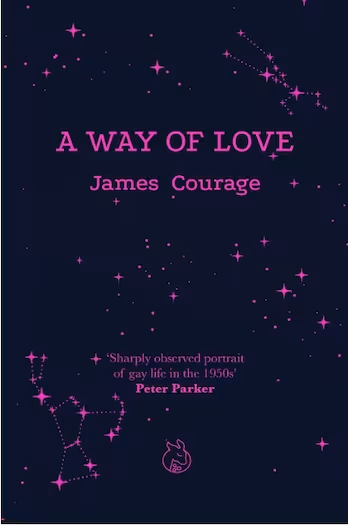
A Way of Love by James Courage (Lurid Editions, 26 September 2026)
This is a notable re-edition of a partly forgotten work of pioneering gay literature. James Courage (St John’s, 1923) (1903–1963) came to Oxford from New Zealand in 1923, studying English at St John's College. While there, he began developing his literary career, publishing poetry in Oxford Poetry, writing music criticism for Isis, and becoming involved with the Oxford University Dramatic Society, which staged two of his short plays in 1926.
He went on to publish eight novels and build a literary life in London, but his attempts to write openly about homosexuality encountered censorship throughout his career. His 1938 play Private History was prevented from transferring to the West End after the Lord Chamberlain refused it a licence, while his 1959 novel A Way of Love was subject to substantial editorial restrictions before publication and subsequently banned in his native New Zealand in 1961.
A Way of Love is a fascinating novel in its own right. Widely considered the first gay novel by a New Zealander and set in late-1950s London, it follows two men attempting to sustain a relationship while sex between men remained criminalised. Quite apart from its literary merits, the novel is unusual for its intimate depiction of gay relationships and everyday life before decriminalisation. This was something that resonated deeply with the novel's first readers, several of whom wrote to Courage about their own experiences of loneliness and isolation as well as their joy at having found themselves depicted in literature.
After 67 years out of print, the publisher notes the introduction of this re-edition by Peter Parker and an afterword by historian Chris Brickell, who edited the James Courage Diaries in 2021.
Courage Day — New Zealand's annual observance of literary censorship and freedom of expression, named after James and his grandmother Sarah — was celebrated on November 15.
King and Country
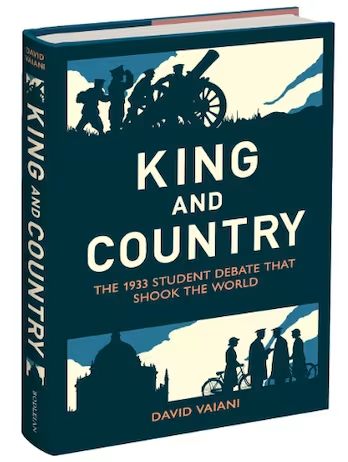
King and Country: The 1933 Student Debate that Shook the World by David Vaiani (Author), Michael J. Beloff KC (Bodleian Library Publishing, Nov 5, 2026)
On 9 February 1933, barely ten days after Adolf Hitler had become Chancellor of Germany, the Oxford Union, the internationally renowned student debating society, sent shockwaves around the world when its members declared that they would, in no circumstances, fight for King and Country.
The Oxford Oath, as it became known, led to furious newspaper editorials, unleashed a political storm that lasted for several weeks, and triggered similar debates at other universities around the world.
The individuals present at the Oxford debate – including, among others, Michael Foot, Dean Rusk and Terence Rattigan – were future stars in their own right, but they were also typical of their generation: young and idealistic, they had grown up in the shadow of the First World War and some of them became pacifists at a time when the world appeared to be falling apart.
King and Country tells the full story of the debate, examines attitudes towards pacifism and appeasement in Britain between the wars, and seeks to understand this fascinating period of history through the eyes of a generation that said no to war.
It is also a fine reflection on the manner in which students hold the world to account with views that are either heterodox for the temper of the times or, depending on your point of view, extreme or wonderfully progressive. All this at a time of hot debate about platforming and no-platforming, free speech and equality, race and gender.