
Painting the Chancellor
The Chancellor’s portraitist Louise Pragnell takes us behind the scenes
Author:
Richard Lofthouse
Tags:
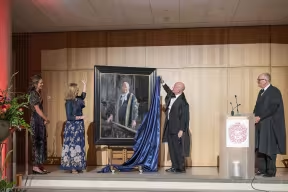
The unveiling on 8 October 2026. Credit: University of Oxford/John Cairns

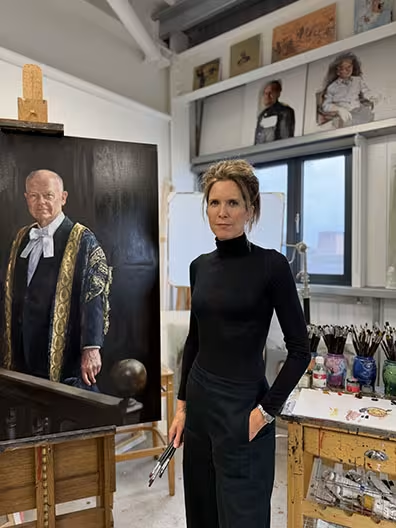
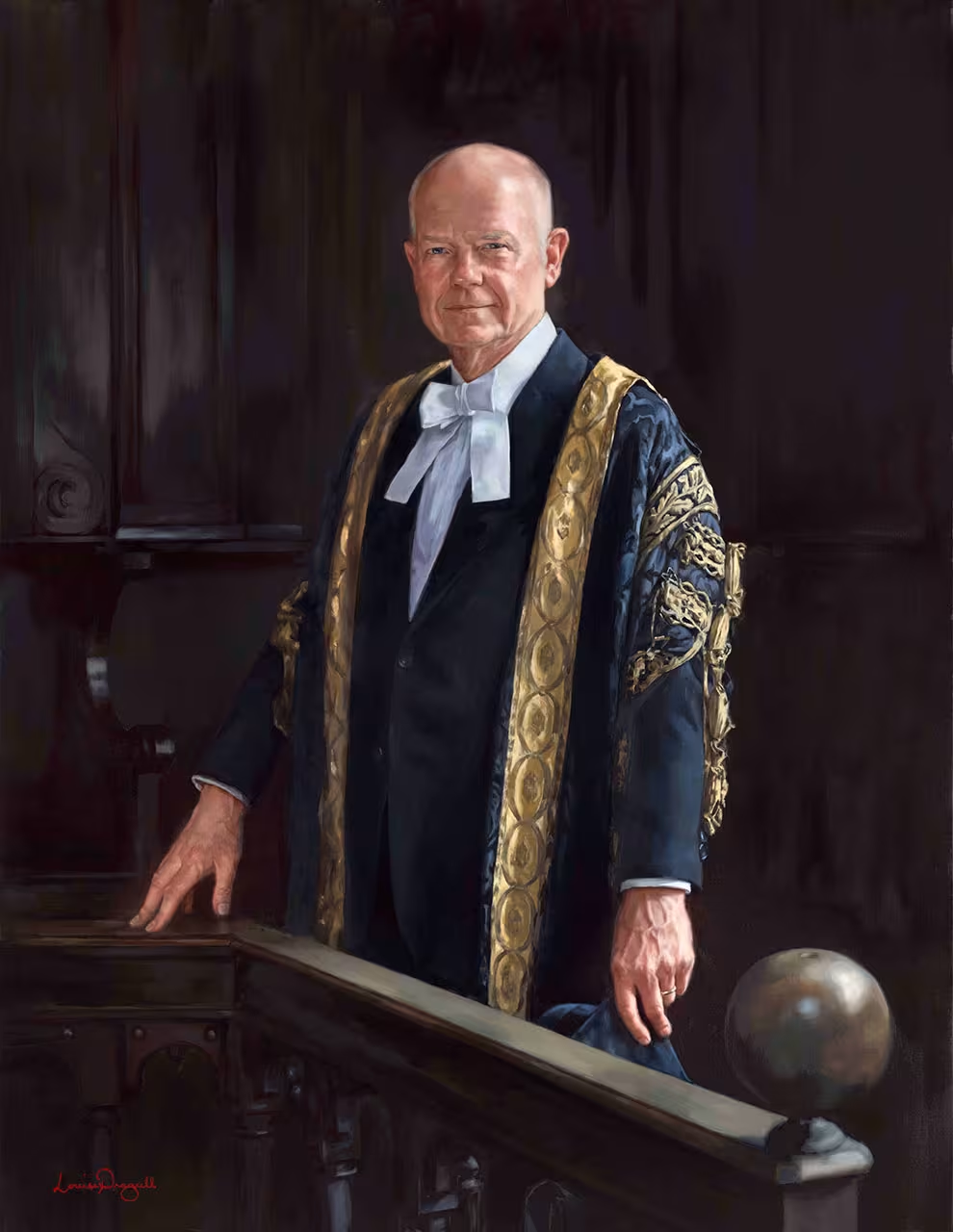
At the 2026 Autumn Meeting of the Chancellor’s Court of Benefactors, an additional treat lay in store for the special gathering in the form of a painting. Not any old painting, you understand, but a portrait of the Chancellor of the University, Rt Hon The Lord Hague of Richmond, CVO.
This work of art by Louise Pragnell places the Chancellor in one of Oxford’s oldest traditions, being the 160th person to hold the office. In fact, the oldest portrait of a Chancellor of the University is Robert Grosseteste, believed to have been the first recognisable Chancellor in c. 1224, but it is preserved only in a manuscript.
Not so the 2026 portrait of Lord Hague, which was unveiled by him and his wife Ffion Hague in the Great Hall atrium of the Schwarzman Centre for the Humanities, on 8 October. Accompanying them was Louise.
Earlier in the day she had travelled up from her London studio with the painting, carefully ensconced in sheets of foam within a tightly screwed together, bespoke wooden case of significant weight and dimension.
This was initially rolled on a wheeled trolley into a secure room inside the Schwarzman Centre, and around teatime we got to meet and discuss the commission process and Louise’s approach to portraiture.
Contact over this commission had begun early in 2025, following Lord Hague’s success in the Chancellor election process the previous autumn.
‘I visited Oxford to talk about it, a classic recce! As the artist, you’re trying to cast it; to feel the context; where the subject fits in a broader context, what’s the message.’
She was given a tour of the Sheldonian Theatre, followed by the adjacent Divinity School, then entered Convocation House through that special door that is almost a secret.
‘It was an amazing feeling; that sense of the generations, and being told how Parliament had been held here during the Civil War.’
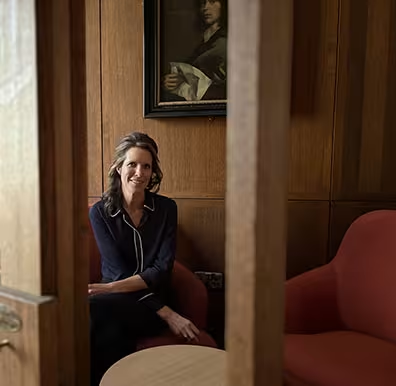
She also comments on ‘the calm atmosphere and lovely light’ and the ‘unusual curved finial pews and balustrades’. She felt that the University offered ‘permanence and continuity, plus awe and mystery’.
She says that a broader discussion covered many other details such as dress, and a further awareness of the portraiture of Lord Hague’s immediate predecessors, the previous three (Harold Macmillan, Roy Jenkins and most recently Chris Patten) painted by Bryan Organ (b. 1935), one of the leading and most innovative English portrait painters of the 20th century.
‘I love the craft of uniforms and robes. It is a declining skill base. The ceremonial gowns worn by William for the sitting are particularly striking in their combination of black and gold.’
She says the first sitting is always the hardest for both sides. ‘It’s a bit experimental. You’re getting to know each other. There is the question of composition and pose. I make paint sketches, but also charcoal, and I take many photos too.’
Several sittings then ensued across the months and into the spring of 2026, a real commitment by both sides. ‘There is a total ban on phones during sittings. The subject must be fully present as a person.’
After unveiling the painting, the Chancellor asked Ffion if she liked it and she said yes. Then he turned to his Court of Benefactors and asked them too, and there was unanimous praise.
The likeness to the subject is not in question, the dimensions majestic, the setting solemn in respect of the dark-toned backdrop of Convocation House, yet awakened by stunning light picking out the elaborate brocade of the robes, and the face of the Chancellor.
Louise’s artistry lies not in innovation for its own sake but in this treasury of light.
To some extent this is Louise’s own cultivation, having studied art first at Edinburgh College of Art followed by the Florence Academy in the early noughties.
‘I adored painting and I adored Florence,’ she says, admitting a small regret that she didn’t stay there longer.
‘I also loved Rembrandt as a teenager. It might sound a bit obvious. But he utilises a limited palette, and there is griminess but also golden tenderness to his portraiture, life touched but not sentimentally.’
Louise explains that her time at art school in Edinburgh took place amid a waterfall of conceptual installations – Damien Hirst, Tracey Emin – so that ‘it felt like a bit of a rebellion to cultivate painting at all’.
But now in 2026, amid wanton fakery through AI and the broader treachery of digital loss, she reports a widespread resurgence in appreciation of the very reassuringly human, physical presence of a portrait painted in oil on canvas.
‘Touch dry is not the same as truly bonded,’ she explains. ‘It takes about a year for the oil paint and the canvas to completely bond.’
An oil painting is not totally durable. Louise notes Sir Winston Churchill despising his 80th birthday portrait by the modernist Graham Sutherland, later destroyed by his inner circle. The episode was recently dramatised in The Crown, renewing it as a popular instance of portraiture blushed with controversy.
‘But look at all the Old Masters. They are hundreds of years old but still here, and they can be restored too; they survive.’
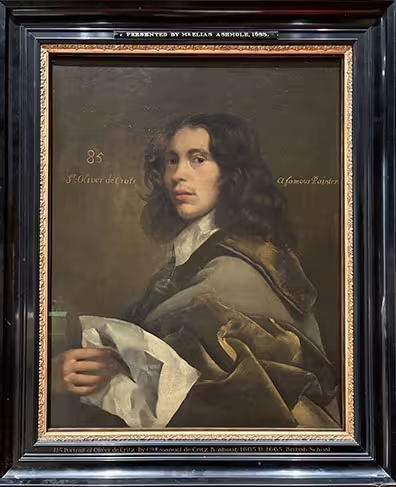
The room we are in happens to have three portraits hanging above our heads, the most immediate presented by Elias Ashmole in 1683, a portrait of a painter – Oliver de Critz, probably by Emanuel de Critz, ‘British School’.
The words ‘Oliver de Crats…a famous painter’ are actually written on the canvas in fine paint, on either side of his head, which Louise finds amusing. The 17th century wasn’t built on modesty.
But altogether the coincidence of this conjuncture of painters and portraits all in one room seemed to mark the moment, a capsule of history already in a building only opened to the public earlier this year, and touching the broader continuity of an office stretching back across 800 years.
The Chancellor is the titular head of the University of Oxford and presides over several important ceremonies as well as acting as an ambassador and advocate for Oxford, representing the University at local, national and international events.
Louise Pragnell is a British contemporary portrait painter whose work ranges from individual commissions to large-scale group portraits. Her work has been selected for the Herbert Smith Freehills Kramer Portrait Award 2026 exhibition at the National Portrait Gallery, including her portrait of former NBA basketball player Pops Mensah-Bonsu. She has also twice been a finalist in the portrait award formerly known as the BP Portrait Award.


