
Professor Aditi Lahiri awarded ERC Proof of Concept Grant to develop flexible speech-recognition technology
Professor Aditi Lahiri, Research Professor of Linguistics in Oxford’s Faculty of Linguistics, Philology and Phonetics, has been awarded a Proof of Concept Grant by the European Research Council (ERC). The €150,000 grant will support the FLEX-CODESWITCH project, which aims to develop a speech-recognition system that can cope with the way multilingual speakers switch between languages in conversation.
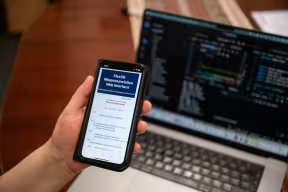

Most automatic speech-recognition systems are designed for English and trained on many thousands of hours of single-language recordings. They perform poorly when speakers move between two or more languages within a conversation, a common feature of multilingual communities known as code-switching.
Professor Lahiri and her team at Oxford have built a single-word recognition system, FlexSR, based on linguistic principles rather than large volumes of training data. It can be adapted across Germanic languages and different accents by changing how words are represented, without the need for additional training, and currently works in Dutch, English and German. The complete system, including its word corpora, is smaller than 10MB, so it can run locally on a device such as a mobile phone without an internet connection.

Professor Lahiri said:
‘Many people speak more than one language and often swap between them during conversations instinctively. Increasingly industries like banking are using AI for speech recognition which struggles to cope with this widespread phenomenon.
'Current AI speech recognition systems use massive amounts of data, and cannot deal with regional variations, such as different accents and words, let alone switching between languages. People, however, are great at this and FlexSR is modelled on how people actually recognise language in a way that current AI systems cannot.
'The benefits of this technology to society are that it is easier and cheaper for industrial and other sectors to use it compared to current AI. This is because FlexSR requires less data, less storage and less computational power to run making it very flexible. FlexSR doesn’t need retraining to handle different languages and can be used from a hand-held device like a mobile phone for internet banking. It will become a very useful tool for a wide variety of users.’
The Proof of Concept funding will allow the team to develop FlexSR further, drawing on linguistic information from Professor Lahiri’s current ERC Synergy project, PAAL (Phonological cognisance and allied linguistic representations: acquisition, bilingualism, change and script). The team will focus on Bengali, Hindi and English, with code-switching and accent variation across the three, extending its transcription-verification system and building a short-phrase command and query tool, initially aimed at the banking and multimedia sectors.
ERC Proof of Concept Grants help current and recent ERC grantees explore the commercial or societal potential of their research findings. Each grant is worth €150,000. In this first 2026 round, the ERC awarded grants to 182 researchers, with total funding of €27.3 million, selected from 554 proposals. The scheme is part of Horizon Europe, the EU’s research and innovation programme.
Further information is available on the ERC’s website here.
For more information about this story or republishing this content, please contact [email protected]


