
‘Dancing jets’ from a black hole reveal their immense power
New research from the University of Oxford and Curtin University has used radio telescopes that spans thousands of kilometres to snap images of jets launched by a black hole, that showed for the first time a black hole jet ‘dancing’ as it orbits a massive star. The ‘dancing jets’ enabled a measurement of the immense power of the black hole jet, confirming key assumptions made by scientists in simulations of large-scale structures in the Universe.
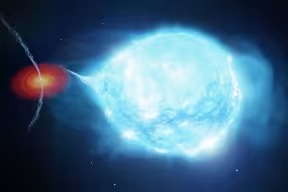
The strong stellar wind from the supergiant star pushes the jets launched by the black hole away from the star. This causes the jet direction to vary as the black hole and the supergiant star move around their orbit. Credit: ICRAR.

In a paper published today in Nature Astronomy, researchers found the power of the jets in Cygnus X-1 – a system comprised of the first confirmed black hole and a supergiant star – was equivalent to the power output of 10,000 Suns.
To record the measurement, researchers used an array of linked up telescopes separated by large distances to observe the black hole jets being buffeted by the winds of the star as the black hole moved around its orbit – much like how strong winds on Earth can push water around in a fountain.
By knowing the power of the wind and measuring how much the jets were bent, the researchers could determine the instantaneous power of the jets for the first time: how much energy they are carrying at any given moment.
In addition, they were able to determine the speed of the black hole’s jets – about half the speed of light, or 150,000 km per second – another measurement that has challenged scientists for decades.

The study was led from the Curtin Institute of Radio Astronomy (CIRA) and the Curtin node of the International Centre for Radio Astronomy Research (ICRAR), in collaboration with the University of Oxford.
The researchers were able to make the measurement using a sequence of images of the ‘dancing jets’ – a term used to describe the jets’ movement pattern as they were repeatedly deflected in different directions by the supergiant star’s powerful winds as the star and black hole moved around their orbits.
The measurement allowed scientists to understand what fraction of the energy released by the material falling towards black holes could be deposited into the surrounding environment through their jets, thereby changing the environment.
Lead author Dr Steve Prabu, (Department of Physics, University of Oxford, formerly at CIRA), said: ‘A key finding from this research is that about 10 per cent of the energy released as matter falls in towards the black hole is carried away by the jets. This is what scientists usually assume in large-scale simulated models of the Universe, but it has been hard to confirm by observation until now.’
For the study, the team used data from two major radio telescope networks: the Very Long Baseline Array (VLBA) in the United States and the European VLBI Network (EVN). These facilities link telescopes across their respective continents to act as a single continent-sized instrument, which enabled the researchers to make extremely high-resolution images of the black hole’s jet. By repurposing and reanalysing archival data spanning 18 years, they were able to track how the jet’s bent shape changes over time.
‘Each observation typically lasted between 6 and 12 hours, giving us detailed snapshots of the system at different points in its orbit,’ added Dr Prabu. ‘Through combining all of these observations, we were able to piece together the “dancing” motion of the jet and measure its properties in a way that hadn’t been possible before. By doing so, we discovered that the stellar wind from the companion star is strong enough to bend the jet, and this gave us a unique way to measure the jet’s power directly.’
“Our discovery of black hole jet bending has opened new ways of studying black holes and general relativity. There are many such systems where a black hole or a neutron star is orbiting a massive star with strong winds, and we hope to study them in the future using similar techniques”
In the centres of galaxies, supermassive black holes launch jets that inject energy, plasma and magnetic fields into their surroundings. This process, known as “feedback”, plays a crucial role in regulating how galaxies grow and evolve. In large-scale simulations of the Universe, scientists previously had to assume how efficient black holes are at converting infalling energy into jets, often using values around 10%. This new result provides the first direct observational measurement of this efficiency, and confirms that the commonly used value is realistic.
Co-author Professor James Miller-Jones (CIRA and the Curtin node of ICRAR) said: ‘With radio telescope projects such as the Square Kilometre Array Observatory currently under construction in Western Australia and South Africa, we expect to detect jets from black holes in millions of distant galaxies, and the anchor point provided by this new measurement will help calibrate their overall power output.’
Other collaborating institutions included the University of Barcelona, the University of Wisconsin-Madison, the University of Lethbridge and the Institute of Space Science.
The paper, ‘A jet bent by a stellar wind in the black hole X-ray binary Cygnus X-1’, has been published in Nature Astronomy.
For more information about this story or republishing this content, please contact [email protected]
Media coverage
- The Times: How black holes wield the firepower of 10,000 suns
- Daily Mail: The immense power of black holes: Scientists record 'dancing jets' as powerful as 10,000 SUNS coming from voids
- The Conversation: Black hole jets ‘dance’ in the wind from a massive companion star
- The Independent: Scientists discover black hole jets are as powerful as 10,000 suns
- Associated Press: Astronomers measure the mind-blowing power and speed of black hole jets for the first time
- Scientific American: Secrets of cosmic evolution may lurk in this black hole’s ‘dancing’ jets
- Interesting Engineering: Power of 10,000 suns: Energy of famous black hole ‘dancing jets’ measured for first time


