
Expert Comment: Social media and AI chatbot limits for children - what does the evidence support?
This week the UK government announced a ban on social media for under-16s and new age limits on romantic and sexual AI chatbots, following the precedent set by Australia. Researchers from the University of Oxford's Department of Psychiatry welcome the focus on children's online safety, but argue that age limits alone are a limited safeguard, and that protecting children depends more on how platforms and AI systems are designed than on who can reach them.
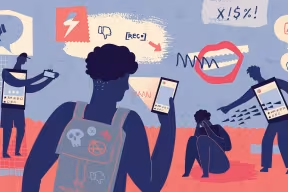

On 15 June, UK Prime Minister Keir Starmer and Technology Secretary Liz Kendall announced plans to ban under-16s from social media platforms expected to include TikTok, Instagram, Facebook, YouTube, Snapchat and X, and to require AI 'romantic companion' chatbots to enforce a minimum age of 18, with intimate functions restricted for under-18s across all chatbots. Messaging services such as WhatsApp are excluded. The government says its approach goes further than Australia's under-16 ban by also curbing features judged particularly harmful to children, including livestreaming and contact from strangers, with protections switched on by default for 16 and 17-year-olds to avoid a 'cliff edge' at 16. Legislation is expected before the UK Parliament by the end of the year, with the first restrictions potentially taking effect in spring 2027.
Researchers at the University of Oxford's Department of Psychiatry, whose work spans children's mental health, the design of AI systems and how young people experience life online, have been weighing up the proposals.

“I welcome the government’s recognition that young people face distinct risks online, and that AI systems - in addition to social media platforms - warrant targeted regulatory attention. The new minimum age of 18 for romantic and sexually simulative AI chatbots is a reasonable step, but it addresses only a narrow slice of the risks young people themselves identify as most pressing.”
Dr Madeline G. Reinecke is a Postdoctoral Researcher in Collective Moral Development in the Department of Psychiatry (NEUROSEC - Design Bioethics Lab) and the Uehiro Oxford Institute (Philosophical Moral Psychology Lab). Her research examines moral cognition across children, adults and artificial intelligence, including how and when people place trust in AI systems. She works with young people as co-researchers on the safeguarding of human-AI interaction.
I welcome the government’s recognition that young people face distinct risks online, and that AI systems - in addition to social media platforms - warrant targeted regulatory attention. The new minimum age of 18 for romantic and sexually simulative AI chatbots is a reasonable step, but it addresses only a narrow slice of the risks young people themselves identify as most pressing.
Our research, conducted with young people as co-researchers, finds that AI companionship and romance are seen by adolescents as low-likelihood concerns, while still acknowledging their potential for harm. By contrast, young people consistently flag high-likelihood, high-impact risks that the policy announced today does not address, such as over-reliance on AI for emotional support and mental health guidance, unwarranted trust in expert-sounding AI responses, and cognitive de-skilling through habitual AI use.
I am also concerned about how age thresholds are being applied in this policy. In the United Kingdom, 16-year-olds may consent to sex and to their own medical treatment. Under this policy, however, the same young people would be prohibited from engaging in simulated romantic interaction with chatbots. There is no conclusive evidence that romantic interaction with AIs exceeds the risks young people are already trusted to navigate at this age.
Rather than restricting access to generative AI (whether in a romantic context or wholesale), we argue that regulation should be building the conditions for competent, critical engagement: investing in AI literacy across schools and care settings, and requiring developers to design systems that support rather than undermine adolescent agency.
In my view, bans and age gates may remove agency from young people without creating incentives for better design. Our recommendation, grounded in co-production with young people, is that the government should prioritise restrictions on the anthropomorphic and engagement-maximising design features of AI systems used by under-16s, regardless of whether those systems involve romantic functionality. This would address a far wider range of potential harms, and do so in a way that reflects the actual landscape of risk as young people experience it.

“When thinking about protecting children, we must also think about those, particularly the most vulnerable, for whom online spaces are where they find support, information, and connection, including for their mental health. Harm and support often sit side by side in the same spaces, which is why a blanket age ban is a blunt tool and a stronger step than the current evidence can support.”
Dr Holly Bear is a Senior Postdoctoral Researcher in the Department of Psychiatry's Child and Adolescent Psychiatry team. Her research focuses on how adolescents' online environments shape their mental health, and on the development, evaluation and implementation of digital mental health interventions for children and young people, including AI-powered tools. Co-production with young people is central to her work.
The aim of protecting children online is one many of us share. But the evidence to date linking social media to children and young people’s mental health and wellbeing is mixed and largely correlational, with effects that depend more on what they see and do online than on access alone. There is little direct evidence that raising the minimum age improves mental health and wellbeing, and it is still early days for Australia’s ban, introduced only in December, so what it achieves for young people’s wellbeing, and how far age limits can be enforced, is not yet clear.
When thinking about protecting children, we must also think about those, particularly the most vulnerable, for whom online spaces are where they find support, information, and connection, including for their mental health. Harm and support often sit side by side in the same spaces, which is why a blanket age ban is a blunt tool and a stronger step than the current evidence can support.
An age limit may change when children reach these platforms, not what is waiting for them when they do. If harmful content is not removed and the algorithms that recommend it are not made safer, the same risks remain in place for every young person once they turn 16, or find a way around the limit sooner. Restricting individual access without regulating the platforms themselves won’t solve these problems. A ban also risks taking away the protective parts of these spaces along with the harmful ones.
None of this is an argument for inaction, but for proportionate, well-targeted measures and rigorous evaluation. The planned Wellcome-led evaluation is a real opportunity to learn whether these measures help, harm or neither, and for whom, including the young people most often at the margins of policy, those for whom these spaces can be a vital source of support. Policy should be designed so it can be tested as it rolls out, and the most useful thing researchers can do now is make sure that evaluation, and those young people’s experiences, are built in from the start, not added afterwards.
For more information about this story or republishing this content, please contact [email protected]


