
Blog: Partnerships for Policy
In the last year, OPEN funding supported projects addressing challenges ranging from those relating to international development, human rights, and health, through to energy, education and the environment. OPEN Coordinator Jess Hedge highlights the key ingredients to successful academic-policy collaborations.
Last updated:


OPEN Coordinator Jess Hedge highlights the key ingredients to successful academic-policy collaborations
What is the most pressing public policy challenge? Mitigating the effects of climate change? Maybe adaptation or resilience? What about the spread of antimicrobial resistance? Or the governance of AI? When considering where to allocate scarce resources, the temptation to set thematic or geographical priorities is strong.
When it comes to allocation of OPEN funding, however, we take a different approach, prioritising high-quality partnerships and strong project design with the potential for impact. In doing so, we’re aiming to complement activities across and beyond the University and encourage engagement that involves a wide range of research disciplines and policy challenges.
Over the last year, OPEN funding supported projects addressing challenges ranging from those relating to international development, human rights, and health, through to energy, education and the environment. Some involved exploratory conversations and workshops, while others took the form of placements within policymaking organisations and development of new policymaking tools.
Catalysing new connections
Funding this year catalysed engagement between 24 research and policy partners who had not worked together before, providing the crucial first opportunity to move from initial scoping discussions to structured collaboration and mutual learning.
Improving fair access to green space
In partnership with Plymouth City Council and the Woodland Trust, Dr Martha Crockatt built on earlier OPEN-funded work to develop a tool to help prioritise neighbourhoods most in need of green-infrastructure investment. ‘This will enable us to work more effectively with investors and funders to deliver socially and environmentally impactful projects in support of strategies such as Plymouth’s Plan for People and Nature,’ concluded Chris Avent, Strategic Programme Manager for the council’s Natural Environment Service. Dr Crockatt is now exploring how the work could support the development of similar tools across the UK.
A new approach to public sector contracting
Contracts work better when relationships come first. That’s the idea behind formal-relational contracting, which acknowledges services can’t be fixed upfront and places learning, collaboration and continuous adaptation at the centre of procurement. Dr Felix Anselm van Lier and Michael Gibson’s collaboration with Southwark Council and Public Digital involved co-design and testing of a practical toolkit to support this approach, which is already being used by Essex County Council to shape a new community of practice on purpose-driven commissioning.
Meeting the challenges of the Ivory Act
Ever tried to distinguish one kind of ivory from another? It’s harder than it sounds. In fact, the UK has limited expertise on identifying and dating different ivories, representing a key challenge in implementing the current legislation. To address this, Ashley Coutu joined forces with the Department for Environment, Food & Rural Affairs and the Victoria and Albert Museum to generate policy recommendations and resources to support implementation of the Ivory Act 2022 and enforcement capability via a new network of research, policy and museum professionals.
Converting gender-focused research into policy impact
Dr Janina Jochim and colleagues established a collaboration with the UN Girls’ Education Initiative (UNGEI), a global partnership hosted by UNICEF focused on advancing gender equality in and through education, contributing to the development of a research agenda and evidence briefs now used to further UNGEI's mission to shape education policy and programming across Sub-Saharan Africa. In Mexico, Dr César Palacios-González’s partnership with an NGO, Information Group on Reproductive Choice (GIRE) generated interdisciplinary research and a white policy paper on preventing obstetric violence, directly informing GIRE’s policy recommendations for reforms to Mexico’s maternal-health legislation.
Examining AI adoption in the classroom
What is the impact of AI use in schools on policy? This was the focus of a collaboration between Dr Sara Ratner and the OECD’s PISA for Schools team, in which they examined how school systems interpret and act on assessment data, contributing directly to the OECD’s global evidence base. Their findings were shared with the PISA Governing Board, representing 83 education ministries worldwide.
Deepening and expanding collaboration
As well as investing in these formative partnerships, OPEN has supported the deepening of existing partnerships to tackle new challenges or build on previous work.
Enhancing cities’ support for migrants
Irregular migration requires national and local authorities to balance humanitarian, economic and national security concerns. In this context, Myriam Cherti used OPEN funding to build on an existing relationship with policy advisers in the City of Utrecht on design of an app providing irregular migrants with clear reliable information about local services. Launched in June, this has laid the groundwork for a municipal ID card to expand access for irregular migrants to essential services and protections, sparking interest from other cities in the Netherlands.
Leveraging languages expertise for policy
From strengthening community cohesion to improving access to public services, research on languages and linguistics has a lot to offer public policy. Having met at an OPEN event in 2023, Charlotte Ryland and her partner in the Cross-Government Languages Group developed a set of resources supporting engagement between languages researchers and policy professionals. These are helping UK civil servants understand the full scope of this untapped potential, and how to leverage it more efficiently and effectively – for example in subsequent iterations of departmental Areas of Research Interest.
Guiding abolition of the death penalty
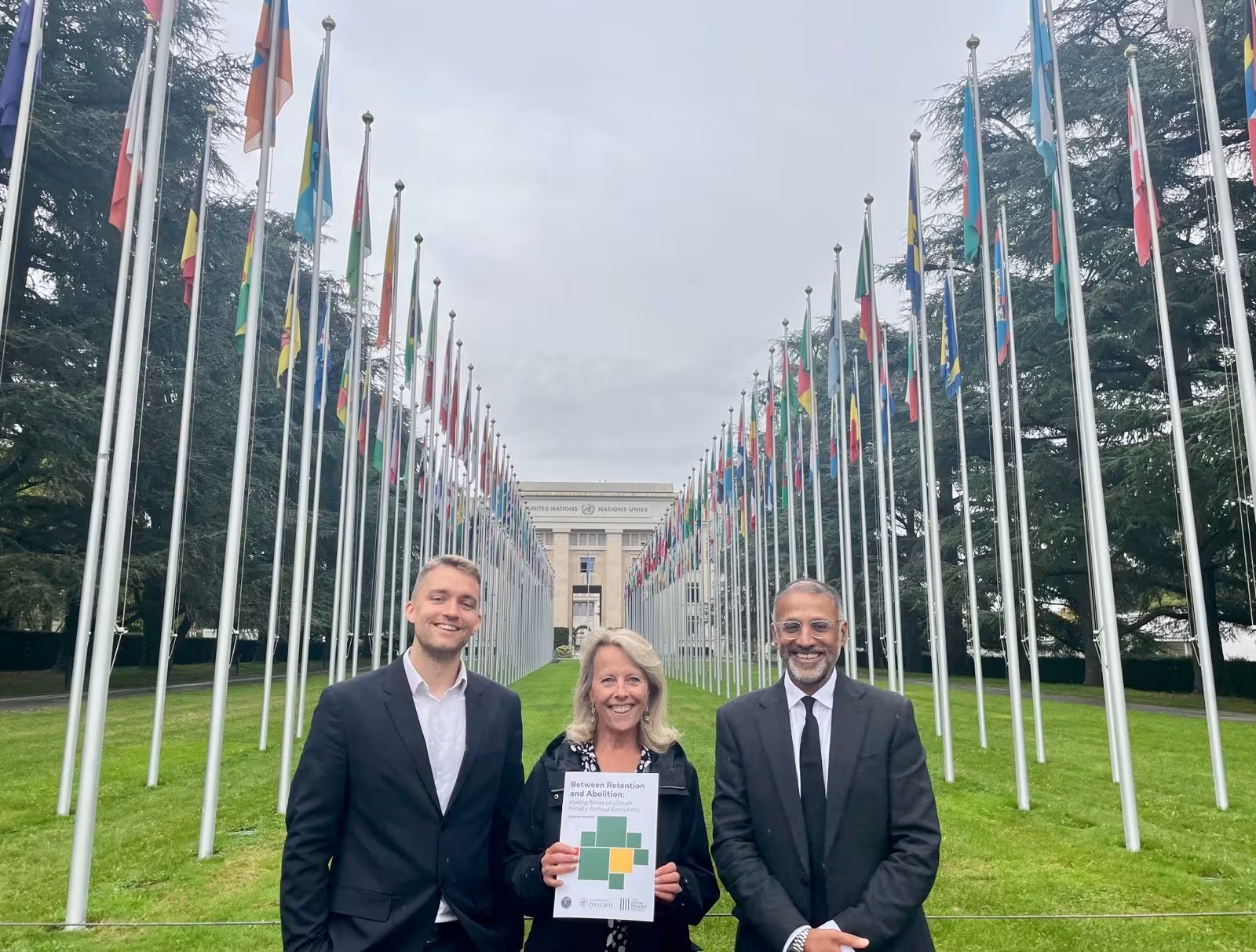
There are over 40 countries in the world that retain death penalty laws yet have not carried out executions for more than 10 years. Researchers Professor Carolyn Hoyle and Daniel Cullen and Director of the Death Penalty Project, Parvais Jabbar, worked with international organisations to develop a new intellectual framework to analyse the death penalty under this situation of ‘de facto abolition’, intended to support policymakers in these countries to overcome the barriers to full abolition. Their work contributed to a multi-year effort by the partners and local civil society groups to abolish the death penalty in Zimbabwe, which came to fruition in December.
A fairer, leaner, better value funding system
Over the coming year, we look forward to building on the work we’ve done to streamline OPEN’s funding schemes via our refined scoring criteria and increased emphasis on value for money. We’ll also seek to make schemes more inclusive and improve how we monitor, learn from and evaluate the partnerships we fund.
(This text first appeared in the OPEN 2024-25 Annual Report, published in January 2026)

“I undertook an OPEN-funded placement with Oxfordshire County Council to explore how partnerships between community, policy and academic organisations can be optimised to address health inequalities.Undertaking this gave me invaluable experience, insights and motivation to further engage with policymakers and provided a key stepping stone to my new role as one of three Chief Scientific Advisors to the Oxfordshire Local Policy Lab. This wouldn't have been possible without supportive guidance and funding from OPEN.”

“OPEN has been fundamental to my research career and impact. I was a recipient of one of the first OPEN awards, enabling me to co-develop a natural capital mapping system in partnership with local councils, including Oxfordshire County Council. This blossomed into an entire range of follow-on projects funded from multiple sources, enabling our team to develop an open-source opportunity mapping tool which is now informing local nature recovery strategies in several counties in England. This last year, I've worked on another OPEN-funded project to develop a related tool supporting councils to provide equitable access to urban green spaces. ”

