
Expert Comment: Is banning under-16s from social media protection or exclusion?
Dr Victoria Nash, Associate Professor & Senior Policy Fellow, Oxford Internet Institute, warns that a social media ban risks leaving teenagers 'protected' but disempowered, cut off from news, learning and support at the very moment the UK is preparing to give 16-year-olds the vote.
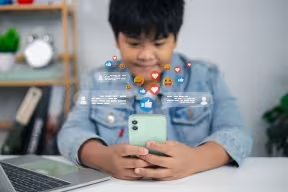

On June 15th 2026, Keir Starmer announced plans for the UK to follow in the footsteps of Australia’s social media ban for children under 16, joining at least 11 other countries in the process of drawing up such legislation.
Although further details won’t be released until July, the initial statement suggests that under-16s will be banned from platforms whose purpose is to enable user-to-user interactions and allow posting of user-generated content, such as Instagram, Snapchat, TikTok, YouTube, Facebook and X.
Messaging services such as WhatsApp and Messenger will be excluded from the ban, but the Prime Minister has indicated an intention to go beyond Australia’s measures, with certain features such as live-streaming and communication with strangers expected to be banned for under-16s on services beyond social media platforms. In addition, under-18s would be banned from engaging with AI chatbots in intimate or romantic conversations.
This bundle of measures was presented as a move ‘to give kids their childhoods back’.
With a sentiment like this at its core, it’s surely impossible to question such a policy. But as Australia has already discovered, good intentions don’t always make for good results.

“Sometimes, the best political decisions are the unpopular ones. Banning under-16s from social media won’t stop determined teens from connecting online, but it will encourage them to break the rules or find new, riskier spaces.”
As the Australian eSafety Commissioner reported in March, although 4.7 million age-restricted social media accounts were removed shortly after the ban took effect, a survey of parents suggested that around 70% of under-age children retained their accounts.
Various factors explain this failure, but the reason most given by parents was that their children had not yet been asked to prove their age. For children who were asked, early reports suggest that popular workarounds such as using older siblings or even masks to pass facial age estimation checks may also have been employed. Even more problematically, the report noted that there had been no discernible reduction in children under-16 reporting harms to the Commissioner’s office, and little change in the number of reported incidents involving cyber-bullying or intimate image abuse.
It is of course, early days for Australia’s social media ban, and corporate compliance may yet improve. Noting the challenges, UK Secretary of State Liz Kendall has already written to OfCom, asking for a rapid assessment of highly effective age assurance tools that would be inclusive and privacy preserving, and would work for this age group.
But a second problem emerges when children do find their accounts shut down. Research from academics in the Digital Child network has shown that for those children, accessing news and information becomes much more difficult.
This shouldn’t come as a surprise: as documented by the Reuters Institute for the Study of Journalism, over the last decade, young people have switched from an ‘online first’ to a ‘social-first’ approach to news consumption. This is reflected amongst younger age groups, with Tik Tok now the most used social media source for UK 12–15-year-olds who express interest in news.
At a moment when the UK is advancing legislation to reduce the voting age to 16, cutting off such access to news resources for under-16s is entirely counter-productive.
News and current affairs aren’t the only type of positive online experience that young people may miss out on. Research has consistently shown that social media communities offer vital support for excluded minoritiessuch as disabled or LGBTQ+ youth. The CEO of the Royal Society for Blind Children has already expressed concern about how this move will affect its young members.
Beyond social media communities, online video content has become a hugely important educational resource, with around 40% of 8–17-year-olds using these resources to learn new things, support hobbies or help with schoolwork. The inclusion of YouTube in the government list of platforms likely to be banned for under-16s seems particularly blunt in this context. There may indeed be valid concerns about algorithmic radicalisation and the compelling nature of autoplay, but cutting off all access to the site’s wealth of information and creative content would be an extraordinary step.
These side-effects of the proposed ban demonstrate the challenges of designing effective policy interventions in this space. Politically, there were compelling reasons to act: 90% of all parents replying to the consultation supported this, whilst the list of other countries pursuing such actions has hit double figures.
But sometimes, the best political decisions are the unpopular ones.
Banning under-16s from social media won’t stop determined teens from connecting online, but it will encourage them to break the rules or find new, riskier spaces.
There are undoubtedly serious harms arising for some young people at the hands of irresponsible social media companies. But instead of punishing and excluding our youth, we should be demanding full platform compliance with existing laws, rich, inspiring content and excellent digital literacy education.
At best, this policy may gradually shift practice and expectations. At worst, it leaves our teenagers without a voice: ‘protected’, but disempowered and disappointed.
For more information about this story or republishing this content, please contact [email protected]


