
New Lancet series shows how thousands of maternal deaths could be prevented each year
Every 12 minutes, somewhere in the world, a woman dies from excessive bleeding after birth (postpartum haemorrhage or PPH). Yet according to a new three-part Lancet Series, led by researchers from the University of Oxford, most of these deaths should never happen.
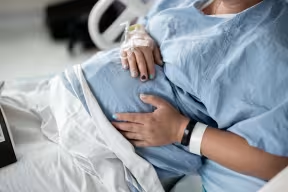

The Series estimates that excessive bleeding after birth affects 27 million women and kills nearly 43,000 mothers every year, making it the world's leading direct cause of maternal death. The condition also imposes a staggering economic burden on countries, health systems and families, costing over US$10 billion each year.
But the message from researchers is clear: the tools to prevent many of these deaths already exist.
In response to the call for action set out in the global Roadmap to combat postpartum haemorrhage 2023–2030, the Series introduces a fundamental shift in how postpartum haemorrhage should be detected and treated. For decades, clinicians have typically waited until a woman lost 500 mL of blood before diagnosing PPH. New evidence reviewed by the authors shows that treatment should begin much earlier - once blood loss reaches 300 mL if accompanied by abnormal vital signs -allowing health workers to intervene before bleeding becomes catastrophic.
The authors also challenge one of maternity care's most entrenched practices: visually estimating blood loss after birth. The Series concludes that this approach is grossly inaccurate, missing around half of all PPH cases. Instead, it calls for routine use of simple objective measurement tools, such as calibrated blood collection drapes, which can detect excessive bleeding far more accurately and trigger life-saving treatment sooner.
The Series highlights missed opportunities to prevent haemorrhage before it starts. Reducing anaemia in pregnancy, addressing the unmet need for contraception, avoiding medically unnecessary caesarean sections, and ensuring all women receive effective uterotonic medicines after birth could substantially lower the global burden of postpartum haemorrhage.
Perhaps the most striking finding is that a simple 5-in-1 first-response treatment bundle (known as MOTIVE) can transform outcomes. By ensuring every woman receives five evidence-based interventions immediately after diagnosis, progression to life-threatening bleeding can be reduced by up to 60%. The approach is specifically designed so that midwives and nurses can act immediately rather than waiting for specialist review.
The Series frames postpartum haemorrhage as a race against time. The authors identify six critical delays during care - from diagnosis to treatment, escalation, and access to blood products - that often determine whether a woman survives. Their conclusion is stark: in an era of effective medicines, simple diagnostic tools, and an evidence-based treatment bundle, no woman should die from postpartum haemorrhage because help came too late.
Professor Arri Coomarasamy, co-author of the Series and Professor of Gynaecology and Reproductive Medicine at the University of Oxford's Nuffield Department of Women's & Reproductive Health, said: "Every maternal death from postpartum haemorrhage is a tragedy, and most are preventable. Our research shows that we already have the tools needed to save thousands of lives. What is needed now is urgent action to ensure these proven interventions reach every woman, everywhere.'
The challenge now is implementation. The Series calls on governments, health systems, professional associations, donors, and the global health community to make postpartum haemorrhage an urgent priority. By equipping every birth facility, empowering frontline health workers, and adopting proven interventions at scale, thousands of lives could be saved each year.
For the millions of women who give birth every year around the world, the Lancet Series offers something rare in global maternal health: a roadmap showing that one of childbirth's deadliest complications can become history.
The Lancet Series on postpartum haemorrhage is published in The Lancet:
https://doi.org/10.1016/S0140-6736(26)00902-5


