
Expert Comment: When popes get theology wrong
Dr Miles Pattenden, historian of the Catholic Church and lecturer in the Faculty of History, University of Oxford, examines the long and contentious relationship between the papacy and theological authority - and asks whether JD Vance's challenge to Pope Leo is quite as theologically illiterate as his critics suggest.
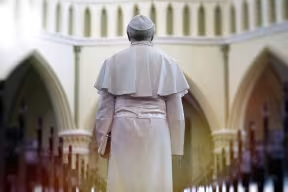


American Vice-President JD Vance was in the news last week for criticising Pope Leo. ‘I think it’s very, very important for the pope to be careful when he talks about matters of theology’, he told a Turning Point USA event in Athens, Georgia last week.
‘Was God on the side of the Americans who liberated Holocaust camps and liberated those, those innocent people, you know, those who had survived the Holocaust?’, he countered in response to the Pope’s tweet that ‘Anyone who is a disciple of Christ, the Prince of Peace, is never on the side of those who once wielded the sword and today drop bombs’.
Vance has been roundly and comprehensively derided for his efforts. ‘Catholic convert JD Vance mansplains theology to the pope’, the Daily Beast declared. ‘When Pope Leo XIV speaks as supreme pastor of the universal Church, he is not merely offering opinions on theology, he is preaching the Gospel and exercising his ministry as the Vicar of Christ’, the US bishops’ doctrinal office reprimanded.
Yet the slam dunk may be less clean than it appears. The bishops’ office invoked Just War theory to defend Leo—but the pope himself has conspicuously jettisoned that tradition in favour of the language of universal pacifism.
Theologian Vincent J. Miller has pointed out that the Catholic Church actually did condemn the Allies use of ‘excessive’ force in World War Two. Yet, Pius XII’s own record in World War Two—Hitler’s Pope, as some have called him—hardly lends itself to triumphalist deployment.
Vance may be wrong about the merits of America’s conflict with Iran, and also of the specifics about how Just War theory is applicable to it. Yet he appears to have noticed the Catholic Church’s long tradition of criticising popes who mistake legal and pastoral authority for theological expertise.
In fact, some of the greatest theological minds in the Church’s history were only too quick to tell popes that they were straying beyond their competence and ought to leave such territory to others.
God’s man is a lawyer
The papacy, throughout its long history, has been, above all, a legal institution. Most popes during the past thousand years have had legal, not theological training. Innocent III (r. 1198–1216), arguably the most powerful pontiff of the Middle Ages, was a canonist from Bologna. Alexander III, Gregory IX, and Innocent IV; Pius IV, Clement VIII, and Benedict XIV—major popes from pre-modern periods—were all lawyers too.
The Church’s great theological minds—Anselm, Bernard of Clairvaux, Bonaventure, Thomas Aquinas, Robert Bellarmine, John Henry Newman—by contrast, were almost never popes (though some have been cardinals). The papacy, a governmental office, has required legal training, administrative competence, diplomatic skill and political cunning—but not necessarily philosophical genius.
Bellarmine is an important figure in the history of papal attempts at theology, but only because he rebuked Clement VIII (one of the most powerful of Counter-Reformation popes) for presuming to be able to rule on a dispute between the Jesuits and Dominicans over the nature of divine grace: ‘[I] often told the pope not to deceive himself and not to image that he could resolve this most difficult of matters himself through study because he was not a theologian.’
Francisco de Vitoria, a sixteenth-century Dominican theologian at Salamanca, and a major exponent of Just War theory, was another key critic who, in effect, told popes to butt out. He argued, explicitly, that moral and theological questions about war require careful reasoning from first principles: ecclesiastical authority cannot simply pronounce them.
Medieval theologians had often held that the pope can get his theology wrong. Honorius I (r. 625–38) was famously denounced as a heretic at the Third Council of Constantinople (680–81). Jean Gerson, the great fifteenth-century theologian and University of Paris Chancellor, argued that the pope’s authority was real but bounded. Theological definition belonged not to one man but only to the Church as a whole.
The First Vatican Council in 1870 was the gathering which turned the tide decisively in favour of popes. The Council voted that the pope, speaking ex cathedra (‘from his chair’), could make binding rulings in matters of faith or morals (this is the basis of the pope’s so-called ‘infallibility’).
Vatican I’s decree built on a long tradition of argument that the pope, as Christ’s representative, could make binding pronouncements. However, that tradition had always been heavily contested. Its original assertions had concerned not theological truth but institutional self-interest. The medieval Franciscans, who had devised them, did so not to establish the pope’s power to define doctrine but to prevent future popes from rescinding privileges that earlier popes had granted them.
Popes themselves have only invoked infallibility once since 1870—when Pius XII defined the Assumption of Mary in 1950—a sure sign that they understand their claim’s controversial nature.
After Vatican I, John Henry Newman still argued that Catholics have a duty to think about papal pronouncements carefully before accepting them. ‘If I am obliged to bring religion into after-dinner toasts, (which indeed does not seem quite the thing) I shall drink—to the Pope, if you please—still, to Conscience first, and to the Pope afterwards.’
Papalisation and its discontents
What has happened since 1870 is a slow but steady inflation of papal authority far beyond what even Vatican I’s protagonists intended. A narrow technical claim of infallibility has grown in the popular imagination and via media coverage into an assumption that whatever the pope says on any moral or political question is beyond serious challenge. The late Church historian John O’Malley SJ termed this process ‘papalisation’.
Papalisation’s causes are not hard to find. The pope is a singular, globally recognised figure who speaks in his own voice, in real time, and on any subject he chooses. Modern media has been extraordinarily kind to him, and he has proved the perfect protagonist for an era of celebrity and personal branding.
Yet ‘papalisation’ is not a Church dogma. It does not make Leo’s statements on Iran remotely beyond interrogation or criticism. Indeed, Leo’s statements remain the moral opinions of one man and deserve the same critical engagement as any serious argument about war, justice and the limits of force (the same is, of course, true of the arguments made by JD Vance and President Donald Trump).
If papal pronouncements on political and military questions do not automatically bind conscience, then Catholic voters, soldiers, politicians and citizens are entitled—indeed required—to reason for themselves. This is the older and more intellectually serious Catholic tradition, rooted in the primacy of conscience to which Newman made reference.
There is a genuine irony here. Vance has been attacked for presuming to question the pope’s theology. But the Catholic tradition he claims to belong to—and which, apparently, he studied seriously enough to convert—actively supports the view that lay Catholics are entitled to question papal statements on political and moral questions.
Others have embraced Leo’s pronouncements with uncritical enthusiasm but that ought to strike any serious Catholic theologian as odd. After all, many of them—those on the secular left—would normally be the first to question institutional religious authority. And yet they have become, in effect, more ‘Ultramontane’ than the most devout amongst the faithful (i.e. JD Vance).
The irony is acute: a whole new generation has discovered papal infallibility just in time to deploy it against that wannabe antipope Donald Trump. Yet the history of popes and theology is just too interesting to leave it to JD Vance or his detractors—culture warriors on either side.
For more information about this story or republishing this content, please contact [email protected]


