
Generative AI case studies
Colleagues across the University have been using generative AI (GenAI) tools since the University’s pilot programmes for ChatGPT Edu and Microsoft 365 Copilot launched in May 2024 and the pilot of Google Gemini which got underway in June 2025.

Read on to find out how staff and students have been transforming their teaching, research and administrative work, unlocking new ways of working, and for advice they would give to people getting started with GenAI.
- GenAI in Education
- GenAI in Research
- GenAI in Professional Services
GenAI in Education
The rapid evolution of AI, and its widespread availability, offers opportunities for experimentation within the collegiate University context.
To support this, the Centre for Teaching and Learning, in partnership with the AI Competency Centre, launched the AI Teaching and Learning Exploratory Fund in summer 2024. The objective of this fund was to explore how AI could be used within teaching and learning contexts at Oxford.
Project outputs and reports are now available to view.
Charles Godfray, Director, Oxford Martin School

For Charles, a longstanding research ambition had always been hampered by the scale of the task. He wanted to test hypotheses in community ecology using data from mid-20th century publications on parasitic wasps. The information was there but locked away in unstructured text that would have taken at least two weeks of full-time manual effort to extract.
With generative AI, that barrier disappeared. Charles fed around 500 pages of scientific papers into Google Gemini, each describing host relations of a group of parasitic wasps. The AI was asked to abstract the information and return it as a structured spreadsheet with ten specific columns. His prompt carefully explained the different conventions used in the original papers and the exact spreadsheet format required. The result was a clean dataset from which food webs could be constructed, which were then used to explore hypotheses about ecological community structuring.
AI was also used to convert a modern PDF checklist into a spreadsheet and then update and check species nomenclature against it. To test accuracy, Charles randomly selected 50 entries from the generated spreadsheet and found just two minor errors, neither of which affected the ecological analyses.
A task Charles had considered but postponed for 20 years because of the daunting workload was achieved in minutes. What once seemed unfeasible became possible with the right application of AI.
His advice for others at Oxford is simple: don’t be afraid of long and quite complex prompts. The more detail you provide about the data, conventions, or output format; the better the AI will perform.
“I ask myself what don’t I want to do — and can AI do it for me?”
Sara Ratner, Principal Investigator of the AI in Education Oxford University (AIEOU) Research Hub and Researcher on the Learning in Families through Technology (LiFT) in the Department of Education
My work for the AI in Education Oxford University (AIEOU) Research Hub and Department of Education explores pedagogy, policy and technology.
In practice, I have found AI useful both as an administrative assistant and as a critical friend. In its administrative capacity, ChatGPT has assisted with drafting newsletters, refining communications and producing copy for materials. It has also been valuable in helping me reshape research outputs for policymakers and practitioners. In its critical friend role, AI functions as a kind of peer reviewer for my drafts. I often ask it to read my work as a critical reviewer, highlighting weaknesses, gaps or structural issues. I then critically evaluate its observations and decide what revisions are worth pursuing.

The benefits have been significant. The workload has been reduced, outputs improved, and communications scaled in ways that would not otherwise have been possible. Regular newsletters, timely updates and well-presented conference materials now reach thousands of collaborators around the world.
For colleagues beginning to use ChatGPT Edu at Oxford, I would recommend taking time to train the system in the context of your work. Providing it with examples of high-quality work helps it approximate the style and standards you wish to achieve. Supplying it with context about your audience and aims is equally important. I have found it helpful to assign it a role, such as that of a critical reviewer, and to give clear instructions on what kind of output I require, whether a policy summary, newsletter or peer review commentary. The most productive exchanges arise when one treats the AI as a colleague to be debated.
Nevertheless, it is essential to remember that the responsibility for quality and ethics rests with the researcher. AI can produce rapid and sometimes insightful work, but it is the human scholar who must take responsibility for accuracy, interpretation and the final form of the work.
How students used GenAI during their Astrophoria Foundation Year
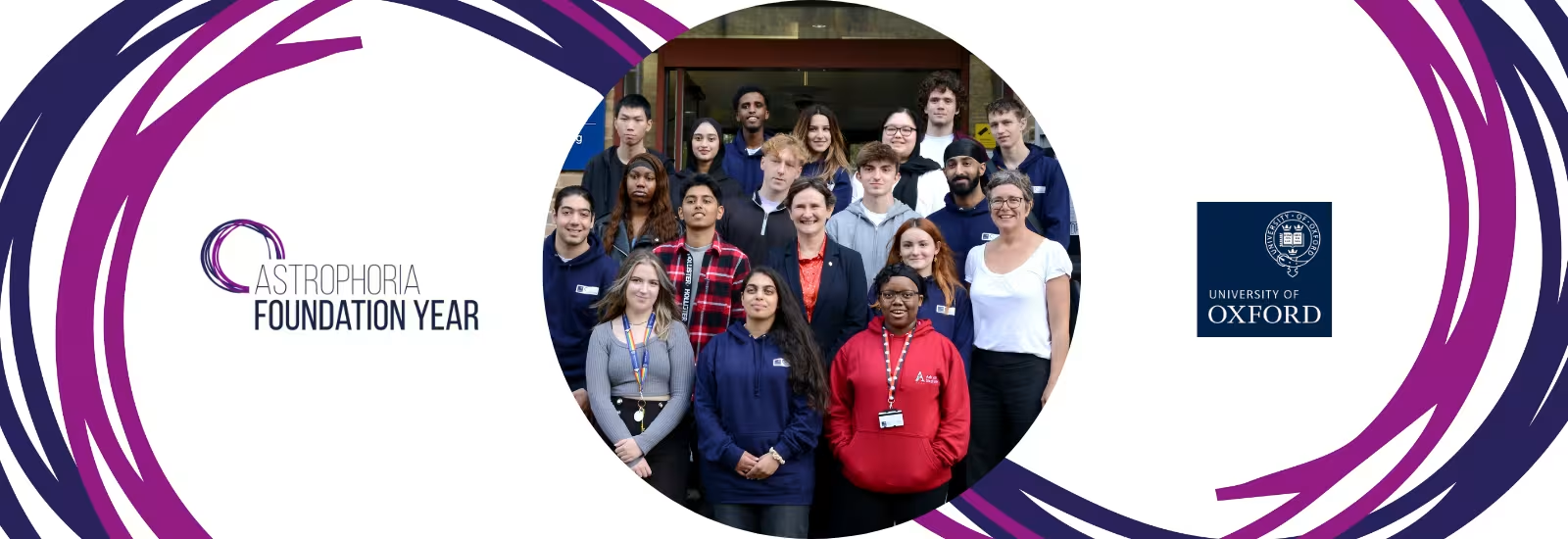
Students on the University’s Astrophoria Physical Sciences Foundation Year course used ChatGPT Edu in a variety of ways to support their learning during the 2024-25 academic year, with a particular focus on revision and independent study. They explored using the tool as a conversational study assistant, a revision partner, and a note organiser, experimenting with features such as projects, voice mode, and image uploads, adapting usage to their own study styles.
Common approaches taken by students during the 2024/25 academic year included:
- Socratic tutoring, where students asked ChatGPT to guide them through problems step by step, encouraging active reasoning rather than passively receiving solutions. Students reported that this made revision feel more like a dialogue than solitary reading.
- Summarising and organising notes, where students uploaded lecture handouts or handwritten work to generate clear, structured summaries. This helped them with breaking down complex material into manageable revision aids.
- Accessibility features, such as using voice mode to revise without typing, or vision tools to interpret handwritten equations, which broadened the ways they could engage with study material.
- Personalisation, with some students assigning ChatGPT a “professional tutor” persona to help them deepen their examination of ideas and arguments.
Students also identified limitations in the GenAI tools they explored. Accuracy issues, particularly in mathematics, meant they had to be cautious not to reinforce mistakes. The tool was sometimes reluctant to mark answers strictly, leaning towards confirming responses as correct. Practical drawbacks, such as the inability to produce diagrams or the difficulty of exporting equations in usable formats, also emerged.
Despite these challenges, students reported that ChatGPT Edu made revision more engaging, provided quick feedback when tutors were not available, and sustained their motivation during long study sessions. All agreed they would want to keep access, highlighting its tutoring support and ability to structure notes as most valuable.
Key lessons included the importance of:
- Framing AI as a complement to independent thinking rather than a shortcut.
- Training students to use strategies such as projects, Socratic questioning, and role assignment to get the best results.
- Encouraging critical engagement with outputs to build confidence without overreliance.
The Astrophoria trial suggests that, when used thoughtfully and with guidance, ChatGPT Edu can support students with independent, active learning and provide new ways of approaching revision in science subjects.
GenAI in Research
Yuhan Zhou, Machine Learning Researcher, Oxford-GSK Institute of Molecular and Computational Medicine
For Yuhan Zhou, much of the research process used to mean long hours spent debugging code, reviewing literature, and waiting on feedback from colleagues. Tasks such as refining manuscripts or brainstorming complex model architectures were often slowed by bottlenecks. Incorporating ChatGPT Edu into his workflow has dramatically changed this pace.
At a technical level, Yuhan has found ChatGPT Edu invaluable as a debugging assistant. When implementing a contrastive learning pipeline in PyTorch Lightning, ChatGPT identified a subtle tensor dimension mismatch he had missed and even proposed an architectural tweak that improved training stability.
Yuhan has also found the tool useful for talking through logic when he is developing complex systems, similar to rubber-duck debugging. More than just a troubleshooter, ChatGPT has become a thinking partner. While adapting Graph Neural Networks (GNNs) for multimodal learning, Yuhan initially considered basic fusion strategies. ChatGPT suggested a more advanced cross-modal transformer approach – an idea that pushed his research forward and strengthened his final model.
Communication has also benefitted. As a non-native English speaker, Yuhan uses ChatGPT to refine manuscripts, grant applications, and emails. By tailoring prompts to suit different audiences - academic peers, interdisciplinary collaborators, or non-technical stakeholders - he ensures his writing is clear, polished, and appropriately pitched. Colleagues have noticed that his drafts are now sharper, more persuasive, and produced more quickly.
Perhaps most importantly, ChatGPT has freed up capacity for exploration. Through its support with coding and literature review, Yuhan has been able to pursue a side project on explainability in protein-structure prediction – a project that he previously would not have had capacity for. A Minimum Viable Product (MVP) prototype was completed in a week, for example – a fraction of the usual timeline.
Yuhan’s advice to others: treat ChatGPT as a collaborator, not a search engine. Provide context, test assumptions, and validate results. Used in this way, ChatGPT Edu is not only a time-saver, but a catalyst for deeper thinking and innovation. Yuhan also suggests that users always validate AI suggestions before implementing them. Like any collaborator, ChatGPT is fallible; it should be used to accelerate thinking, not to replace critical judgement.

“As a postdoc, I’d recommend using ChatGPT Edu as a high-level thinking partner and technical assistant.”
Riadh Salem, Surgeon and Research Fellow, Nuffield Department of Surgical Sciences
For Riadh Salem, interdisciplinary collaboration is central to solving problems. Before using ChatGPT Edu, the only way to explore how other disciplines might approach challenges was to attend hackathons, seminars or networking events. While these conversations were valuable, they were also reliant on chance encounters and were often slow to yield the right expertise.

Riadh now uses Generative AI for ‘Deep Research’, leaning on ChatGPT to help him cut across traditional disciplinary boundaries. When he tackles a surgical problem, he asks how the same core challenge is framed and solved in other fields. His work focuses on intraoperative surgical quality assurance, and this approach lets him go beyond standard medical literature to learn from high-stakes industries like advanced manufacturing and aerospace. He might, for instance, prompt the system to surface models of sensor-based performance feedback used in aviation. The result could be a set of battle-tested principals from other domains that he can adapt to surgery. This would have been incredibly difficult to do using conventional academic search engines.
What once took weeks of speculative searches or waiting for the right conversations to be held can now be explored in an afternoon. More importantly, ChatGPT helps Riadh to address the challenge of 'unknown unknowns’. By reframing his problem and asking the AI to search across domains, he uncovers entire methodologies and solutions he never knew existed. This shift from "not knowing what I don't know" to "knowing what I don't know", creates a roadmap for targeted investigation and stronger, more innovative research questions.
Riadh’s advice for others: treat ChatGPT not as a search engine, but as a tireless interdisciplinary research assistant. Frame problems broadly, ask AI how other disciplines have approached problems, use it as an ideation partner to spark new perspectives, and always validate outputs against primary sources. The aim isn't to get a final answer from ChatGPT; it's about getting a vetted set of ideas you can then adapt.

“[ChatGPT] saves you time, but perhaps more importantly energy.”
Regent Lee, Professor of Interdisciplinary Innovation, Nuffield Department of Surgical Sciences
My work has involved harnessing GenAI to support innovative advances in scanning techniques to support cancer management. Healthcare systems are facing the unprecedented challenge of caring for an ageing population.
The European Cancer Information System reported 2.74 million new cancer diagnoses in 2022 and more than 3.24 million per year are anticipated by 2040. This places an increasing stress on the healthcare system to meet the growing demands for cancer management.
Computerised Tomography (CT) scans and Positron Emission Tomography (PET) scans are two of the key types of radiology imaging used for cancer patients around the world today. Contrast enhanced CT (CE-CT) scans rely on the injection of radiocontrast media (RCM) to produce detailed cross-sectional images of the body, while PET scans use radioactive tracers to visualise cancer activity within tissue.

Typically, PET scans are combined with CT scans (PET-CT) to give anatomical and functional information that enhances the accuracy of diagnosis and enables decision-making about appropriate cancer treatment.
These types of CT scan require the injection of Radiographic Contrast Media (RCM) or radioactive tracers, and both are relatively resource intensive compared to non-contrast CT scans. They also have a far larger carbon footprint.
The injection of radiopharmaceuticals for CE-CT and PET-CT scans requires the use of multiple single-use items, which have to be disposed of as clinical waste. On average, each CT scan generates 9kg of CO2 emissions, which is predominantly due to the contrast dye injection. The average CO2 associated with each PET-CT scan is 60kg. Altogether, the use of these RCMs in CT scanning accounts for about 3% of all pharmaceuticals detected in water systems.
To address some of these issues, my team invented and patented the method of synthesising ‘digital radioactive tracer’ and ‘digital contrast’, using through deep learning (DL) GenAI approaches.
This has enabled us to remove the need for radiopharmaceuticals injection in CT scans. The first technical proofs of concept were developed in the context of aortic aneurysms and head/neck cancer, but subsequent work revealed the potential to apply this GenAI approach to simulating contrast enhancement in solid organs such as the spleen, and to identify abnormal/cancerous tissue in the liver and lung.
This ongoing research brings together a cross-disciplinary team working across four continents and 18 hospital sites. We are collaboratively establishing one of the largest CT data repositories (involving one million datasets) to support ongoing research and using GenAI to address the carbon footprint of CT scans.
GenAI in Professional Services

Emmanuelle Denis, Senior Operations Manager, Epidemic Diseases Clinical Research Group, Pandemic Sciences Institute
Emmanuelle Denis is responsible for coordinating complex grant applications, reviewing detailed funder guidance, and preparing accurate meeting minutes. Before adopting ChatGPT Edu, these processes were slow and manual: drafting proposals by reworking old documents, combing through long guidance documents to find key requirements, and typing up meeting minutes from scratch.
Now, ChatGPT has become a central support tool in Emmanuelle’s workflow. For grant applications, she uses it to generate first drafts of sections such as project plans and budget narratives. She also asks ChatGPT to cross-check grant applications against funder requirements, ensuring eligibility and compliance. For meetings, she provides ChatGPT with transcripts (with the permission of meeting attendees) and a template, so that it produces concise minutes in the correct style and format, complete with action owners and deadlines. Summarising complex guidance and contracts is also now significantly faster and easier.
The impact has been clear: faster first drafts, improved accuracy, and a much smoother process overall. Grant writing is less daunting, comprehension of dense documents is quicker, and Emmanuelle’s least favourite task, writing meeting minutes, has become painless.
Emmanuelle’s advice for others is simple: always verify outputs. For instance, when using ChatGPT to summarise guidance, she asks it to include citations and section references so she can cross-check against the original. She also recommends investing time in carefully formulating prompts, instructing ChatGPT to seek clarification if needed. Finally, she highlights the value of the ‘Projects’ capability in ChatGPT: by uploading guidelines, draft protocols and past applications, she creates a reference base that ChatGPT can draw on, across multiple sessions.

“There are countless ways to use [ChatGPT], and different people will find value in different areas”
Kanza Basit, Senior Research Facilitator, Social Sciences Division
Kanza Basit often found herself fielding repeated questions from colleagues about finance, reimbursements, and the University’s financial regulations. While answering these queries was essential, it was also time-consuming and often left less room for higher-value work. The feeling was also shared by other senior team members of her team.

To solve this, Kanza turned to ChatGPT Edu and created a custom GPT designed specifically for her team. By training it on the University’s financial regulations and the Division’s terms and conditions, she built a tool that allows colleagues to ask direct questions and receive clear, step-by-step guidance. Whether it’s checking if an expense is eligible for reimbursement or navigating complex rules, the GPT provides accurate answers instantly - freeing Kanza and her team from having to repeat the same explanations hundreds of times.
The benefits have been immediate. Tasks that once required staff intervention are now automated, giving colleagues faster access to reliable information while reducing the administrative burden on the team. For Kanza, this means less time spent answering repetitive queries and more time to focus on supporting researchers across the Division.
Her experience also highlights an important lesson: the quality of the GPT depends on the quality of its training material. Feeding it with accurate, up-to-date documents ensures its guidance is correct. Kanza also recommends rigorous testing before rolling out a custom GPT more widely - trialling it with colleagues to identify gaps, refine prompts, and align outputs with expectations.
By combining her understanding of team needs with ChatGPT Edu’s flexibility, Kanza has transformed a persistent challenge into a practical solution. Her custom finance assistant is not just a time-saver; it’s an example of how AI can be tailored to meet specific organisational needs, making everyday processes smoother, smarter, and more sustainable.

“Use [ChatGPT] as cognitive enhancement tool, do not outsource your brain.”
Matt Reid, Web Developer, Technology-Assisted Lifelong Learning, Department for Continuing Education
As a web developer, Matt Reid often faced the challenge of solving tricky coding problems. Before using ChatGPT Edu, his workflow involved searching Google with carefully chosen keywords, trawling through coding forums, testing potential fixes, and often repeating the process when solutions fell short. While sometimes fruitful, this trial-and-error approach could result in hours lost.

With ChatGPT Edu, Matt has reshaped this process. He created a custom GPT tailored to his environment by providing it with details such as his operating system, remote server setup, institutional context, and the software he works with. This means ChatGPT can give context-aware answers, concise at first but ready to expand into detail on request. The integration with tools like his terminal and Visual Studio Code further streamlined the process, reducing the need to copy, paste or reframe context.
The impact has been tangible: Matt estimates the time he spends fixing bugs and implementing new features has been reduced by about one-third. Beyond efficiencies, ChatGPT has also boosted his confidence to tackle more advanced or unfamiliar problems. Its chat history sidebar helps him to group related ideas by project, which prevents repetition and makes it easier for him to track progress across multiple tasks.
Matt also values the reassurance that ChatGPT Edu inputs are all private and all data is retained within the University. Because the tool does not record sensitive information, he feels he can focus fully on problem-solving, without worrying about feeling the need to censor his prompts.
Matt’s advice to others is to approach ChatGPT Edu like a competent colleague: provide assumptions, attempted solutions and context early, and ask for alternatives, with pros and cons, before implementing any new solutions. He also highlights the value of integrating ChatGPT with coding tools for richer, faster feedback, and recommends switching between different large language models if progress stalls.

“[ChatGPT]’s not a replacement for expert advice or institutional knowledge, but it's an incredibly helpful assistant for day-to-day tasks.”
Becca Chesworth, Digital Communications Officer, Keble College
Becca Chesworth has mostly been using ChatGPT Edu for improving and reviewing her writing. Before using it, she would spend much more time and energy drafting and finalising text, and relying on limited services like Grammarly for grammar checks. She also sought more peer input for support with content and tone.

Now, she can generate and refine social media captions, enhance the tone of articles, check newsletter entries, create article blurbs, and improve the structure of new communications documents more quickly and without needing as much support from others. This has also increased Becca’s confidence that she can produce work to the standard she wants and needs.
Alongside this, Becca created a custom GPT to track her own career and skill progression. By uploading a daily work diary, she can identify the hard and soft skills she has demonstrated each week and spot areas of her job description that may not be reflected in her recent work. This has helped Becca to recognise skills she might otherwise have overlooked. It has given her a clearer picture of where any gaps might be. She uses the custom GPT option to generate weekly summaries less often but when she does, it provides a useful starting point for reflecting or writing about her progression. Overall, this has made her self-reflection easier and more comprehensive.
Becca has learned that ChatGPT is most effective for her when she provides it with an existing starting point like a draft. It works best for generating ideas, refining content and improving tone, rather than for producing text from scratch. Approaching the tool in this way has meant the final output she uses still feels primarily authored by her, whilst also saving her time and energy.

“I just love [ChatGPT], it’s honestly been the best tool that we've got! I'm also dyslexic, so it has helped massively when my brain gets scrambled.”
Related links
- GenAI support and information for staff on OxIntranet (SSO login required)
- GenAI support and information for students
- AI training
- Generative AI tools at Oxford