
Nuffield Department of Women's & Reproductive Health
The Nuffield Department of Women's & Reproductive Health (NDWRH) is one of the largest academic and clinical departments in the world in its field, encompassing multi-disciplinary research across the full spectrum of women’s health.
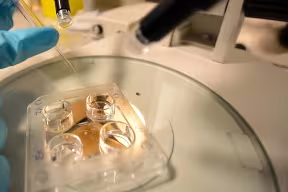
Egg vitrification in the laboratory. Credit: Zachary Domach / Graduate Photography Competition

Overview
There are around 270 people working in the department, including senior academic staff, research support staff, professional staff, and graduate students. The department is a multidisciplinary research department with expertise in laboratory science, clinical research, epidemiology, health economics and social science.
The department's work has five overarching themes:
- cancer
- global health
- maternal, child and foetal health
- reproductive medicine and genetics
- data science and methodology
The laboratories of NDWRH are fully equipped for a wide range of molecular and cell biology work with dedicated image analysis and flow cytometry facilities. Dry lab resources include access to high performance computing facilities, multiple national and international data assets, national observational research and clinical trial platforms.
The department's research degrees are based in:
- the Women’s Centre at the John Radcliffe Hospital
- the Weatherall Institute of Molecular Medicine at the John Radcliffe Hospital
- the Institute of Reproductive Sciences (IRS), Oxford Business Park
- the Big Data Institute
- New Radcliffe House
The laboratories at the Women’s Centre give excellent access to patients and clinical samples for research from clinics, theatres and delivery suites. The department maintains many special clinical services data infrastructures and national audit and review programmes which help generate programmes of research.
There are collaborations with the department's institutes, the University’s science departments and with researchers outside Oxford, in both the UK and abroad, especially in low middle-income countries.
The department has a variety of students studying towards research degrees, including students from laboratory, clinical, data and social science backgrounds.
Courses offered
The courses shown below are offered at postgraduate-level.
- MSc in Clinical Embryology (full time)
- Doctor of Medicine (DM) (variable intensity)
- MSc in Reproductive Genetics (full time)
- DPhil in Women's and Reproductive Health (full time and part time)
- MSc by Research in Women's and Reproductive Health (full time)
Medical Sciences Division
The Medical Sciences Division houses some of the strongest biomedical research in the world; Oxford is repeatedly placed first in clinical, pre-clinical and health in the Times Higher Education World University Rankings.

The Medical Sciences Division's departments and institutes in Oxford and overseas are home to some of the strongest biomedical research in the world, regularly appearing at the highest levels in world rankings and rated world-leading and internationally excellent.
The division’s 2,000 researchers cover a wide range of research, from atomic-resolution molecular structural biology to epidemiology as applied to very large populations. This enables students to work on virtually any biomedical problem.
The division provides a stimulating and challenging environment for more than 2,000 talented graduate students with excellent new facilities and close personal supervision by world-class researchers. To complement research supervision and course teaching there is a wide range of facilities aimed at the personal and professional development of students, strengthening their existing skills and developing new skills.
All candidates who apply by the December or January deadline shown on the course page are automatically considered for full funding awards, irrespective of their nationality.