Research
Oxford University is world-famous for research excellence. Our core commitment is to maintain originality, significance and rigour in research within a framework of the highest standards of infrastructure, training, and integrity.
Search below for a range of research stories by department or topic. These stories include impact case studies, videos, news and the research in conversation series. For more information please see individual department websites.

Medical evidence through a philosophical lens
Impact case study
Dr Jeremy Howick’s application of philosophical approaches to health science has helped shape how we leverage placebos in clinical trials and treatment, and determine the quality of evidence required in ‘evidence-based medicine’.

Bringing the past to the present through history and community theatre
Impact case study
Professor Selina Todd and Dr Andrea Thomson are drawing on their research to develop community theatre with partners in Manchester and Salford, enabling young people and women and men across a wide age range to develop their confidence, performance skills, and historical interest in the region

A breakthrough in the development of a universal flu vaccine
Impact case study
A new approach to making influenza vaccines, based on mathematical models developed at the University of Oxford, could result in the development of a vaccine which will potentially protect people against influenza for a lifetime.

Putting 'no deforestation' into practice in the palm oil industry
Impact case study
Knowledge exchange work at the University of Oxford has led to the successful uptake of science in the development of new industry standards for oil palm plantations. This is helping to protect rainforests, maintain biodiversity and make palm oil production more sustainable.

Understanding how fiction-reading can influence eating disorders
Impact case study
An Oxford academic has begun a long-overdue investigation into the psychological effects of fiction on readers – especially those suffering from eating disorders.

OpenPrescribing: putting data and statistics into action to save the NHS money
Impact case study
To identify the biggest prescribing quality improvement and cost-saving opportunities for General Practices and Clinical Commissioning Groups every month, and help them to improve, the Nuffield Department of Primary Care Health Sciences’ EBM DataLab brings together health researchers and software developers to transform large prescribing datasets into useful data explorer tools for coalface NHS staff.
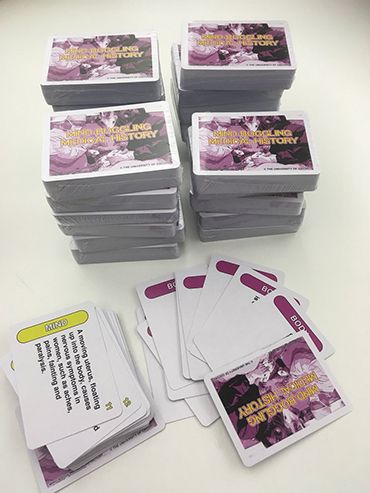
Mind-Boggling Medical History
Researchers at Oxford University in partnership with the Royal College of Nursing, have developed a game which helps nurses to develop critical thinking skills and supports evidence-based practice.

Increasing crop yields for global food security
Impact case study
Pioneering research between the University of Oxford and Rothamsted Research has led to the development of a new compound that could transform crop yields of all kinds.
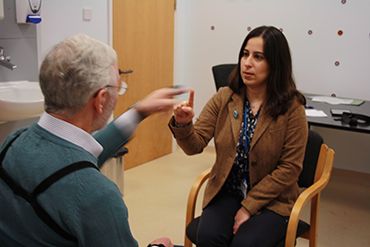
New ways to measure brain diseases
Impact case study
The OxQUIP project is developing new, more objective ways of measuring symptoms in diseases such as Parkinson’s, in order to speed up diagnosis and the hunt for effective treatments.
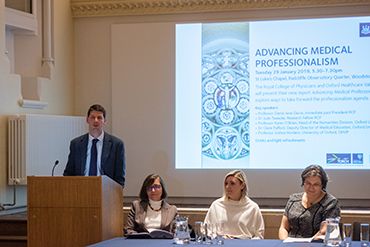
Advancing Medical Professionalism
Impact case study
A new report by Oxford University’s Healthcare Values Partnership and the Royal College of Physicians aims to support doctors’ satisfaction in their profession and promote innovative, high quality healthcare for patients.

Measuring chilli heat with electrochemistry
Impact case study
The success of University of Oxford chemists in using electrochemical sensing to detect the spiciness of chillies has led to the recent development of new sensors for garlic, turmeric and ginger.

Women Speak Out: An Academic-Community Collaboration to Explore the Links Between HIV, Gender-Based Violence and Human Rights Among Women with Drug Dependence
Women Speak Out is an academic-community collaboration between Oxford University and the Indonesian Drug Users Network aimed at addressing HIV and gender-based violence among drug-using women in Indonesia.

Interdisciplinary Study of Energy use and Activities
Understanding the timing of energy demand is becoming ever more important. The uptake of renewable sources of energy, such as wind and solar, is accelerating and systems have to accommodate their sometimes volatile outputs.
Creating vehicles that drive themselves
From 2005 to 2017 Paul Newman led the Oxford Mobile Robotics Group (MRG) within the Dept. of Engineering Science. In 2017 MRG become the Oxford Robotics Institute. During this time he led the development of a suite of technology that enabled autonomous vehicles to navigate with zero dependence on infrastructure at scale. It is a foundation technology.

Global Jet Watch for Social Change
The creation of the Global Jet Watch observatories has led to real impact on communities spanning four continents, which work together to track Galactic black holes and exploding stars in the night sky.

LAB282
There is currently a lack of funding and industrial expertise available to help translate innovative, world class, biomedical discoveries at Oxford University into next generation drug discovery programmes that can be commercialised for patient benefit.
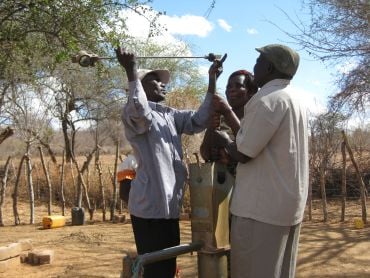
Smart Handpumps
In Africa around 275 million people don't have access to a decent reliable water supply.
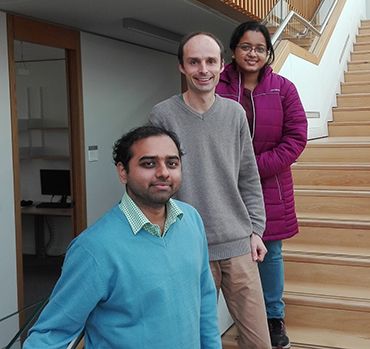
Mitigation of arsenic mass poisoning: a unified experimental and theoretical approach
The Ganges–Brahmaputra Delta is a global hotspot for arsenic groundwater contamination. Naturally occurring arsenic concentrates in water drawn from deep wells, creating a major public health issue in West Bengal and Bangladesh, which has been described as the largest mass poisoning of a population in history.

The Language Problem Language Problem: Building consensus on Developmental Language Disorder
Video
Around 7% of people suffer from a developmental language disorder, and yet not many people have even heard of them.
 Spectacular fossil treasure trove pushes back origins of complex animals
 Oxford scientists uncover how the brain resolves emotional ambiguity
 Oldest genetic evidence for domestic dogs identified in Europe and Türkiye
 New study finds that stored sperm deteriorates across the animal kingdom
 Expert Comment: From frontier to feedback loop - Why space must become circular
 Blood test may improve survival of childhood cancer in Africa