DPhil in Particle Physics
About the course
The DPhil in Particle Physics is a research-based course investigating fundamental particles and forces via high-energy accelerators and cosmic observations. Topics include neutrinos, dark matter, dark energy, and physics beyond the Standard Model.
The course is hosted by the Particle Physics sub-department, one of six sub-departments of the Department of Physics. The sub-department is one of the largest in the UK and is well equipped to carry out research in a wide range of topics, from the study of particles produced at high energy accelerators to neutrinos, dark matter and dark energy in the Universe. The work of this world-class sub-department is in experimental particle physics, particle astrophysics and accelerator physics.
As a DPhil student, you will join an existing research group which typically consists of academics, postdocs, fellows and current students. Your research work begins on day one and will be underpinned by a taught graduate course in the first year that runs in parallel.
To learn more about the research topics you’ll have the opportunity to explore, please refer to the Research areas section on this page.
Whilst working on your research project you can engage in skills training including workshops and seminars in transferable skills, generic research skills and specific research techniques. There are also numerous seminars and lectures held in the department by local and visiting physicists, and you will be provided with opportunities to meet experts in various fields. There will be routine opportunities for you to present your work at informal collaboration meetings, as well as form conferences.
Attendance
The course is full-time and requires attendance in Oxford. Full-time students are subject to the University's Residence requirements.
Provision exists for students on some courses to undertake their research in a ‘well-founded laboratory’ outside of the University. This may require travel to and attendance at a site that is not located in Oxford. Where known, existing collaborations will be outlined on this page. Please read the course information carefully, including the additional information about course fees and costs.
The sub-department’s experiments are carried out at facilities around the world, including facilities in:
- Canada (Sudbury Neutrino Observatory)
- Italy (DarkSide experiment)
- Japan (T2K experiment),
- Switzerland (Large Hadron Collider and the future particle physics facility known as FCC); and
- USA (LZ experiment and DUNE)
Depending on the project, you will often be able to spend significant amounts of time away at the experimental site for your research.
Resources to support your study
As a graduate student, you will have access to the University's wide range of resources including libraries, museums, galleries, digital resources and IT services.
The Bodleian Libraries is the largest library system in the UK. It includes the main Bodleian Library and libraries across Oxford, including major research libraries and faculty, department and institute libraries. Together, the Libraries hold more than 13 million printed items, provide access to e-journals, and contain outstanding special collections including rare books and manuscripts, classical papyri, maps, music, art and printed ephemera.
The University's IT Services is available to all students to support with core university IT systems and tools, as well as many other services and facilities. IT Services also offers a range of IT learning courses for students to support with learning and research, as well as guidance on what technology to bring with you as a new student at Oxford.
You will usually be allocated your own desk in a shared office or laboratory. As a DPhil student, you will be provided with appropriate computing support to conduct your research. You will be given accounts on central Linux and Windows servers and, once you arrive at Oxford, you will be able to select the machine and operating system which works the best in your research group. Additionally, if you are working on a computationally intensive project, you will have appropriate access to the departmental cluster computers and national facilities.
During time spent away at the experimental site (if applicable for your project), a similar level of provision will be available.
Supervision
The allocation of graduate supervision is the responsibility of the Sub Department. It is not always possible to accommodate the preferences of incoming graduate students to work with a particular member of staff. Under exceptional circumstances a co-supervisor may be found outside the Sub-Department.
Assessment
All students will be initially admitted to the status of Probationer Research Student (PRS). Within a maximum of six terms as a PRS student and normally by the fourth term you will be expected to apply for transfer of status from Probationer Research Student to DPhil status.
A successful transfer of status from PRS to DPhil status will require satisfactory attendance and completion of problem sets during your first two terms, and submission of a report and thesis outline. Submission on a report and thesis outline. Students who are successful at transfer will also be expected to apply for and gain confirmation of DPhil status within nine terms of admission, to show that your work continues to be on track.
Both milestones normally involve an interview with two or more assessors other than your supervisor and therefore provide important experience for the final oral examination (ie the viva).
The actual DPhil viva requires you to submit a substantial and original thesis not exceeding 250 pages after three or at most four years from the date of admission. To be successfully awarded a DPhil in particle physics you will need to defend your thesis orally (viva voce) in front of two appointed examiners.
Graduate destinations
The particle physics doctoral programme at Oxford is ideally suited to students who would like to pursue a career in research, either in academia or industry all over the world.
Students have taken on a wide variety of jobs in other fields, including investment banking, business analysis, and consulting. Physics as a discipline is always in high demand.
Changes to this course
The University will seek to deliver this course in accordance with the description set out in this course page. However, there may be situations in which it is desirable or necessary for the University to make changes in course provision, either before or after registration. The safety of students, staff and visitors is paramount and major changes to delivery or services may have to be made if a pandemic, epidemic or local health emergency occurs. In addition, in certain circumstances, for example due to visa difficulties or because the health needs of students cannot be met, it may be necessary to make adjustments to course requirements for international study.
Where possible your academic supervisor will not change for the duration of your course. However, it may be necessary to assign a new academic supervisor during the course of study or before registration for reasons which might include illness, sabbatical leave, parental leave or change in employment.
For further information please see our page on changes to courses and the provisions of the student contract regarding changes to courses.
Research areas
The department is involved in many of the world's major particle physics endeavours. At the Large Hadron Collider (LHC), members of the department work on ATLAS experiment studying the Higgs boson in increasing detail. We search for Supersymmetry and others beyond the Standard Model theories and test the fundamentals of quantum mechanics at the highest energy scales possible in the laboratory. Also at the LHC, the LHCb experiment collects and studies huge samples of beauty and charm hadrons.
Neutrino oscillations and neutrino properties are studied at the T2K experiment in Japan, MicroBooNe and DUNE in the USA, and at the Sudbury Neutrino Observatory (SNO+) in Canada.
The sub-department is also involved in the study of neutrino oscillations and neutrino properties at the T2K experiment in Japan, MicroBooNe and DUNE in the USA, and at the Sudbury Neutrino Observatory (SNO+) in Canada. Direct searches for dark matter is undertaken at both the LZ experiment in the US and DarkSide in Italy. And most recently the sub-department has taken leading roles in the development of the future particle physics facility known as FCC.
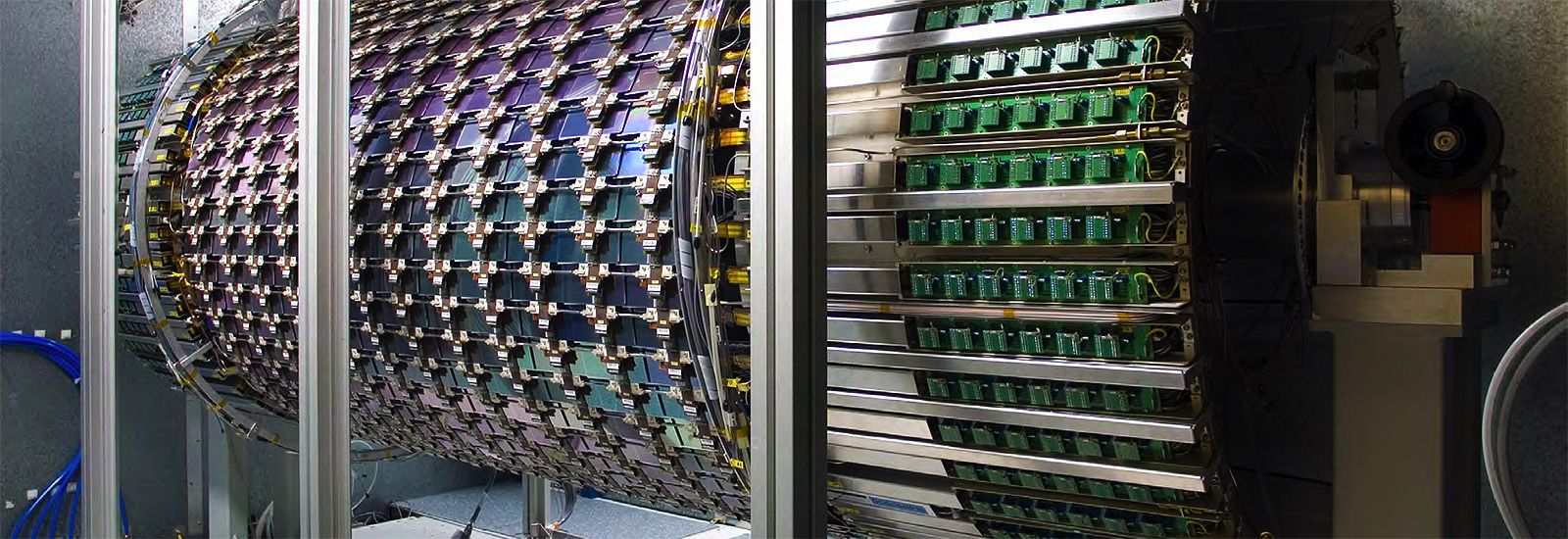
The future of particle physics relies on the development of new instruments for detecting particles and novel ideas in accelerator physics. The sub-department is heavily involved in the development of these areas. It has outstanding facilities to build the new silicon detectors needed for the luminosity upgrade of the LHC and other applications.
Further information
Information about potential research projects, academic and research staff and departmental research can be found on the department's website.
Entry requirements for entry in 2026-27
Proven and potential academic excellence
The requirements described below are specific to this course and apply only in the year of entry that is shown. You can use our guidance to help you evaluate whether your application is likely to be competitive.
Please be aware that any studentships that are linked to this course may have different or additional requirements and you should read any studentship information carefully before applying.
Degree-level qualifications
As a minimum, applicants should hold or be predicted to achieve the following UK qualifications or their equivalent:
- a first-class or strong upper second-class undergraduate degree with honours in physics, mathematics or related fields. The equivalent of a UK four-year integrated MPhys or MSci degree is typically required. Bachelor's degrees with a minimum four years' standard duration may satisfy the entry requirements.
Entrance is very competitive and most successful applicants have a first-class degree or the equivalent. In exceptional cases, the requirement for a first-class or strong upper-second class undergraduate degree with honours can be alternatively demonstrated by a graduate master’s degree or substantial directly-related professional or research experience.
For applicants with a bachelor's degree from the USA, the minimum overall GPA that is normally required to meet the undergraduate-level requirement is 3.5 out of 4.0. However, selection of candidates also depends on other factors in your application and most successful applicants have achieved higher GPA scores.
If your degree is not from the UK or another country specified above, visit our International Qualifications page for guidance on the qualifications and grades that would usually be considered to meet the University’s minimum entry requirements.
GRE General Test scores
No Graduate Record Examination (GRE) or GMAT scores are sought.
Other qualifications, evidence of excellence and relevant experience
It is helpful to include details of any of the following applicable attributes, which may strengthen your application:
- Details of any publications. Many candidates with no peer-reviewed publications, however, receive offers each year. Research or professional experience in areas aligned with the proposed supervisors' research interests.
- Depending on the project, evidence of training in scientific computer programming or related numerical techniques.
- Previous experience in a scientific or technical research environment.
English language proficiency
This course requires proficiency in English at the University's standard level. If your first language is not English, you may need to provide evidence that you meet this requirement. The minimum scores required to meet the University's standard level are detailed in the table below.
| Test | Minimum overall score | Minimum score per component |
|---|---|---|
| IELTS Academic (Institution code: 0713) | 7.0 | 6.5 |
| TOEFL iBT* including the 'Home Edition' (Institution code: 0490) | 100 | Listening: 22 Reading: 24 Speaking: 25 Writing: 24 |
| C1 Advanced† | 185 | 176 |
| C2 Proficiency‡ | 185 | 176 |
| Oxford Test of English Advanced | 155 | 145 |
*Changes to the TOEFL iBT test are being introduced on 21 January 2026. The University will not accept TOEFL tests taken from that date to meet the English language condition until a review of the revised test has been completed. Our Application Guide provides full details of the tests we accept.
†Previously known as the Cambridge Certificate of Advanced English or Cambridge English: Advanced (CAE)
‡Previously known as the Cambridge Certificate of Proficiency in English or Cambridge English: Proficiency (CPE)
Your test must have been taken no more than two years before the start date of your course. Our Application Guide provides further information about the English language test requirement.
Declaring extenuating circumstances
If your ability to meet the entry requirements has been affected by the COVID-19 pandemic (eg you were awarded an unclassified/ungraded degree) or any other exceptional personal circumstance (eg other illness or bereavement), please refer to the guidance on extenuating circumstances in the Application Guide for information about how to declare this so that your application can be considered appropriately.
References
You will need to register three referees who can give an informed view of your academic ability and suitability for the course. The How to apply section of this page provides details of the types of reference that are required in support of your application for this course and how these will be assessed.
Supporting documents
You will be required to supply supporting documents with your application. The How to apply section of this page provides details of the supporting documents that are required as part of your application for this course and how these will be assessed.
Performance at interview
Interviews are normally held as part of the admissions process.
It is expected that interviews will take place in February. Interviews will normally take place in person or online.
You will be asked questions that probe your current knowledge of Particle Physics/Accelerator Physics. You may also be asked about any projects, supervised or unsupervised, you have done in the course of your undergraduate study or vacation placements.
Offer conditions for successful applications
If you receive an offer of a place at Oxford, your offer will outline any conditions that you need to satisfy and any actions you need to take, together with any associated deadlines. These may include academic conditions, such as achieving a specific final grade in your current degree course. These conditions will usually depend on your individual academic circumstances and may vary between applicants. Our 'After you apply' pages provide more information about offers and conditions.
In addition to any academic conditions which are set, you will also be required to meet the following requirements:
Financial Declaration
If you are offered a place, you will be required to complete a Financial Declaration in order to meet your financial condition of admission.
Disclosure of criminal convictions
In accordance with the University’s obligations towards students and staff, we will ask you to declare any relevant, unspent criminal convictions before you can take up a place at Oxford.
Academic Technology Approval Scheme (ATAS)
This course may require you to obtain an ATAS certificate before you can apply for a visa/immigration permission. If you are offered a place, the academic department will confirm whether an ATAS certificate is required. If so, they will also send you the information you need to apply for one. You can apply for ATAS whilst your offer is conditional and before the Confirmation of Acceptance for Studies (CAS) is issued. Further information about ATAS is available on the student visa webpages.
Other factors governing whether places can be offered
The following factors will also govern whether candidates can be offered places:
- the ability of the University to provide the appropriate supervision for your studies, as outlined under the 'Supervision' heading in the About section of this page;
- the ability of the University to provide appropriate support for your studies (eg through the provision of facilities, resources, teaching and/or research opportunities); and
- minimum and maximum limits to the numbers of students who may be admitted to the University's taught and research programmes.
Funding
For entry in the 2026-27 academic year, the collegiate University expects to offer over 1,100 full or partial graduate scholarships across a wide range of graduate courses.
If you apply by the January deadline shown on this page and receive a course offer, your application will then be considered for Oxford scholarships. For the majority of Oxford scholarships, your application will automatically be assessed against the eligibility criteria, without needing to make a separate application. There are further Oxford scholarships available which have additional eligibility criteria and where you are required to submit a separate application. Most scholarships are awarded on the basis of academic merit and/or potential.
To ensure that you are considered for Oxford scholarships that require a separate application, for which you may be eligible, use our fees, funding and scholarship search tool to identify these opportunities and find out how to apply. Alongside Oxford scholarships, you should also consider other opportunities for which you may be eligible including a range of external funding, loan schemes for postgraduate study and any other scholarships which may also still be available after the January deadline as listed on our fees, funding and scholarship search tool.
Details of college-specific funding opportunities can also be found on individual college websites:
Please refer to the College preference section of this page to identify which of the colleges listed above accept students for this course.
For the majority of college scholarships, it doesn’t matter which college, if any, you state a preference for in your application. If another college is able to offer you a scholarship, your application can be moved to that college if you accept the scholarship. Some college scholarships may require you to state a preference for that college when you apply, so check the eligibility requirements carefully.
Further information about funding opportunities for this course can be found on the department's website.
Costs
Annual course fees
The fees for this course are charged on an annual basis.
Fees for the 2026-27 academic year at the University of Oxford
What do course fees cover?
Course fees cover your teaching as well as other academic services and facilities provided to support your studies. Unless specified in the additional information section below, course fees do not cover your accommodation, residential costs or other living costs. They also don’t cover any additional costs and charges that are outlined in the additional costs information below.
How long do I need to pay course fees?
Course fees are payable each year, for the duration of your fee liability (your fee liability is the length of time for which you are required to pay course fees). For courses lasting longer than one year fees will usually increase annually, as explained in the University’s Terms and Conditions.
Graduate students who have reached the end of their standard period of fee liability will be required to pay a University continuation charge and/or a college continuation charge.
The University continuation charge, per term for entry in 2026-27 is £656, please be aware that this will increase annually. For part-time students, the termly charge will be half of the termly rate payable by full-time students.
If a college continuation charge applies (not applicable for non-matriculated courses) it will be between £150 and £500, as explained in our information about continuation charges. Please contact your college for more details, including information about whether your college's continuation charge is applied at a different rate for part-time study.
Where can I find more information about fees?
Our fees and other charges pages provide further information, including details about:
- course fees and fee liability;
- how your fee status is determined;
- changes to fees and other charges; and
- continuation charges.
Information about how much fees and other costs will usually increase each academic year is set out in the University's Terms and Conditions.
Additional costs
Living costs
In addition to your course fees and any additional course-specific costs, you will need to ensure that you have adequate funds to support your living costs for the duration of your course.
Living costs for full-time study
For the 2026-27 academic year, the range of likely living costs for a single, full-time student is between £1,405 and £2,105 for each month spent in Oxford. We provide the cost per month so you can multiply up by the number of months you expect to live in Oxford. Depending on your circumstances, you may also need to budget for the costs of a student visa and immigration health surcharge and/or living costs for family members or other dependants that you plan to bring with you to Oxford (if dependant visa eligibility criteria are met).
Further information about living costs
The current economic climate and periods of high national inflation in recent years make it harder to estimate potential changes to the cost of living over the next few years. For study in Oxford beyond the 2026-27 academic year, it is suggested that you budget for potential increases in living expenses of around 4% each year – although this rate may vary depending on the national economic situation.
A breakdown of likely living costs for one month during the 2026-27 academic year are shown below. These costs are based on a single, full-time graduate student, with no dependants, living in Oxford.
| Lower range | Upper range | |
|---|---|---|
| Food | £315 | £545 |
| Accommodation | £825 | £990 |
| Personal items | £160 | £310 |
| Social activities | £50 | £130 |
| Study costs | £35 | £90 |
| Other | £20 | £40 |
| Total | £1,405 | £2,105 |
For information about how these figures have been calculated as well as tables showing the likely living costs for nine and twelve months, please refer to the living costs page of our website.
College preference
Students enrolled on this course will belong to both a department/faculty and a college. Please note that ‘college’ and ‘colleges’ refers to all 43 of the University’s colleges, including those designated as societies and permanent private halls (PPHs).
If you apply for a place on this course you will have the option to express a preference for one of the colleges listed below, or you can ask us to find a college for you. Before deciding, we suggest that you read our brief introduction to the college system at Oxford and our advice about expressing a college preference.
If you are a current Oxford student and you would like to remain at your current Oxford college, you should check whether it is listed below. If it is, you should indicate this preference when you apply. If not, you should contact your college office to ask whether they would be willing to make an exception. Further information about staying at your current college can be found in our Application Guide.
The following colleges accept students on the DPhil in Particle Physics:
Before you apply
Our guide to getting started provides general advice on how to prepare for and start your application, including advice to help you evaluate whether your application is likely to be competitive.
If it is important for you to have your application considered under a particular deadline – eg under the January deadline in order to be considered for Oxford scholarships – we recommend that you aim to complete and submit your application at least two weeks in advance. Check the deadlines on this page and the information about deadlines and when to apply in our Application Guide.
Application fee waivers
An application fee of £20 is payable for each application to this course. Application fee waivers are available for the following applicants who meet the eligibility criteria:
- applicants from low-income countries;
- refugees and displaced persons;
- UK applicants from low-income backgrounds; and
- applicants who applied for our Graduate Access Programmes in the past two years and met the eligibility criteria.
You are encouraged to check whether you're eligible for an application fee waiver before you apply.
Readmission for current Oxford graduate taught students
If you're currently studying for an Oxford graduate taught course and apply to this course with no break in your studies, you may be eligible to apply to this course as a readmission applicant. The application fee will be waived for an eligible application of this type. Check whether you're eligible to apply for readmission.
Application fee waivers for eligible associated courses
If you apply to this course and are considering applying (or have already applied) to any of the associated courses listed below, you can request an application fee waiver so that you only need to pay one application fee. We recommend that you use your application fee waiver to apply only for eligible courses that are closely related in research area to this one.
For full details about how to request an application fee waiver, please select the course you are interested in from the list below and refer to the equivalent section of its course page.
The following associated courses are taking part in this application fee waiver scheme:
- Autonomous Intelligent Machines and Systems, EPSRC CDT
- Biomedical and Clinical Sciences (Oxford-GSK), DPhil
- Cancer Science (Biological background), CDT
- Cancer Science (Clinician), DPhil
- Cancer Science (Intercalation), DPhil
- Cancer Science (Maths/Physics background), CDT
- Chemical Synthesis for a Healthy Planet, CDT
- Engineering Biology, BBSRC and EPSRC CDT
- Fundamentals of AI, EIT CDT
- Fusion Power, EPSRC CDT
- Generative Biology EIT DTP
- Genomic Medicine and Statistics, DPhil
- Healthcare Data Science, EPSRC CDT
- Inflammatory and Musculoskeletal Disease, DPhil
- Inorganic Materials for Advanced Manufacturing, EPSRC CDT
- Intelligent Earth, UKRI CDT in AI for the Environment
- Interdisciplinary Life and Environmental Science, DPhil
- Materials 4.0, EPSRC CDT
- Mathematics of Random Systems: Analysis, Modelling and Algorithms, CDT
- Neuroscience (1+3), DPhil
- Robotics and AI for Net Zero, EPSRC CDT
- Statistics and Machine Learning, EPSRC CDT
- Superconductivity: Enabling Transformative Technologies, EPSRC CDT
- Transformative Technologies in Pharmaceutical Science BBSRC CDT
Do I need to contact anyone before I apply?
You do not need to contact the department before you apply but you are encouraged to visit the relevant departmental webpages to read any further information about your chosen course.
If you have any queries about the course, you should contact the departmental representative (rather than individual academics) using the contact details provided on this page.
Research areas may overlap across the different physics DPhil courses. If you are in any doubt about which course(s) to apply to, you are advised to read each of the physics course pages carefully before starting an application. If you have any course-related questions, please refer to the 'Further information and enquiries' section on each page for the relevant contact details.
Completing your application
You should refer to the information below when completing the application form, paying attention to the specific requirements for the supporting documents.
If any document does not meet the specification, including the stipulated word count, your application may be considered incomplete and not assessed by the academic department. Expand each section to show further details.
Proposed field and title of research project
If you are applying with your own research proposal, enter your project title, under 'Proposed field and title of research project'. It is not necessary agree this with a potential supervisor in advance. You should not use this field to type out a full research proposal.
You will be able to upload your research supporting materials separately if they are required (as described below).
Proposed supervisor
If known, under 'Proposed supervisor name' enter the name of the academic(s) who you would like to supervise your research. You can also enter the name of the experimental collaboration(s) in which you are interested, eg ATLAS, LZ, etc. Otherwise, leave this field blank.
Referees:
Three overall, generally academic
Whilst you must register three referees, the department may start the assessment of your application if two of the three references are submitted by the course deadline and your application is otherwise complete. Please note that you may still be required to ensure your third referee supplies a reference for consideration.
Three academic references are usually required. However, if you have been out of education and in employment for a few years, you may arrange one professional and two academic references.
Your references will support intellectual ability, academic achievement, motivation, and your ability to work in a group.
Official transcript(s)
Your transcripts should give detailed information of the individual grades received in your university-level qualifications to date. You should only upload official documents issued by your institution and any transcript not in English should be accompanied by a certified translation.
More information about the transcript requirement is available in the Application Guide.
CV/résumé
A CV/résumé is compulsory for all applications. Most applicants choose to submit a document of one to two pages highlighting their academic achievements, and research if you have undertaken any, and any relevant professional experience.
Research proposal:
A maximum of 500 words
You do not need to provide a detailed research proposal; you should only give a brief indication of the area in which you wish to carry out research. This may be quite specific, but need not be if you have not yet decided on your preferred topic or area.
Your proposal should focus on your research rather than personal achievements, interests and aspirations.
The proposal should be written in English.
If possible, please ensure that the word count is clearly displayed on the document.
This will be assessed for:
- your reasons for applying
- the coherence of the proposal
- the originality of the project
- evidence of motivation for and understanding of the proposed area of study
- the ability to present a reasoned case in English
- the feasibility of successfully completing the project in the time available
- commitment to the subject, beyond the requirements of the degree course
- preliminary knowledge of research techniques
- capacity for sustained and intense work
- reasoning ability
- ability to absorb new ideas, often presented abstractly, at a rapid pace.
Start or continue your application
You can start or return to an application using the relevant link below. As you complete the form, please refer to the requirements above and consult our Application Guide for advice.
After you've submitted your application
Your application (including the supporting documents outlined above) will be assessed against the entry requirements detailed on this course page. Whether or not you have secured funding will not be taken into consideration when your application is assessed. You can find out more about our shortlisting and selection process in our detailed guide to what happens next.
Find out how to manage your application after submission, using our Applicant Self-Service tool.