
Department of Physics
As a graduate student at Oxford’s Department of Physics, you will work alongside world experts and have access to the department’s world-class facilities.
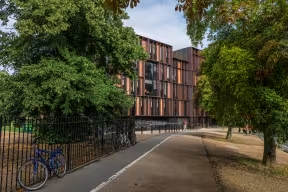
The Beecroft Building. Credit: OU Images/John Cairns

Overview
Graduate students also get to benefit from the close relations the department fosters with other facilities in the UK and around the world. In the UK, these include the leading science and innovation campus at Harwell home to the Rutherford Appleton Laboratory and Diamond Light Source synchrotron among others. Internationally, it extends to the Large Hadron Collider at CERN, T2K in Japan, DUNE in the USA and large telescopes around the world.
Each year, the department welcomes approximately 90 graduate research students to study for a 3 to 4-year DPhil research degree – which is equivalent to a PhD. Alongside our DPhil courses, we also offer a one-year taught masters in Quantum Technologies.
The department’s research students have access to world-class facilities and resources, from the ultra-low vibration and ultra-low temperature labs in the state-of-the-art Beecroft Building, to the in-house specialist research facilities, mechanical and electronic workshops and technicians.
Research students can choose from a range of specialisms across the six sub-departments:
- Astrophysics
- Atmospheric, Oceanic and Planetary Physics
- Atomic and Laser Physics
- Condensed Matter Physics
- Particle Physics
- Theoretical Physics
Each of these sub-departments is autonomous, although many of the research projects available are interdisciplinary.
As well as the sub-department DPhil specialisms, we also offer a CDT course – Superconductivity: Enabling Transformative Technologies (EPSRC CDT).
Please note, you must submit a separate application for each Physics DPhil course you wish to be considered for.
Courses offered
The courses shown below are offered at postgraduate level.
- DPhil in Astrophysics (full time)
- DPhil in Atmospheric, Oceanic and Planetary Physics (full time)
- DPhil in Atomic and Laser Physics (full time)
- DPhil in Condensed Matter Physics (full time)
- Intelligent Earth (UKRI CDT in AI for the Environment) (full time and part time)
- MSc in Mathematical and Theoretical Physics (full time)
- DPhil in Particle Physics (full time)
- MSc in Quantum Technologies (full time)
- Superconductivity: Enabling Transformative Technologies (EPSRC CDT) (full time and part time)
- DPhil in Theoretical Physics (full time)